
 Budi Mulyono
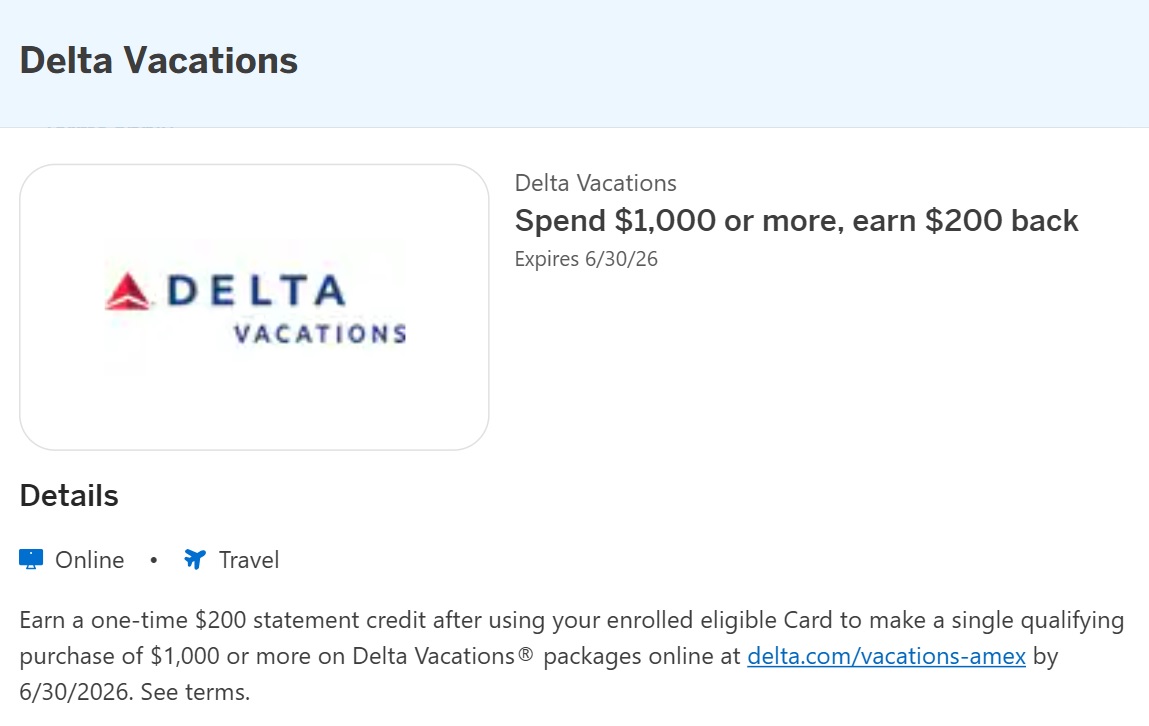
Delta Air Lines, in coordination with its primary financial partner American Express, has launched a targeted promotional campaign designed to incentivize high-value vacation bookings through the airline’s official travel subsidiary, Delta Vacations. The centerpiece of this initiative is a new Amex Offer that provides cardholders with a $200 statement credit upon spending a minimum of $1,000 on qualifying Delta Vacations packages. This financial incentive is structured to be stackable with an existing tiered promotional code, potentially reducing the net cost of a luxury travel package by up to $500, while simultaneously accelerating the accrual of elite status metrics within the Delta SkyMiles loyalty ecosystem.
The introduction of this offer comes at a pivotal time for the travel industry, as major carriers seek to capture a larger share of the "all-in-one" booking market, competing directly with third-party online travel agencies (OTAs) such as Expedia and Booking.com. By leveraging the data-rich partnership between American Express and Delta, the companies are aiming to increase transaction volume on Delta-branded credit cards while bolstering the revenue of the airline’s vacation arm.
Detailed Breakdown of the Targeted Statement Credit
The current Amex Offer is a targeted promotion, meaning it is not universally available to all American Express cardholders. It is most frequently appearing on Delta-branded SkyMiles credit cards, including the Gold, Platinum, and Reserve variants, though some reports indicate it may also surface on consumer cards like the American Express Gold Card or The Platinum Card.
Under the terms of the agreement, cardholders who successfully add the offer to their account and spend $1,000 or more in one or more transactions with Delta Vacations will receive a one-time $200 statement credit. This represents a 20% return on investment at the minimum spend threshold, a significantly higher yield than standard cashback or points-earning rates. The offer is specifically restricted to Delta Vacations, which operates as a separate entity from Delta Air Lines; therefore, standard flight-only purchases made directly through the airline’s main website do not qualify for the credit.
Maximizing Value Through Stackable Promotional Codes
What distinguishes this promotional window is the ability to layer the $200 statement credit with a separate, long-term discount code. Delta Vacations is currently promoting code SMMED300, which offers tiered discounts based on the total cost of the vacation package. This code is currently slated for use through April 30, 2026, for travel completed by September 30, 2026.
The discount tiers for the SMMED300 code are structured as follows:
- $75 Discount: Applicable to vacation packages priced between $1,000 and $3,999.
- $150 Discount: Applicable to vacation packages priced between $4,000 and $6,999.
- $250 Discount: Applicable to vacation packages priced between $7,000 and $9,999.
- $300 Discount: Applicable to vacation packages priced at $10,000 or more.
When these two offers are combined, a traveler booking a $1,000 vacation package would receive a $75 immediate discount at checkout, bringing the total charged to the card down to $925. However, to trigger the $200 Amex statement credit, the final amount charged to the card must exceed $1,000. Therefore, a traveler would need to book a package with a gross price of at least $1,075. After the $75 promo code is applied, the $1,000 charge would hit the American Express statement, subsequently triggering the $200 credit and resulting in a net cost of $800—a total savings of 25.5%.

The Role of Medallion Qualification Dollars in Loyalty Retention
Beyond the immediate financial savings, the promotion carries significant weight for members of the Delta SkyMiles program. Following the controversial and extensive overhaul of Delta’s loyalty program in 2024, Medallion Qualification Dollars (MQDs) have become the sole metric for achieving elite status.
Under the current Delta Vacations earning structure, SkyMiles members earn 1 MQD for every $1 spent on the total price of the vacation package, excluding taxes and certain fees. This is a departure from standard flight bookings, where MQDs are typically earned only on the base fare of the ticket. In a Delta Vacations package, the spend on hotels, car rentals, and activities also contributes to the MQD total.
For a traveler aiming for Silver Medallion status (requiring 5,000 MQDs) or Gold Medallion status (requiring 10,000 MQDs), a single $5,000 vacation package booked during this promotional period could provide half or all of the necessary requirements for status in the following year. When combined with the "MQD Headstart" benefit provided by certain Delta Amex cards (which grants 2,500 MQDs annually per card), these vacation bookings become a highly efficient vehicle for status acquisition.
Comparative Market Analysis: Bundled Packages vs. Component Booking
The strategic value of Delta Vacations is often debated among travel enthusiasts who prefer booking flights and hotels separately to maximize flexibility. However, industry data suggests that bundled packages can offer superior value in specific markets, particularly in luxury leisure destinations such as Mexico, the Caribbean, and Hawaii.
Delta Vacations operates as a "bulk" purchaser of hotel room blocks and airline seats. By packaging these components, they can often offer a combined price that is lower than the sum of the individual parts, especially when premium cabin airfare (Delta One or First Class) is included. The addition of a $200 statement credit and a $75-$300 discount code tips the scales further toward the bundled model for cost-conscious travelers.
Furthermore, booking through a proprietary airline vacation brand provides a layer of consumer protection. In the event of flight cancellations or hotel overbookings, the airline’s vacation arm is responsible for re-accommodating the entire itinerary, whereas travelers booking components separately may find themselves with a hotel reservation they cannot reach due to a canceled flight, often with no recourse for a refund from the hotel.
Chronology and Terms of the Promotional Window
The timeline for these offers reflects a long-term strategy by Delta to stabilize its revenue streams through 2026. While the specific Amex Offer for the $200 credit typically has a shorter expiration window (often 90 days from the date it appears on the account), the SMMED300 promo code is notable for its extended two-year validity.
Key Deadlines:
- Amex Offer: Variable based on individual cardholder accounts, but generally requires the transaction to be completed within the current quarter.
- SMMED300 Promo Code Expiration: April 30, 2026.
- Travel Completion Deadline: September 30, 2026.
It is important to note that the "spend" requirement for the Amex Offer is usually met at the time of booking, even if the travel occurs months later, provided that Delta Vacations processes the payment as a single qualifying transaction.
Broader Economic Context of the Delta-Amex Partnership
The partnership between Delta Air Lines and American Express is widely considered the most lucrative in the aviation industry. In 2023, Delta reported that its remuneration from American Express reached $6.8 billion, with a long-term goal of hitting $10 billion annually. These targeted offers are a fundamental component of that growth strategy.
By encouraging cardholders to book through Delta Vacations, American Express ensures that high-limit transactions remain within its ecosystem. Simultaneously, Delta benefits from increased load factors and higher margin "land" sales (hotels and tours). Analysts suggest that these promotions are also designed to mitigate the impact of rising travel costs. As hotel ADRs (Average Daily Rates) and airfares have climbed post-pandemic, statement credits and tiered discounts serve as a "psychological buffer" for consumers who might otherwise scale back their travel plans.
Reactions from the Travel Industry
While Delta has not issued a formal press release for this specific targeted offer—consistent with its practice of keeping Amex Offers semi-private—travel industry analysts have noted the aggressive nature of the discount.
"Delta is increasingly moving toward becoming a lifestyle brand rather than just a transportation company," says one loyalty program consultant. "By integrating deep discounts into their vacation arm and tying it so closely to their credit card products, they are creating a ‘closed-loop’ economy where the customer is incentivized at every turn to stay within the Delta and Amex family. The $200 credit is a powerful tool for customer acquisition in the vacation package space, which has traditionally been dominated by third-party aggregators."
Conclusion and Strategic Implications
For the informed consumer, the current alignment of the $200 Amex Offer and the SMMED300 promo code represents a rare opportunity to extract significant value from a major carrier. The combination of direct cash savings and the accelerated path to Medallion status makes Delta Vacations an attractive option for the 2024 and 2025 travel seasons.
However, the targeted nature of the Amex Offer remains a caveat. Travelers are encouraged to check the "Amex Offers and Benefits" section of their online accounts or mobile apps frequently, as these deals are often limited to a specific number of enrollments. As the travel landscape continues to evolve with a focus on premium experiences and loyalty integration, the synergy between financial institutions and airline vacation brands is expected to intensify, with this current offer serving as a blueprint for future promotional cycles.




 Anjar Salim
 Chandra Hamzah
 Tatiana Tantri Indah Sari

