Budi Mulyono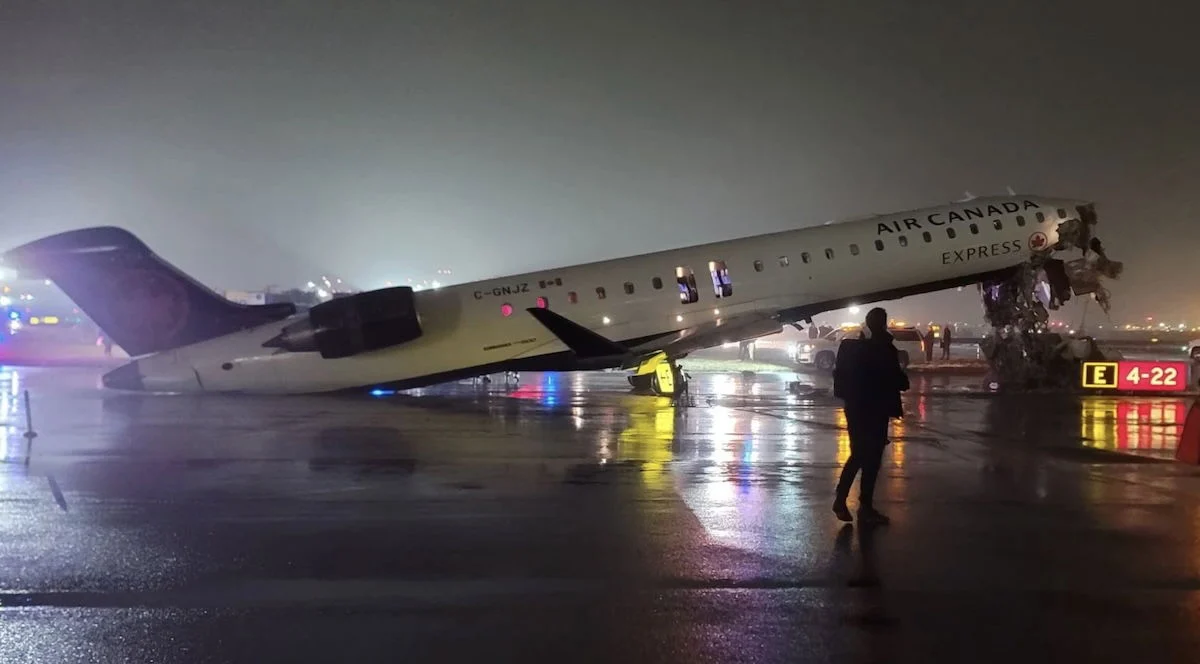
New York’s LaGuardia Airport became the site of a major aviation accident late Sunday night when a regional jet landing from Montreal collided with an airport fire truck on an active runway. The incident, which occurred at approximately 11:40 PM on March 22, 2026, involved an Air Canada Jazz Bombardier CRJ-900 and an Aircraft Rescue and Firefighting (ARFF) vehicle. Preliminary reports from the scene indicate significant damage to both the aircraft and the emergency vehicle, alongside critical injuries to ground personnel. The National Transportation Safety Board (NTSB) and the Federal Aviation Administration (FAA) have launched a full-scale investigation into what appears to be a catastrophic failure in air traffic control coordination.
The aircraft, operating as a regional flight for Air Canada, was concluding its journey from Montreal-Trudeau International Airport (YUL). As the CRJ-900 touched down on Runway 4, it struck a fire truck that had been cleared to cross the same runway at Taxiway Delta. The impact was severe; the nose section of the aircraft was completely destroyed, and the aircraft came to a rest with its nose pitched upward, resting on the wreckage of the fire truck. The fire truck itself sustained such extensive damage that officials described it as nearly unrecognizable in the immediate aftermath.
Chronology of the Incident
The sequence of events leading to the collision began as the Air Canada Jazz flight was cleared for a standard visual approach to Runway 4. LaGuardia, known for its constrained geographical footprint and complex taxiway intersections, requires precise coordination between the tower and ground movements.
At 11:38 PM, as the CRJ-900 was on short final approach, a ground vehicle identified as "Truck 1" contacted the tower. According to leaked air traffic control (ATC) audio recordings, the driver requested permission to cross Runway 4 at Taxiway Delta to reach the other side of the airfield. The controller on duty responded with a clear authorization: "Truck 1 and company, cross 4 at D."
Seconds later, as the aircraft transitioned from flight to its landing roll, the controller realized the imminent danger. Audio captures a series of urgent commands: "Stop, stop, stop, stop, stop, Truck 1, stop, stop, Truck 1, stop." However, the momentum of the landing aircraft and the position of the truck made a collision unavoidable. The aircraft struck the vehicle at high speed, resulting in the structural failure of the plane’s nose gear and forward fuselage.
Casualties and Emergency Response
The Air Canada Jazz CRJ-900 is configured to carry 76 passengers and is staffed by a crew of four, including two pilots and two flight attendants. While the exact number of passengers on board the Sunday night flight has not been officially confirmed, the aircraft was reportedly near capacity. Initial assessments suggest that while passengers and flight crew suffered various injuries, the most critical casualties occurred among the occupants of the fire truck.
First responders from the Port Authority of New York and New Jersey (PANYNJ) were on the scene within seconds, as the accident occurred in the middle of the airfield. Medical teams transported several individuals to local trauma centers. As of Monday morning, reports indicate that at least two firefighters are in critical condition. The airport was immediately closed to all traffic, with incoming flights diverted to John F. Kennedy International (JFK) and Newark Liberty International (EWR).
Technical Specifications of the Involved Equipment
The Bombardier CRJ-900 is a mainstay of regional aviation, designed for short-to-medium-haul routes. It has a wingspan of 81 feet 6 inches and a length of 118 feet 11 inches. On landing, the aircraft typically maintains a speed of approximately 140 to 150 knots (160–170 mph). The impact at these speeds against a heavy ARFF vehicle—which can weigh between 60,000 and 80,000 pounds when fully loaded with water and foam—generates massive kinetic energy, explaining the near-total destruction of the aircraft’s nose and cockpit area.
The fire truck involved, a standard ARFF unit, is designed for high-speed response and rugged durability. These vehicles are equipped with sophisticated thermal imaging and high-capacity water cannons. The fact that such a robust vehicle was "barely identifiable" following the crash underscores the violence of the collision.
Air Traffic Control Staffing Concerns
A significant focus of the burgeoning investigation is the staffing levels at the LaGuardia tower at the time of the accident. Reports have surfaced that due to the late hour, a single controller may have been managing multiple positions simultaneously. Industry analysts and union representatives have long warned about the risks associated with "single-person crews" during the midnight shift.
Information provided by aviation insiders suggests the controller involved had been working the position solo for approximately one hour prior to the crash. In such scenarios, a single individual is responsible for monitoring the radar, communicating with landing aircraft, and coordinating ground vehicle movements. This "overload" environment is a known factor in runway incursions, as it reduces the "redundancy of eyes" intended to catch verbal or procedural errors.
The Role of LaGuardia’s Infrastructure
LaGuardia Airport (LGA) is often cited as one of the most challenging airports for pilots and controllers in the United States. Its two main runways, 4/22 and 13/31, intersect each other, and the taxiway system is notoriously tight. Runway 4, where the accident occurred, requires ground vehicles to cross the active strip frequently to move between the terminal areas and the maintenance or emergency hangars.
While the airport recently underwent an $8 billion redevelopment of its terminals, the fundamental layout of the runways remains unchanged from its mid-20th-century design. This incident will likely reignite debates regarding the implementation of more advanced ground safety technologies, such as Runway Status Lights (RWSL) and the Airport Surface Detection Equipment, Model X (ASDE-X), which are designed to provide automated alerts to both pilots and controllers when a runway is occupied.
Official Statements and Investigation
The FAA issued a brief statement shortly after the incident: "An Air Canada Jazz CRJ-900 collided with a ground vehicle upon landing at LaGuardia Airport. The FAA and NTSB will investigate. The airport remains closed until further notice."
Air Canada released a statement confirming that the flight was operated by Jazz Aviation LP: "Our immediate priority is the well-being of our passengers and crew, as well as the emergency responders involved in this incident. We are cooperating fully with the authorities to determine the cause of this accident."
The NTSB has dispatched a "Go Team" to New York. Investigators will recover the Cockpit Voice Recorder (CVR) and the Flight Data Recorder (FDR) from the CRJ-900. They will also review the "ground loop" recordings of the ATC frequencies and interview the controller and the driver of the fire truck. A preliminary report is expected within 15 days, though a full determination of probable cause could take 12 to 18 months.
Broader Implications for Aviation Safety
This collision is the most serious runway incursion at a major U.S. airport in recent years. It follows a series of "close calls" that prompted the FAA to hold a Safety Summit in 2023 and 2024 to address the rising trend of surface safety incidents. The LaGuardia crash represents the "worst-case scenario" that safety experts had feared: a failure of the multi-layered system of clearances and visual checks.
The aviation industry is likely to face renewed pressure to address the chronic shortage of air traffic controllers. The National Air Traffic Controllers Association (NATCA) has frequently pointed out that many facilities are staffed below the 80% threshold, leading to mandatory overtime and increased fatigue. If the investigation confirms that controller fatigue or solo-staffing contributed to the LaGuardia accident, it could lead to federal mandates requiring minimum staffing levels for all shifts, regardless of traffic volume.
Furthermore, the accident may accelerate the mandate for "cockpit alerting systems" that notify pilots directly if a ground vehicle is on the runway ahead of them. While some modern aircraft have these capabilities, they are not yet universal in regional fleets like the CRJ-900.
As the sun rises over New York, the wreckage remains on Runway 4, a stark reminder of the thin margin for error in modern aviation. For the families of the critically injured firefighters and the traumatized passengers of the Air Canada Jazz flight, the focus remains on recovery. For the aviation world, the focus shifts to ensuring that such a breakdown in communication never happens again.



 Walid Sujud Trenggono
 Anjar Salim
 Chandra Hamzah