
 Chandra Hamzah
The familiar rhythm of a cruise vacation, often dependent on the whims of the weather, can be disrupted by a simple change of port. While passengers might lament the loss of a planned destination, they are frequently compensated with onboard credits. However, the situation escalates dramatically when the entire cruise itinerary is altered, leaving travelers with a holiday that bears little resemblance to the one they meticulously planned, saved for, and booked. This is precisely the predicament faced by Laura McCarthy, her family, and their parents, who are now challenging cruise line terms and conditions, asserting that such fundamental changes mean they did not receive the service they paid for. Their case is poised to become a landmark legal battle, as most cruise lines routinely rely on their contractual fine print to fend off compensation claims for itinerary modifications.
The saga began for Laura McCarthy and her extended family when their planned Pacific Islands cruise, a highly anticipated getaway from Melbourne, was dramatically rerouted. The family, including her husband, four children, and her parents, had made arrangements to travel to Sydney on January 15th. Laura’s mother, a seasoned cruiser, always preferred to arrive a day prior to departure, ensuring a stress-free embarkation. This meticulous planning, however, was met with a late-night notification that would fundamentally alter their holiday.
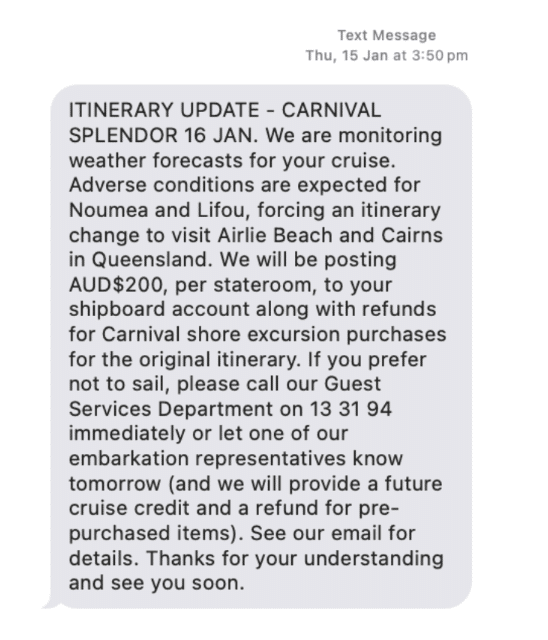
Just the night before their scheduled departure, a text message arrived from Carnival, informing them of expected adverse weather conditions affecting their planned destinations of Noumea and Lifou. The cruise line proposed an alternative itinerary, replacing the South Pacific islands with visits to Airlie Beach and Cairns in Queensland. For Laura and her family, this was not merely a minor inconvenience but a complete subversion of their travel plans.
"We had a cruise booked for the Pacific Islands. And we’re from Melbourne, so we travelled to Sydney on the 15th of January," Laura recounted to Cruise Passenger. "Mum likes to get there the day before when we’re going on a cruise. We checked into the hotel at about four o’clock, then the night before our cruise, we get a text message from Carnival to say adverse conditions are expected for Noumea and Lifou, forcing an itinerary change to visit Airlie Beach and Cairns in Queensland."
The family’s immediate reaction was one of disbelief and frustration. A lengthy phone call ensued, spanning approximately two and a half hours, as they attempted to articulate their position to Carnival representatives. "We told them, we’re not paying $13,000 to go on a domestic cruise," Laura stated. The cruise line, however, remained steadfast, citing their terms and conditions as justification for the proposed options: accept the Queensland itinerary or receive a future cruise credit.
Laura and her family found these options unacceptable, particularly given the significant shift from an international to a domestic experience. "We kept insisting that wasn’t acceptable. We were trying to use ChatGPT in the middle of it to see what our rights actually were," she explained, highlighting the extent of their efforts to understand their legal standing. "And you know, it was a major change to the itinerary. It went from being an international cruise to a domestic cruise. It was just going around in circles; they kept insisting they didn’t have to give us a refund."

Ultimately, the McCarthy family made the difficult decision not to board the altered cruise. This decision left them a staggering $13,000 out of pocket, with the added complication of coordinating another family trip, a logistical challenge given the disparate schedules of multiple family members. Laura discovered she was not alone in her dissatisfaction; within a dedicated Facebook group for the cruise, numerous other passengers expressed similar frustrations. Some had even purchased passports specifically for the intended international destinations.
Laura’s stance is not about forcing a ship into dangerous weather. Instead, she emphasizes that the fundamental service she purchased – an international cruise to specific destinations – was no longer being offered. She firmly believes she is entitled to a refund under these circumstances.
A Test Case for the Cruise Industry
Laura McCarthy has now lodged a case with the Victorian Civil and Administrative Tribunal (VCAT), a move that is being closely monitored by consumer advocates and legal experts. This case is anticipated to serve as a crucial test for how cruise lines handle itinerary changes and what recourse consumers have when the vacation they booked is significantly altered.
Carnival’s initial offer of a future cruise credit or a mere $200 onboard credit per stateroom did little to appease Laura and her family. They argued that the proposed Queensland cruise was not equivalent to the South Pacific holiday they had invested in and that the difficulty of rescheduling a multi-generational trip meant a future cruise credit was not a practical solution.
It is important to note that the terms and conditions cited by Carnival are not unique to that company. All major cruise lines typically include clauses that grant them the discretion to alter itineraries due to various factors, including weather. However, the growing number of consumer complaints and the increasing scrutiny from consumer advocates and legal professionals are raising questions about the adequacy of the current legal framework in Australia to protect passengers in such situations.
Advocating for Stronger Consumer Protections
Adam Glezer, owner of Consumer Champion, an agency dedicated to assisting consumers in the travel industry with their rights and compensation claims, is a vocal proponent for enhanced consumer protections. He argues that a change in itinerary that transforms an international voyage into a domestic one constitutes a significant alteration, and passengers should be afforded refunds.
"This is a major change – full stop," Glezer asserted. "If a trip like this isn’t refundable, how can any Australian book a holiday with confidence? Right now, they simply can’t." He further elaborated on the perceived deficiencies in Australian Consumer Law, suggesting that its vagueness leaves ordinary consumers vulnerable to exploitation by large corporations.
"There are clear gaps in the law that need to be fixed," Glezer stated. "It’s not good enough to leave things open to interpretation – the law needs to spell out exactly when a customer is entitled to a refund. No grey areas, no loopholes." He believes that the current situation, where a family is informed of such a drastic change before even departing, is unacceptable. "A line has to be drawn here. They were being told, before the cruise even left port, that they won’t be visiting a single overseas destination they paid for – which was the point of the trip for Sinead and her family. That is not acceptable."
Glezer’s perspective is grounded in what he terms "common sense." He questions the fairness of expecting holidaymakers to accept a fundamentally different trip from the one they purchased. He uses the "pub test" analogy, suggesting that the cruise line’s actions would not be considered reasonable by the average person if it were their own family facing such a predicament. "The decision makers at Carnival should ask themselves – does this pass the pub test? If it was your mum, your dad, or your mate who’d saved up for months for a dream holiday and was told they wouldn’t get their money back, would you accept that? Nobody would."
He also highlights the inherent power imbalance between consumers and large corporations. "These are ordinary everyday Australians who work hard, save hard, and don’t have thousands of dollars sitting around to fight a corporation in court. The cruise companies know that and take advantage of it. Australians deserve better." Glezer concludes that the current legal framework is failing to adequately protect consumers against the deep pockets and legal resources of cruise companies.
The Nuance of Terms and Conditions
The standard terms and conditions of cruise lines routinely stipulate their right to alter itineraries. Victoria Roy, principal solicitor at Victory Travel & Cruise Lawyers, acknowledges this, but cautions that these clauses are not an impenetrable shield against compensation claims. She explains that the success of such claims often hinges on a case-by-case evaluation, largely due to the inherent ambiguity in consumer protection laws.
Roy points to a precedent-setting case, Moore v Scenic Tours, where Scenic Tours was found to have breached the Australian Consumer Law (ACL) and could not rely on its contractual terms. This case, she suggests, demonstrates that terms and conditions are not always absolute.
However, Roy also notes the absence of specific, universally applicable rules for determining the success of itinerary change claims. "Cases are decided on a case-by-case basis and are usually very fact-specific," she stated. "It is therefore hard to come up with any hard and fast rules to help your readers. However, I would say that one factor that would be crucial for a claim to be successful is that the itinerary change had a significant impact on the cruise."
The impact, she elaborates, is contingent on the specific itinerary and the nature of the changes. Under the ACL, cruise lines are obligated to provide services that are fit for purpose and of a quality that passengers can reasonably expect to achieve their desired outcome. For a South Pacific cruise, this reasonable expectation likely includes warm weather and foreign destinations, not a domestic itinerary.
Roy further advises that even when cruise lines cite clauses related to weather or events beyond their control, passengers should still consider seeking compensation if the cruise line had prior knowledge of the impending changes. "The infamous s.261(1)(c) ACL exclusion that we all know about from COVID applies to breaches of ACL guarantee: where the breach was due to an act by a third party or a cause independent of human control after services were supplied."
"I would say that if a passenger experienced significant itinerary changes that were within the cruise line’s control, or which the cruise line knew about or ought to have known about in advance, the passenger should not be deterred by the Ts&Cs and still seek compensation from the cruise line," she concluded.
The McCarthy family’s challenge at VCAT, therefore, is not just about reclaiming $13,000; it is about establishing a precedent that could redefine consumer rights in the cruise industry and ensure that Australians can book their dream holidays with greater confidence and assurance that they will receive the service they have paid for. The outcome of this case will undoubtedly be closely watched by both consumers and the travel industry.
Laura’s real name has been changed to protect her privacy.




 Anjar Salim
 Tatiana Tantri Indah Sari
 Budi Mulyono
