Chandra Hamzah
The world of cruising, long understood to be intrinsically linked to the vagaries of weather, is facing a significant legal challenge that could redefine passenger rights. For many holidaymakers, the inconvenience of a rerouted port due to adverse conditions is a familiar, albeit disappointing, aspect of sea travel. Often, such disruptions are met with onboard credit, a gesture that typically smooths over the disappointment. However, the case of Laura McCarthy and her family illuminates a far more profound issue: what happens when an entire cruise itinerary is fundamentally altered, transforming a long-anticipated international voyage into a domestic one, leaving passengers with a holiday experience vastly different from what they purchased and paid for?
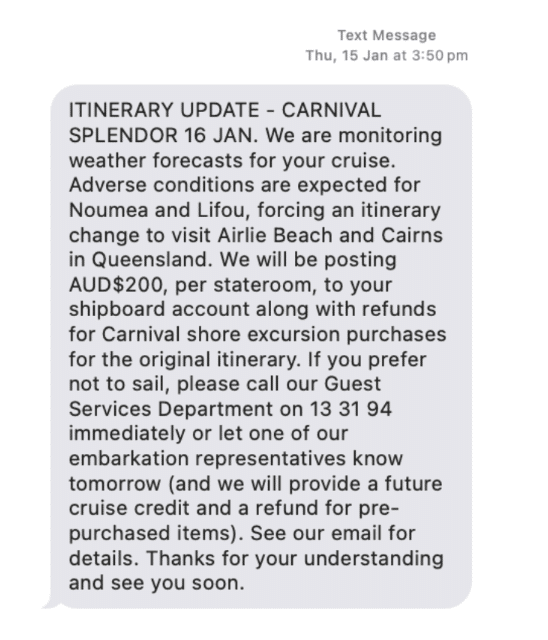
McCarthy, along with her husband, four children, and her parents, found themselves in this exact predicament. After meticulously planning and saving for a Pacific Islands cruise, incurring significant costs for travel and accommodation to Sydney, they received a last-minute notification from Carnival Cruise Line just the night before their scheduled departure. Adverse weather conditions were forecast for their planned destinations of Noumea and Lifou, leading to a drastic itinerary change that would see them visiting Airlie Beach and Cairns in Queensland instead. This pivot from an international, exotic escape to a domestic exploration left the family questioning the value of their $13,000 booking.
"We were not paying $13,000 to go on a domestic cruise," McCarthy stated in an interview, recalling the prolonged phone call with the cruise line. Despite their strong objections, Carnival reportedly insisted that their only options were to accept the revised Queensland itinerary or receive a future cruise credit, citing their terms and conditions. The family’s attempts to understand their rights, even using artificial intelligence like ChatGPT during the heated discussion, underscored their frustration and sense of powerlessness against what they perceived as a significant deviation from the contracted service. The core of McCarthy’s challenge lies in the fundamental shift from an international to a domestic cruise, a change so substantial that she argues the service provided was no longer what she had bought and paid for, thereby entitling her to a refund.
This situation is poised to become a landmark case, as most cruise lines routinely employ similar terms and conditions in their contracts as a defence against passenger claims for compensation when itineraries are altered. The outcome of McCarthy’s legal challenge, now before the Victorian Civil and Administrative Tribunal (VCAT), will be closely scrutinized by both the industry and consumer advocacy groups, potentially setting a precedent for how such significant itinerary changes are handled in Australia.
A Family’s Disrupted Dream: The Chronology of Events
The McCarthy family’s ordeal began with careful planning. Hailing from Melbourne, they made the necessary arrangements to travel to Sydney on January 15th to embark on their Pacific Islands cruise. McCarthy’s mother, adhering to a preference for arriving a day prior to any cruise departure, had also made travel and accommodation arrangements. After checking into their hotel around 4 p.m., the family received the unexpected text message from Carnival the evening before their cruise.

The message, delivered with little advance notice, cited "adverse conditions" for Noumea and Lifou as the reason for the itinerary change. The proposed alternative ports were Airlie Beach and Cairns, located in Queensland, Australia. This alteration immediately transformed the nature of their holiday from an international exploration to a domestic one.
The family’s immediate reaction was to contact Carnival. The ensuing conversation, which reportedly lasted approximately two and a half hours, was characterized by a significant disconnect between the passengers’ expectations and the cruise line’s stance. McCarthy articulated their position clearly: they had not booked an expensive domestic holiday. However, Carnival’s representatives consistently referred to the cruise line’s terms and conditions, presenting the Queensland itinerary or a future cruise credit as the only available options. The family’s persistent attempts to negotiate or secure a refund were met with what they described as a circular argument, with Carnival maintaining they were not obligated to provide a refund.
The decision to disembark and forgo the altered cruise was not taken lightly. The family was left $13,000 out of pocket, facing the daunting prospect of trying to coordinate another trip for such a large family group in the future. McCarthy noted on social media that other passengers on the same cruise shared similar sentiments of disappointment and frustration, with some having even acquired new passports specifically for the intended international destinations.
McCarthy emphasized that her grievance was not about avoiding bad weather. Instead, it was about the fundamental unsuitability of the substitute service. She believes that when a service fundamentally differs from what was purchased, a refund should be an entitlement. Her subsequent action in filing a case with VCAT signals her determination to challenge what she perceives as an unfair application of cruise line terms and conditions.
The Legal Landscape: Terms and Conditions Under Scrutiny
Cruise lines worldwide typically include clauses in their booking agreements that grant them the discretion to alter itineraries due to various factors, including weather, operational requirements, or unforeseen circumstances. These clauses are a cornerstone of their defence when passengers seek compensation for changes. However, the validity and enforceability of these terms and conditions, particularly when the changes are as substantial as a complete shift from international to domestic destinations, are increasingly being questioned.
Adam Glezer, owner of Consumer Champion, a firm that advocates for consumers in the travel industry, believes that current consumer protections are insufficient. He argues that a change of this magnitude – transforming an international cruise into a domestic one – warrants a refund. "This is a major change – full stop," Glezer stated. "If a trip like this isn’t refundable, how can any Australian book a holiday with confidence? Right now, they simply can’t."
Glezer points to perceived vagueness in Australian Consumer Law (ACL) as a vulnerability for consumers. He advocates for clearer legislation that leaves no room for interpretation regarding refund entitlements. "There are clear gaps in the law that need to be fixed," he asserted. "It’s not good enough to leave things open to interpretation – the law needs to spell out exactly when a customer is entitled to a refund. No grey areas, no loopholes." He further stressed that the situation, where passengers are informed of such drastic changes before the cruise even departs, is unacceptable and leaves ordinary Australians exposed to corporate practices.
Victoria Roy, principal solicitor at Victory Travel & Cruise Lawyers, acknowledges that while cruise lines have the right to make itinerary changes, these terms and conditions are not always absolute. She highlights the importance of the "significance" of the itinerary change. "One factor that would be crucial for a claim to be successful is that the itinerary change had a significant impact on the cruise," Roy explained. "That of course will depend on the itinerary and what changes were made."
Roy references the case of Moore v Scenic Tours, where Scenic Tours was found to have breached the ACL despite their terms and conditions. This case suggests that contractual clauses are not an impenetrable shield against consumer law obligations. Roy further elaborated on the Australian Consumer Law’s guarantee that services must be "fit for purpose" and of a quality that "might reasonably be expected to achieve the result desired by the passengers." For a Pacific Islands cruise, this expectation would naturally include experiencing warm weather and visiting foreign destinations, not a domestic itinerary.
Roy also addressed the common exclusion clause, often invoked during events outside human control. However, she cautioned that if a cruise line was aware of potential itinerary changes in advance, passengers should not be deterred from seeking compensation. "If a passenger experienced significant itinerary changes that were within the cruise line’s control, or which the cruise line knew about or ought to have known about in advance, the passenger should not be deterred by the Ts&Cs and still seek compensation from the cruise line," she advised.
Broader Implications for the Cruise Industry and Consumers
The McCarthy case and the commentary from consumer advocates and legal experts underscore a growing tension between the operational flexibility sought by cruise lines and the consumer expectations of receiving the service they paid for. The core issue revolves around the definition of "significant" change and the extent to which cruise line terms and conditions can override fundamental consumer rights.
The fact that this situation is not unique to Carnival, with all major cruise lines employing similar contractual language, amplifies the need for a systemic review of consumer protections. The reliance on future cruise credits, while offering flexibility for the cruise line, often fails to adequately compensate passengers who may have specific timing constraints, travel companions, or financial situations that make rebooking difficult or impossible.
The "pub test" analogy, invoked by Glezer, resonates with the public’s sense of fairness. The idea that a consumer should not be forced to accept a holiday experience that is fundamentally different from what they contracted for, especially when it results in a substantial financial loss and a missed opportunity, strikes a chord with many. The current legal framework, which often requires individual legal battles for consumers against well-resourced corporations, presents a significant hurdle for everyday Australians.
The implications of this case extend beyond the immediate financial loss for the McCarthy family. It has the potential to:
- Prompt legislative reform: A successful challenge could lead to clearer definitions within Australian Consumer Law regarding significant itinerary changes and the automatic right to refunds.
- Influence industry practices: Cruise lines may be compelled to review and revise their terms and conditions, offering more transparent and consumer-friendly policies for itinerary alterations.
- Empower consumers: A favourable outcome could encourage other passengers who have experienced similar issues to pursue their rights, leading to increased accountability within the industry.
- Highlight the role of consumer advocacy: The case emphasizes the critical role of organizations like Consumer Champion and legal firms specializing in travel law in protecting consumer interests.
As Laura McCarthy’s case progresses through the VCAT, it represents more than just a personal dispute; it is a crucial test for the fairness and adequacy of consumer protection laws in the context of modern travel services, particularly in the dynamic and often complex world of cruise holidays. The outcome will undoubtedly shape how future itinerary changes are managed and how passenger rights are upheld in Australia.


 Budi Mulyono
 Lukman Taruna Persada Ramadan
 Gabriela Annisa
 Tatiana Tantri Indah Sari