
 Walid Sujud Trenggono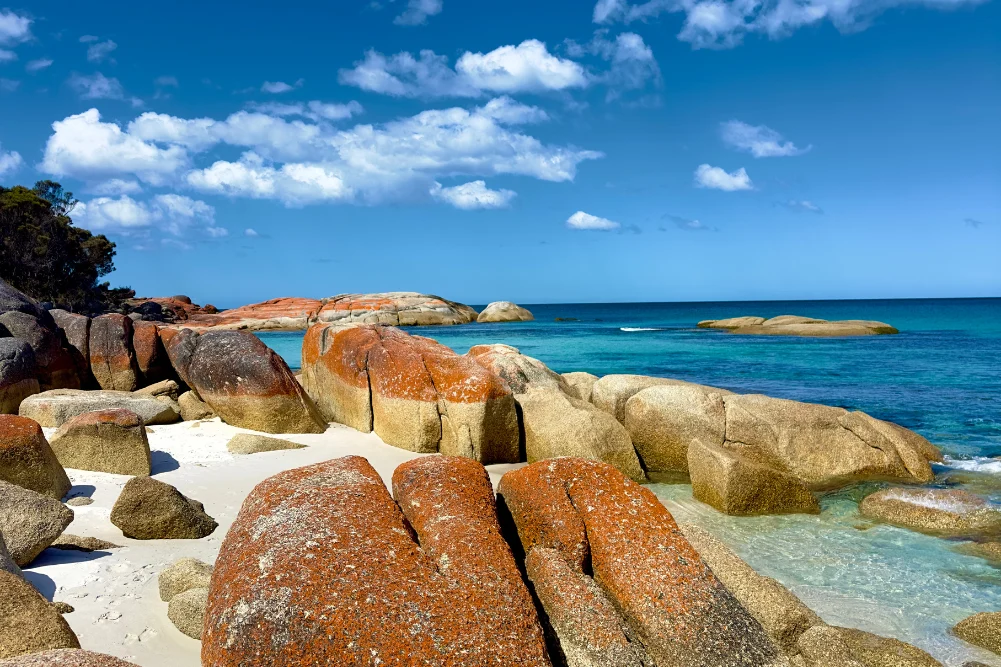
The Bay of Fires, situated on the northeastern coast of Tasmania, has long been regarded as one of the most visually arresting wilderness regions in the Southern Hemisphere. Known to the local Palawa people as Larapuna, the area has recently garnered international acclaim, having been designated as Australia’s most beautiful beach for 2025. This accolade reflects a broader trend in the global travel industry: the rise of "soft adventure" tourism, where travelers seek immersive experiences in the natural world without sacrificing the comforts of modern infrastructure. A recent three-day guided expedition led by Intrepid Travel highlights the region’s unique intersection of geological splendor, maritime history, and ecological diversity.
Historical Context and Geological Origins
The nomenclature of the Bay of Fires dates back to 1773, when Captain Tobias Furneaux, navigating the HMS Adventure, observed numerous fires burning along the coastline. These fires were the hearths of the Palawa people, the traditional custodians of the land who had inhabited the region for millennia. Today, the "fires" that define the coast are geological rather than literal. The coastline is characterized by massive granite boulders encrusted with Caloplaca marina, a bright orange lichen that creates a striking contrast against the region’s white quartz sands and turquoise waters.
Geologically, the area is part of the Devonian granite basement that forms much of northeastern Tasmania. The interaction between these ancient rock formations and the Southern Ocean has created a complex coastline of secluded coves, expansive beaches, and dense coastal heathlands. The environmental integrity of the region is protected under several jurisdictions, including the Humbug Point Conservation Area and Mount William National Park, ensuring that the landscape remains largely unchanged since Furneaux’s initial sighting.
A Chronology of the Coastal Expedition
The standard guided trek typically commences in Launceston, Tasmania’s second-largest city and a primary gateway for wilderness tourism. From Launceston, groups transit approximately two hours to St Helens, the largest town on the northeast coast. Historically a center for tin mining and commercial fishing, St Helens now serves as the vital "base camp" for expeditions into the Bay of Fires.
Day One: The Humbug Point Conservation Area
The inaugural leg of the trek often begins at the Skeleton Bay Track, leading toward Dora Point within the Humbug Point Conservation Area. This initial four-kilometer hike serves as an introduction to the volatile Tasmanian climate, often characterized by "sneaky rain"—a local colloquialism for high-humidity precipitation that penetrates standard waterproof gear. Despite the weather, the trail offers immediate exposure to the region’s biodiversity, including coastal heath, flowering paperbarks, banksia, and tea trees. The day concludes with a return to St Helens, where high-end accommodations like the Panorama Hotel provide hikers with professional culinary services and modern amenities, reinforcing the "soft adventure" ethos.
Day Two: Eddystone Point and the Lighthouse Circuit
The second day represents the expedition’s most rigorous physical challenge, covering approximately 12 kilometers and an average of 25,000 steps. The journey begins at Eddystone Point, known as Larapuna to the Aboriginal community. The focal point of this location is the Eddystone Point Lighthouse, a 35-meter-high tower constructed from pink granite in 1889. This structure was a response to the treacherous conditions of the Tasman Sea, which had claimed numerous vessels in the 19th century.
Hikers traverse Eddystone Beach, facing wind gusts that frequently exceed 60 kilometers per hour. The trail moves through shell coves—deep accumulations of mollusk remains—and transitions into fire trails flanked by fragrant wildflowers. This segment of the trek highlights the avian diversity of the region, with sightings of Pacific gulls, sandpipers, and oystercatchers being common. The day’s end emphasizes the logistical benefits of guided tours, as transport vehicles return hikers to their base for recovery, bypassing the need for heavy-pack camping.
Day Three: Mount William National Park and Wildlife Integration
The final day focuses on the northern reaches of the bay within Mount William National Park. This area is a stronghold for Tasmanian wildlife, particularly the common wombat (Vombatus ursinus). With a statewide population of nearly one million—roughly double the human population of Tasmania—the wombat is a keystone species of the coastal scrub. The park is also home to the Tasmanian echidna, a subspecies of the short-beaked echidna that is notably larger and hairier than its mainland counterparts to better withstand the cooler temperate climate.
The trek concludes with a 6-kilometer loop at Stumpy’s Bay, followed by a return journey toward Launceston. This return leg typically includes stops at significant cultural and geological sites, such as the Little Blue Lake and the town of Derby.
Gastronomy and the Local Economy
A critical component of the Bay of Fires experience is the integration of local industry into the tourism model. St Helens remains the game-fishing capital of Tasmania, and the region’s economy is heavily supported by aquaculture. Lease 65, located just minutes from the town center, produces oysters that are globally recognized for their plumpness and salinity, driven by the nutrient-rich waters of the Bay.
The "soft adventure" model relies heavily on local hospitality. Establishments such as the Lifebuoy Cafe have become integral to the trekking circuit, providing high-quality, locally sourced meals that cater to the nutritional needs of active travelers. This symbiotic relationship between tour operators like Intrepid Travel and local vendors ensures that the economic benefits of tourism are distributed throughout the regional community.
Environmental Analysis and Tourism Implications
The success of the Bay of Fires as a tourist destination has significant implications for Tasmania’s broader economic strategy. As the state moves away from traditional extractive industries—such as the tin mining that once dominated Derby and the surrounding areas—eco-tourism has emerged as a sustainable alternative.
- Economic Transition: The town of Derby serves as a case study for this shift. Once the site of the rich Endurance tin mine, it has reinvented itself as a premier mountain-biking and gelato destination, attracting a younger, affluent demographic.
- Environmental Management: The "leave no trace" philosophy of guided treks is essential for preserving the white sands and lichen-covered rocks. The high concentration of minerals in sites like the Little Blue Lake—a legacy of 19th-century mining—serves as a reminder of the need for careful environmental stewardship. The lake’s vivid blue color, caused by suspended white clay and mineral particles, attracts photographers but remains unsafe for swimming, illustrating the complex intersection of industrial history and modern aesthetics.
- The "Soft Adventure" Market: Data suggests that the demographic for these tours—individuals who appreciate the outdoors but require "the great indoors" for recovery—is growing. This segment is willing to pay a premium (tours typically start at $1,680 AUD) for expert guidance, safety, and logistical ease. The presence of professionals, such as police officers and paramedics, among the hiking ranks underscores the appeal of these organized treks as training grounds for even more grueling international trails like the Kokoda Track.
Conclusion
The Bay of Fires is more than a scenic coastline; it is a complex ecosystem where history, geology, and modern tourism converge. From the ancient heritage of the Palawa people to the 19th-century maritime architecture of Eddystone Point, the region offers a deep sense of place. For the modern hiker, the experience is defined by the contrast between the ruggedness of the Tasman Sea and the refined comforts of Tasmanian hospitality.
As Tasmania continues to position itself as a global leader in wilderness travel, the Bay of Fires stands as its crown jewel. The combination of pristine air, unique wildlife, and world-class gastronomy ensures that the region will remain a "hiker’s heaven" for the foreseeable future. The pledge of many visitors to return—often carrying a souvenir wombat or a memory of the "sneaky rain"—is a testament to the enduring allure of this remarkable Australian landscape. Through careful management and a commitment to quality, the Bay of Fires serves as a blueprint for the future of sustainable, high-impact tourism in the 21st century.




 Anjar Salim
 Chandra Hamzah
 Tatiana Tantri Indah Sari
 Budi Mulyono
 Lukman Taruna Persada Ramadan
