
 Budi Mulyono
The landscape of airline loyalty programs has shifted dramatically in recent years, moving away from traditional mileage-based systems toward spend-centric models, a transition most notably led by Delta Air Lines. For frequent flyers aiming to secure or maintain elite Medallion status, this evolution has necessitated a more strategic approach to booking, often involving "mileage runs" or "status runs" that maximize Medallion Qualification Dollars (MQDs) relative to the actual out-of-pocket cost. A newly identified itinerary from San Francisco International Airport (SFO) to Indira Gandhi International Airport (DEL) in New Delhi represents a significant opportunity for Delta loyalists, offering a high-yield MQD return through a complex multi-carrier SkyTeam itinerary.
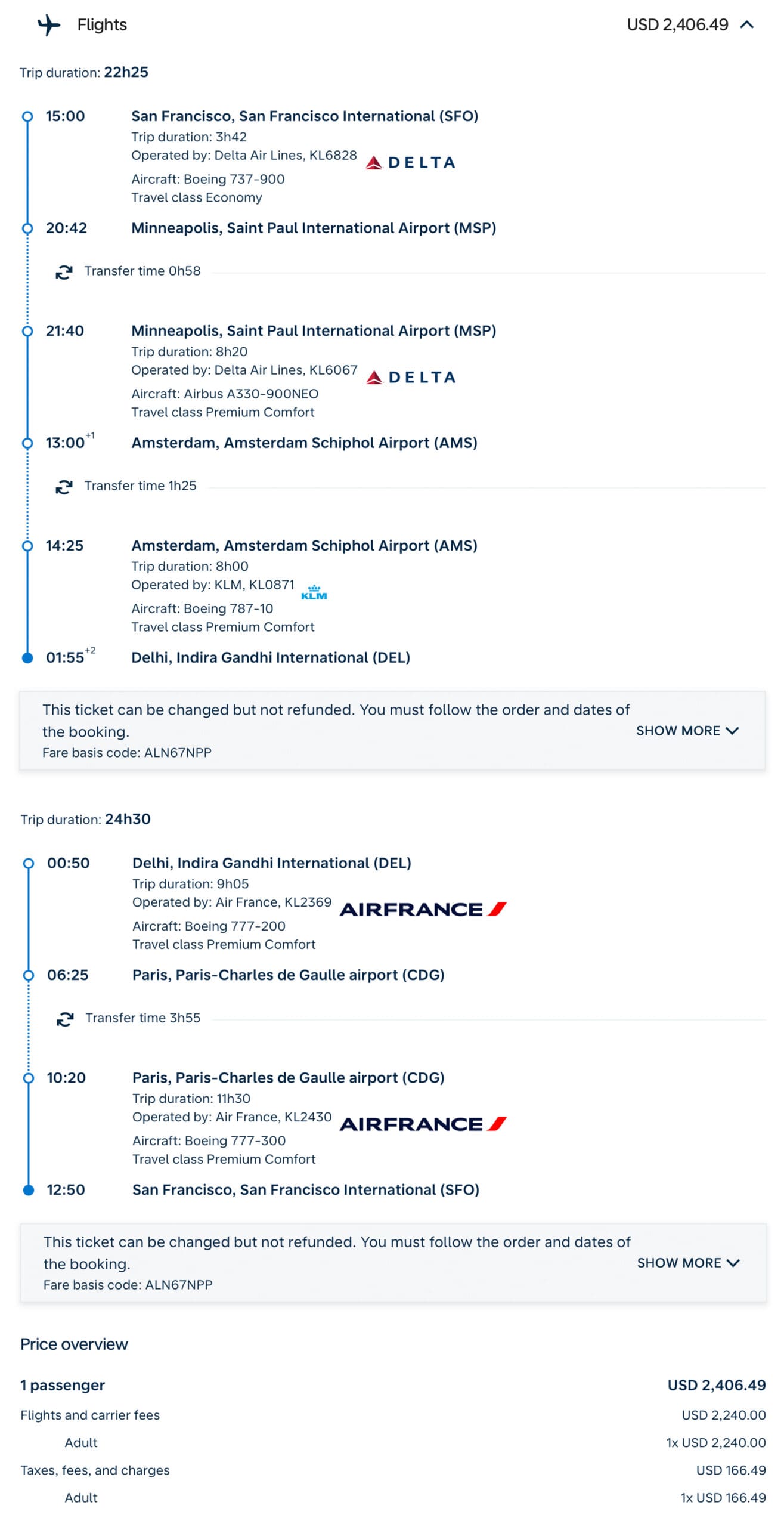
The itinerary, dubbed a "SkyTeam Sampler," utilizes a combination of Delta Air Lines, KLM Royal Dutch Airlines, and Air France. While the flights are operated by three different carriers, the entire ticket is marketed by KLM and booked under KLM flight numbers. This distinction is critical for earnings, as Delta’s partner earning rules allow for MQD accrual based on a percentage of the total distance flown rather than the ticket price, provided the flight is marketed by a partner airline.
The Strategic Framework of Partner MQD Accrual
To understand the value of the San Francisco to New Delhi route, one must examine the mechanics of the Delta SkyMiles program. In early 2024, Delta streamlined its elite status qualification by making MQDs the sole metric for reaching Medallion tiers. Under current rules, when a traveler books a flight directly through Delta, they earn 1 MQD per $1 spent on the base fare and carrier-imposed surcharges. However, when booking through a SkyTeam partner like KLM or Air France, the MQD earn is calculated as a percentage of the flight distance, with the specific percentage determined by the fare class.
In this specific itinerary, the flights are ticketed in the "A" fare class, which corresponds to Premium Economy. According to Delta’s current partner earning charts for KLM-marketed flights, "A" class fares earn MQDs at a rate of 25% of the total miles flown. For long-haul international routes, this math often results in an MQD yield that far exceeds the actual cash price of the ticket, creating a "loophole" that savvy travelers use to accelerate their progress toward Diamond or Platinum Medallion status.
Itinerary Chronology and Route Logistics
The sample itinerary is scheduled for October 2026, a period that typically sees a stabilization of trans-Atlantic and trans-continental airfares following the peak summer travel season. The journey begins on October 5 at San Francisco International Airport and concludes with a return to the same terminal on October 12.
Outbound Phase: October 5 – October 7
The outbound journey involves three distinct segments with a total travel time of approximately 22 hours and 25 minutes.

- Segment 1 (SFO to MSP): The trip commences with a domestic leg from San Francisco to Minneapolis-Saint Paul International Airport. Although this flight is operated by Delta Air Lines, it carries the KLM flight number KL6828. This segment is flown in the Economy cabin.
- Segment 2 (MSP to AMS): Following a layover in Minneapolis, travelers board a trans-Atlantic flight to Amsterdam Airport Schiphol. This leg is also operated by Delta (KL6067) but utilizes Premium Economy seating.
- Segment 3 (AMS to DEL): After arriving in Amsterdam, the itinerary transitions to KLM-operated metal (KL0871) for the long-haul flight to New Delhi. This segment is flown in KLM’s "Premium Comfort" cabin, arriving in India on October 7.
Inbound Phase: October 12
The return journey is streamlined into two long-haul segments operated by Air France, totaling 24 hours and 30 minutes of travel time.
- Segment 4 (DEL to CDG): The return begins with a flight from New Delhi to Paris Charles de Gaulle Airport, operated by Air France under the flight number KL2369. This leg is flown in Premium Economy.
- Segment 5 (CDG to SFO): The final leg is a direct trans-Atlantic flight from Paris back to San Francisco, also operated by Air France (KL2430) in Premium Economy.
Quantitative Analysis of Earnings and Investment
The financial viability of this status run is rooted in the distance-to-cost ratio. The total distance for the five-segment route is approximately 19,386 miles. Based on the 25% accrual rate for the KLM "A" fare class, the projected MQD earn is approximately $4,847.
With a total ticket cost of approximately $2,406, the "MQD return on investment" is roughly 2:1. In the context of the Delta Medallion program, where Platinum Medallion status requires $15,000 MQDs and Diamond Medallion requires $28,000 MQDs, a single trip of this nature provides nearly one-third of the requirement for Platinum status at a fraction of the traditional cost. Furthermore, because the MQDs are calculated based on distance, the traveler is essentially "buying" status at a 50% discount compared to booking standard Delta-marketed fares.
Beyond MQDs, the itinerary also generates redeemable SkyMiles. For "A" class fares on KLM-marketed flights, the earn rate is typically 100% of the miles flown, plus any applicable Medallion bonuses. This results in at least 19,386 redeemable miles, which can be valued at approximately $230 to $300 toward future travel, further offsetting the net cost of the trip.
The Role of Marketing vs. Operating Carriers
A point of potential confusion for travelers is the distinction between the marketing carrier and the operating carrier. Delta’s policy dictates that the airline whose flight number is listed on the ticket (the marketing carrier) determines the mileage accrual rules. In this instance, even though Delta and Air France operate four of the five segments, the KLM flight numbers ensure that the entire trip is governed by the KLM partner chart.
Industry analysts note that this distinction is the cornerstone of modern mileage running. If a traveler were to book these exact same flights through Delta.com with Delta flight numbers, the MQD earn would be tied to the $2,406 fare. By booking through KLM, the earn is tied to the 19,386-mile distance. This technicality is a byproduct of the joint venture agreement between Delta, KLM, and Air France, which allows the airlines to share revenue and coordinate schedules while maintaining independent loyalty program structures.
Broader Implications for the Airline Industry
The existence of such high-yield MQD opportunities highlights the ongoing friction between airline revenue management and loyalty program engineering. While Delta has attempted to simplify its program to reward high-spending corporate travelers, the partnership with SkyTeam members maintains a pathway for "status hackers" to achieve elite levels through strategic routing.
For the airlines involved, these fares serve a dual purpose. For KLM and Air France, they help fill Premium Economy cabins on long-haul routes during shoulder seasons. For Delta, while these runs may seem like a "loss" in terms of status exclusivity, they reinforce brand loyalty and ensure that high-value customers remain within the SkyTeam ecosystem rather than defecting to competitors like United Airlines or American Airlines.
Furthermore, the focus on New Delhi as a destination is significant. India has become one of the fastest-growing aviation markets in the world. By offering competitive Premium Economy fares on routes involving Delhi, SkyTeam partners are positioning themselves against Middle Eastern carriers like Emirates and Qatar Airways, which dominate the transit market between North America and South Asia.
Risks and Booking Considerations
Despite the clear mathematical advantages, such complex itineraries carry inherent risks. The primary concern for status runners is "credit failure," where a flight segment is improperly coded, leading to zero MQD accrual. This often occurs if a traveler accidentally enters a different loyalty program number (such as a Flying Blue number) during check-in or if the airline’s automated systems fail to recognize the partner fare class.
Additionally, the use of third-party booking portals or "Online Travel Agencies" (OTAs) can complicate the process. While portals like Chase Travel or Amex Travel may offer bonus points on the purchase, they can make it difficult to manage flight disruptions, cancellations, or seat assignments. Experts generally recommend booking directly through the marketing carrier’s website—in this case, KLM.com—to ensure the ticket is issued correctly under the necessary flight numbers.
Conclusion and Final Approach
The San Francisco to New Delhi SkyTeam Sampler stands as a prime example of the specialized travel planning required in the modern era of frequent flyer programs. It combines the comfort of Premium Economy with a highly efficient MQD yield, making it an attractive option for those looking to bridge the gap to their next Medallion tier.
As airlines continue to refine their algorithms and loyalty structures, these "sweet spots" in the partner charts are expected to become rarer. For the dedicated Delta flyer, the math remains the ultimate guide: an investment of $2,400 yielding nearly $5,000 in status credit represents a top-tier opportunity in the current market. However, as with all such deals, the window of availability is often narrow, reflecting the volatile nature of international airfare pricing and the constant adjustments made by airline revenue management teams.



 Chandra Hamzah
 Gabriela Annisa
 Tatiana Tantri Indah Sari
 Anjar Salim