
 Budi Mulyono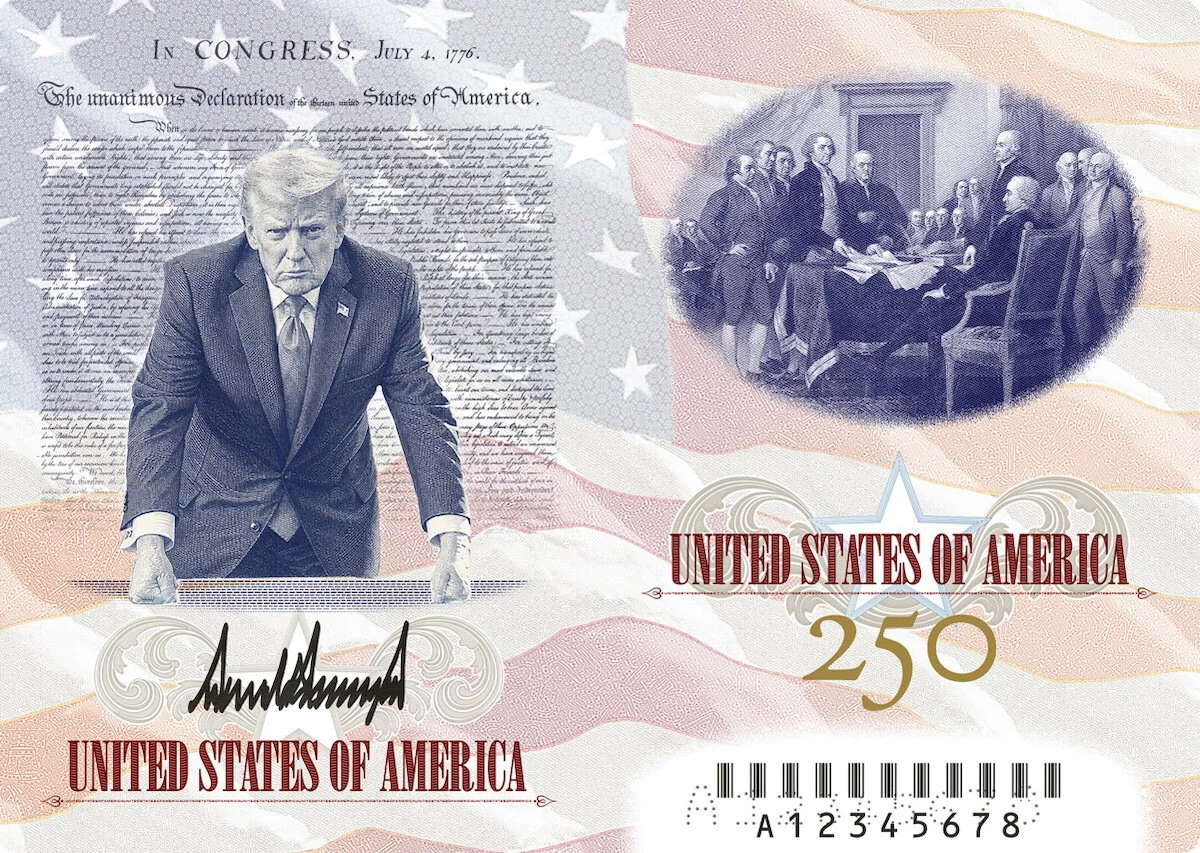
President Donald J. Trump has officially revealed the final design for a commemorative "Patriotic Passport" intended to mark the 250th anniversary of the United States. In a series of announcements made via his Truth Social platform in late June 2026, the President showcased the updated aesthetics of the travel document, which is scheduled for a limited-edition release during the nation’s Semiquincentennial celebrations. The design features significant departures from standard U.S. passport imagery, most notably including a depiction of the President himself alongside the Declaration of Independence and a new, unconventional slogan: "Welcome, but be good!"
The unveiling follows several weeks of speculation regarding the "America250" initiatives, a suite of federal programs and commemorative releases managed by the U.S. Semiquincentennial Commission. While the State Department typically maintains a standardized design for the Next Generation Passport (NGP) to ensure international security compliance, this limited-edition variant represents a unique intersection of national branding and executive commemorative power.
Evolution of the Patriotic Passport Design
The design revealed in June 2026 shows several modifications from preliminary concepts circulated earlier in the year. Initial drafts reportedly featured a prominent gold-ink signature of the President and a close-up portrait. However, the finalized version presented on Truth Social displays a full-body silhouette of President Trump standing in front of the original text of the Declaration of Independence. The signature, while still present, has been adjusted to a more traditional black ink, integrated into the security features of the data page.
The most discussed element of the new design is the inclusion of the phrase "Welcome, but be good!" prominently displayed within the interior pages. According to administration officials, the phrase is intended to serve as a "signature warning and greeting" that reflects the administration’s focus on national sovereignty and the rule of law. The placement of this slogan has prompted inquiries from travel experts and legal scholars regarding its intended audience and diplomatic function.
Historical Context: The U.S. Semiquincentennial
The year 2026 marks 250 years since the signing of the Declaration of Independence in 1776. The U.S. Semiquincentennial Commission, established by Congress under the Semi-quincentennial Commission Act of 2016, was tasked with planning the "America250" ceremonies. Historically, the United States has used major anniversaries to update national symbols and currency. During the 1976 Bicentennial, the U.S. Treasury issued special quarters, half-dollars, and dollars, while the State Department issued commemorative passport inserts.
The 2026 Patriotic Passport, however, goes further than previous commemorative efforts by altering the primary visual identity of the document itself. The administration has positioned the passport not merely as a travel document but as a collector’s item and a statement of national pride. The rollout is expected to coincide with a series of high-profile events in Philadelphia, Washington D.C., and other historic sites across the thirteen original colonies.

Analyzing the "Welcome, but be good!" Slogan
The inclusion of the phrase "Welcome, but be good!" has become a focal point of public discourse. In a journalistic and administrative context, the phrase presents a unique case study in federal messaging. Traditionally, U.S. passports contain a formal request from the Secretary of State to "permit the citizen/national of the United States named herein to pass without delay or hindrance."
The new slogan appears to serve a dual-purpose ideological role:
- A Message to Returning Citizens: Administration surrogates have suggested the phrase is a reminder to U.S. citizens of their responsibilities to uphold the law upon returning to the country. This aligns with the President’s "Law and Order" platform, extending the rhetoric of border security to the very documents held by citizens.
- A Global Statement of Intent: By placing the phrase in a document that is presented to foreign customs and immigration officials, the administration effectively broadcasts its domestic policy stance—"Welcome, but be good!"—to an international audience. This is seen by some analysts as a "FAFO" (Find Out) warning, a colloquialism often used by the President’s supporters to describe a philosophy of firm consequences for misconduct.
Critics and travel industry analysts have raised questions about the clarity of the message. Since passports are issued to U.S. citizens, who possess an inherent right of entry to the United States, the word "Welcome" is technically redundant, and the directive to "be good" lacks specific legal weight within the context of the Immigration and Nationality Act (INA). However, from a branding perspective, the administration has doubled down on the phrase as a core component of the "America First" identity.
Technical Specifications and Security Integration
Despite the stylistic changes, the Patriotic Passport must adhere to the strict standards set by the International Civil Aviation Organization (ICAO). To maintain its status as a valid travel document, the limited edition incorporates the latest in security technology:
- Polycarbonate Data Page: The main page is constructed from multi-layered plastic, making it nearly impossible to delaminate or alter without detection.
- Laser Engraving: The image of the President and the Declaration of Independence are laser-engraved into the polycarbonate, rather than printed on the surface.
- Tactile Features: Certain elements of the "Welcome, but be good!" slogan are reportedly embossed, providing a tactile security feature that can be felt by immigration officers.
- Color-Shifting Ink: The 250th-anniversary seal uses Optically Variable Ink (OVI) that changes color when viewed from different angles.
- Biometric Chip: The contactless chip embedded in the back cover contains the holder’s digital signature and biometric data, ensuring the passport remains compatible with automated border control gates worldwide.
The State Department has confirmed that while the Patriotic Passport features unique artwork, its internal electronic architecture is identical to the standard Next Generation Passport, ensuring that travelers will not face delays at foreign checkpoints due to technical incompatibility.
Administrative Rollout and Public Response
The limited-edition passports are expected to be available for application starting in the summer of 2026. The State Department’s Bureau of Consular Affairs has indicated that a "special issuance fee" may be applied to the Patriotic Passport to cover the costs of the custom design and to fund other America250 initiatives.
Public reaction has largely followed partisan lines. Supporters of the administration have praised the design as "Patriotic AF" and a "dope" representation of modern American leadership. On social media, influencers within the "MAGA" movement have celebrated the document as a way to "reclaim the border" and project strength abroad. Fox News and other conservative outlets have highlighted the design as a successful fulfillment of the President’s promise to make the 250th anniversary a "spectacular" event.

Conversely, some travel advocacy groups have expressed concern that the inclusion of political imagery could lead to increased scrutiny for U.S. travelers in certain jurisdictions. Historically, U.S. passports have avoided featuring living political figures to maintain a sense of neutrality and continuity across different administrations. The decision to feature the sitting President’s image represents a significant break from this tradition.
Implications for U.S. Travel and Diplomacy
The introduction of the Patriotic Passport carries broader implications for how the United States is perceived on the global stage. For decades, the U.S. passport has been a symbol of soft power, featuring images of American landscapes, the bald eagle, and quotes from a diverse array of historical figures like Martin Luther King Jr. and Anna Julia Cooper.
By pivoting to a design that focuses heavily on the current executive and a directive-based slogan, the administration is signaling a shift toward a more assertive and personality-driven form of national identity. This move is consistent with other administration policies, such as the implementation of "Visa Integrity Fees" for visitors and a preference for bilateral rather than multilateral diplomatic engagements.
Legal analysts are also monitoring whether the design will face any challenges under federal regulations governing the "use of the likeness of the President" or statutes regarding the neutrality of federal documents. However, given the President’s broad authority over the executive branch and the State Department, such challenges are unlikely to prevent the 2026 rollout.
Timeline of the America250 Passport Project
- January 2026: President Trump announces the intent to create a "spectacular" 250th-anniversary celebration, including a redesign of the U.S. passport.
- March 2026: The State Department forms a task force to integrate commemorative artwork with NGP security standards.
- May 2026: Preliminary "gold signature" designs are leaked to travel blogs and news outlets.
- June 26, 2026: President Trump unveils the final "Welcome, but be good!" design on Truth Social.
- July 4, 2026: Official launch of the America250 celebrations; application portal for the limited-edition passport opens to the public.
As the United States approaches its 250th year, the Patriotic Passport stands as a testament to the current administration’s vision for the country—one that emphasizes historic foundations, executive presence, and a clear, if unconventional, message to both its citizens and the world. Whether the "Welcome, but be good!" slogan becomes a lasting part of the American lexicon or remains a curiosity of the Semiquincentennial will likely depend on the cultural and political legacy of the 2026 celebrations.




 Anjar Salim
 Chandra Hamzah
 Tatiana Tantri Indah Sari
 Lukman Taruna Persada Ramadan
