
 Budi Mulyono
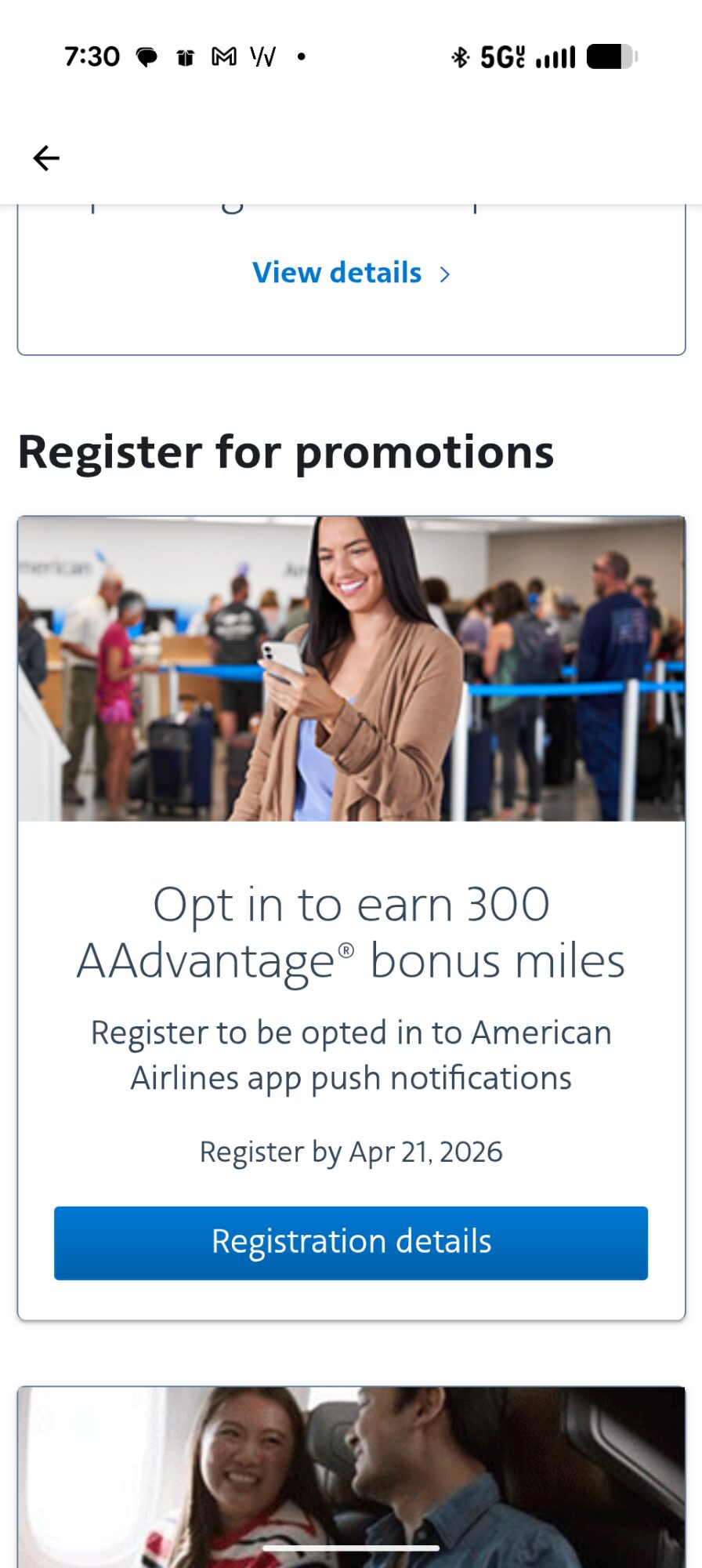
American Airlines has initiated a strategic digital engagement campaign designed to increase user interaction within its proprietary mobile application by offering AAdvantage members a one-time bonus of 300 redeemable miles. This promotional offer, which requires participants to opt into mobile push notifications, represents a shift toward incentivizing digital "stickiness" as major carriers seek to control the end-to-end customer journey through their own technology platforms. The promotion is currently available to a broad segment of the AAdvantage membership base, though it appears to be targeted primarily at users who have not yet enabled full notification suites on their mobile devices.
To qualify for the 300-mile bonus, members must navigate the American Airlines mobile application, access the "AAdvantage" account overview, and locate the offer within the "Promotions" tab. Upon selecting the specific notification promotion, users are prompted to register and subsequently agree to receive push notifications on the devices they use to access their accounts. This process is designed for minimal friction, requiring only a few seconds of user interaction to trigger the eligibility for the reward.
Chronology of the Promotion and Implementation Details
The rollout of this incentive follows a broader trend in the aviation industry where carriers are moving away from traditional advertising toward direct-to-consumer communication. The promotion was first observed in early July 2024, appearing in the "Promotions" section of the AAdvantage member dashboard. Unlike complex flight-based challenges or spend-threshold bonuses, this offer is categorized as a "micro-incentive," intended to drive immediate behavioral change—specifically, the granting of permission for the airline to send real-time data to the user’s lock screen.
According to the technical terms of the offer, the 300 bonus miles are classified as "redeemable-only." This distinction is critical within the current framework of the AAdvantage program. Since the overhaul of the program in March 2022, American Airlines has moved to a "Loyalty Points" system for elite status qualification. While these 300 miles can be used toward award flights, car rentals, or hotel stays, they do not contribute to a member’s progress toward AAdvantage Gold, Platinum, or Executive Platinum status. Furthermore, the airline has specified a processing window of six to eight weeks following the conclusion of the promotional period for the miles to reflect in member balances.
Strategic Valuation and Economic Impact
While 300 miles may seem negligible to high-frequency travelers, the valuation of these points carries specific weight in the loyalty ecosystem. Industry analysts typically value American Airlines AAdvantage miles at approximately 1.4 to 1.5 cents per mile when redeemed for mid-range domestic travel. Consequently, the 300-mile bonus equates to a cash value of roughly $4.20 to $4.50.
From the perspective of American Airlines, the cost of issuing these miles is marginal compared to the long-term value of a direct communication channel. By securing a place in a customer’s notification tray, the airline gains the ability to send gate change updates, baggage tracking information, and, crucially, upsell opportunities for seat upgrades and co-branded credit card offers. This direct line of communication bypasses email filters and third-party platforms, significantly increasing the likelihood of conversion on high-margin ancillary products.
Data from mobile marketing research indicates that users who enable push notifications have a 190% higher retention rate than those who do not. For a legacy carrier like American Airlines, which manages a loyalty program with over 115 million members, increasing the percentage of app-engaged users is a primary objective for the 2024-2025 fiscal period.
Context within the AAdvantage Loyalty Framework
The AAdvantage program, established in 1981 as the first major frequent flyer program in the world, has undergone significant transformations to remain competitive in a landscape dominated by spend-based rewards. The current iteration of the program prioritizes total engagement over miles flown. By offering rewards for non-flying activities—such as enabling notifications, using the AAdvantage Shopping portal, or dining at partner restaurants—American Airlines is attempting to integrate its brand into the daily lives of its consumers.
The 300-mile promotion also serves as a mechanism for account maintenance. For many members, a small infusion of miles can prevent account dormancy. Although American Airlines updated its policy to ensure that miles do not expire as long as there is any account activity within a 24-month period, these small promotional "drops" ensure that even occasional flyers remain tethered to the ecosystem.
Industry Comparisons and Competitive Landscape
American Airlines is not alone in its pursuit of mobile dominance. Competitors such as Delta Air Lines and United Airlines have launched similar initiatives to bolster their digital presence. Delta’s recent investment in "Sync" and free Wi-Fi for SkyMiles members is a parallel strategy aimed at forcing users to interact with the airline’s digital interface. United Airlines has focused on "Live Activities" for iOS, providing real-time flight data on the lock screen, which similarly requires users to grant extensive notification permissions.
Industry experts suggest that the "notification economy" is the next frontier for airline loyalty. "The goal is no longer just to sell a ticket; it is to own the traveler’s attention from the moment they think about a trip until they return home," says aviation consultant Marcus Thorne. "Giving away 300 miles is a very inexpensive way for American Airlines to buy a permanent billboard on the most valuable real estate the customer owns: their smartphone."
Privacy Considerations and Consumer Response
The move to incentivize push notifications does raise questions regarding consumer privacy and data fatigue. By opting in, users are essentially allowing the airline to track app usage patterns and send targeted marketing messages based on location data and past purchasing behavior. While the current promotion is a simple "opt-in" for miles, the underlying data exchange is a significant component of the airline’s broader "Big Data" strategy.
Early reactions from the frequent flyer community have been largely positive, characterized by a "low effort, low reward" sentiment. On various loyalty forums and social media platforms, members have noted the ease of the registration process. However, some users have expressed skepticism regarding the 6-8 week delivery timeline, noting that such a delay for a digital transaction seems antiquated in an era of real-time processing.
Broader Implications for Digital Marketing in Aviation
The success of this promotion may signal a shift in how airlines handle customer service and marketing. If American Airlines can successfully migrate a significant portion of its user base to an "always-on" notification status, it can reduce the burden on its call centers and gate agents. Automated notifications for delays and rebookings are significantly cheaper to manage than human-led interventions.
Furthermore, this promotion highlights the increasing "gamification" of loyalty. By breaking down rewards into smaller, more frequent "wins," airlines keep members engaged with the app on a daily or weekly basis, rather than only when they have an upcoming flight. This keeps the AAdvantage brand top-of-mind when the consumer eventually prepares to book their next journey.
Conclusion and Future Outlook
The American Airlines 300-mile push notification promotion is a calculated move to strengthen the airline’s digital infrastructure. While the immediate reward for the consumer is modest, the strategic advantage for the carrier is substantial. As the airline industry continues to navigate a post-pandemic landscape defined by high demand and rising operational costs, the ability to communicate directly and instantly with customers via mobile technology remains a top priority.
Members interested in the promotion are encouraged to check their American Airlines app periodically, as these "quick-hit" offers are often time-limited and may be rotated with other engagement-based incentives. As the 6-8 week window for mileage posting approaches, it will become clearer how many members successfully converted this offer and whether American Airlines will expand this micro-incentive model to other app features, such as biometric login or document scanning. For now, the 300-mile offer stands as a testament to the high value airlines place on the digital attention of their customers.




 Anjar Salim
 Chandra Hamzah
 Tatiana Tantri Indah Sari
 Lukman Taruna Persada Ramadan
