
 Budi Mulyono
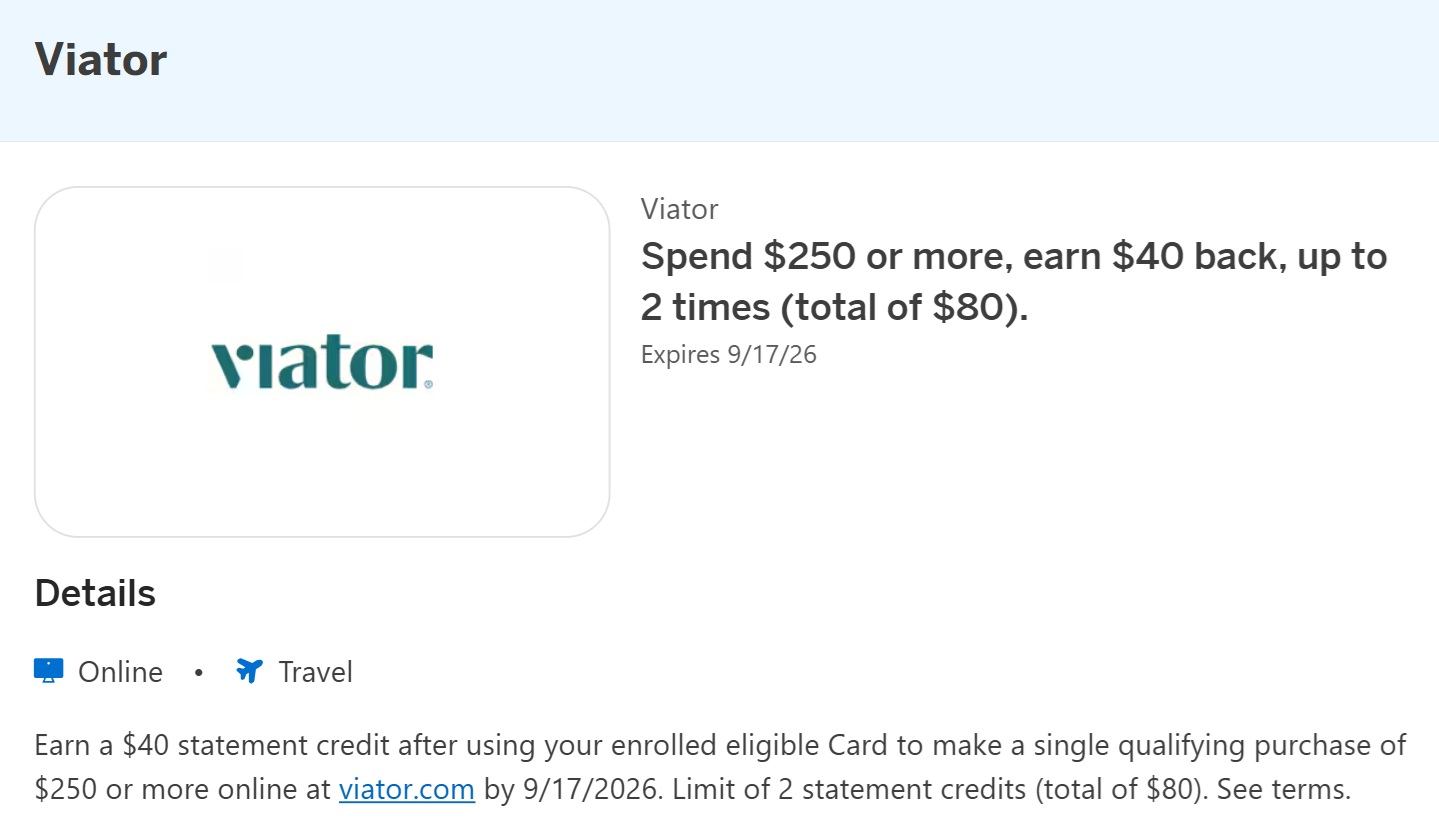
American Express has initiated a new targeted promotional campaign for its cardholders, offering a $40 statement credit for qualifying purchases of $250 or more made through Viator, a leading global marketplace for travel experiences. This promotion, part of the broader Amex Offers ecosystem, represents a strategic effort by the financial services giant to capture a larger share of the burgeoning "experience economy" spend during the peak travel season. The offer is specifically structured to reward high-value transactions, requiring the $250 threshold to be met in a single transaction, distinguishing it from other cumulative spending offers frequently seen in the credit card rewards market.
Mechanics and Technical Specifications of the Offer
The current Viator Amex Offer is designed with specific parameters that cardholders must navigate to successfully trigger the statement credit. Unlike many retail-based promotions that allow for "spend-to-get" totals to be reached across multiple smaller purchases, this specific Viator promotion necessitates a single transaction of at least $250. This requirement places a higher barrier to entry on the promotion but offers a substantial 16% return on investment for those spending exactly at the threshold.
Furthermore, the offer is unique in its repeatability. Eligible cardholders who find the offer on their account dashboard can utilize the promotion up to two times. This provides a maximum potential benefit of $80 in statement credits on a total spend of $500 or more, provided the spending is split into two distinct transactions of at least $250 each. Industry analysts note that such "multi-use" offers are becoming more common as American Express seeks to drive sustained engagement with specific merchant partners rather than one-off transactions.
Understanding Viator’s Role in the Travel Ecosystem
To understand the impact of this offer, it is necessary to examine the merchant involved. Viator, a subsidiary of Tripadvisor, is one of the world’s largest online platforms for booking tours, activities, and attractions. With a catalog exceeding 300,000 experiences across 200 countries, the platform serves as a critical intermediary between local tour operators and global travelers.
For American Express, partnering with Viator allows the bank to tap into the premium travel segment. Viator’s offerings range from basic walking tours and museum tickets to high-end private excursions and helicopter tours. By incentivizing a $250 spend, the offer encourages cardholders to book more expensive, curated experiences—a category of spending that has seen significant growth in the post-pandemic era. According to recent market data, the global travel activities market is projected to reach approximately $1.4 trillion by 2030, with digital bookings like those facilitated by Viator leading the expansion.
Chronology of Travel-Related Credit Card Promotions
The rollout of this Viator offer follows a series of competitive moves by major credit card issuers to capture travel-related spending. Over the past twelve months, the industry has observed a cyclical pattern of travel promotions:

- Late Q4 2023: Issuers focused on "holiday travel" and hotel-specific credits (e.g., Marriott, Hilton, and Hyatt offers).
- Q1 2024: A shift toward airline-specific rebates and "spring break" travel preparation.
- Q2 2024: The introduction of "experience-based" rewards, including the launch of similar, though less lucrative, offers from competitors.
- Current Period: The launch of the $40 off $250 Viator offer, coinciding with the peak summer and early autumn booking window for international and domestic tours.
This chronology suggests that financial institutions are increasingly using data-driven insights to align their promotional calendars with the actual booking behaviors of their high-net-worth cardholders.
Comparative Analysis: American Express vs. Chase
The current Amex Offer enters a competitive landscape where Chase, another major player in the rewards space, has also been active with Viator-related incentives. However, a comparative analysis reveals distinct differences in the financial engineering of these two promotions.
Chase recently offered a Viator promotion through its "Chase Offers" platform, providing an 8% statement credit on spending up to a $125 limit. In contrast, the American Express offer provides a flat $40 credit on a $250 spend.
- Yield Comparison: The Amex Offer provides a 16% return for a $250 spend, whereas the Chase offer provides an 8% return regardless of the spend amount (up to the cap).
- Target Audience: The Chase offer is more accessible for casual travelers booking low-cost activities (e.g., a $50 museum tour), as it has no minimum spend requirement. The Amex Offer is clearly targeted at more substantial bookings, such as full-day excursions or family group bookings, where the price point easily clears the $250 mark.
- Transaction Requirements: While Chase typically allows for cumulative spending to trigger rewards, the current Amex/Viator promotion is strictly tied to a single transaction, requiring more deliberate planning from the consumer.
The Role of Shopping Portals and Strategic Stacking
A critical component of modern credit card rewards strategy is "stacking"—the process of combining multiple offers to maximize the total discount or points earned. For the Viator Amex Offer, the $40 statement credit is only one layer of potential savings.
Financial experts point to the role of third-party shopping portals such as Rakuten, Capital One Shopping, and TopCashback. These platforms frequently offer cash-back rates for Viator ranging from 5% to as high as 15% or 20% during special "flash" events. When a cardholder clicks through a portal to Viator and pays with a card linked to the Amex Offer, they can effectively reduce the net cost of a $250 excursion by nearly 30% or more when the statement credit and portal rewards are combined.
The Capital One Shopping browser extension, in particular, has been noted for its "targeted" email offers. Consumers who browse Viator without completing a purchase often receive personalized emails offering elevated cash-back rates, which can then be used in conjunction with the American Express statement credit.
Technical Terms and Compliance
As with all Amex Offers, compliance with the "Key Terms" is essential for the credit to post to the cardholder’s account. The current offer specifies that the purchase must be made in U.S. dollars and must be processed through Viator’s primary booking engine. Transactions made through third-party travel agencies or "white-label" versions of the Viator site may not trigger the credit if the merchant of record does not appear as "Viator" on the billing statement.
Furthermore, the "single transaction" rule is a frequent point of failure for consumers. If a cardholder books two separate tours costing $125 each, they will not receive the $40 credit, even if the total spend reaches $250. This reflects a shift in merchant service agreements where brands like Viator prefer to incentivize larger individual "basket sizes" rather than multiple smaller interactions.
Broader Economic and Industry Implications
The existence of such generous targeted offers reflects broader trends in the financial services and travel industries. For American Express, these promotions serve as a tool for "customer stickiness." By providing tangible, high-value discounts, the issuer reinforces the value proposition of its annual-fee-bearing cards, such as the Platinum or Gold cards, in an era where consumers are increasingly scrutinizing the cost of premium credit products.
From the perspective of Viator and its parent company Tripadvisor, these promotions are a sophisticated form of customer acquisition. The cost of the statement credit is often shared between the issuer and the merchant. For Viator, the "cost" of the $40 discount is offset by the acquisition of a high-spending customer who may become a repeat user of the platform.
Industry analysts also point to the "Experience Economy" as a driving force. Post-pandemic consumer behavior has shifted significantly from the acquisition of physical goods to the pursuit of unique experiences. By aligning with Viator, American Express is positioning itself at the center of this cultural shift. The data collected from these transactions—where people travel, what kind of tours they prefer, and how much they are willing to spend—provides invaluable insights for future marketing and product development.
Conclusion and Future Outlook
The Viator Amex Offer of $40 back on a $250 spend is a prime example of the sophisticated, targeted marketing that now defines the credit card industry. It rewards higher-tier spending with a significant 16% rebate, provided cardholders adhere to the strict single-transaction requirement.
As the travel industry continues its robust recovery, market watchers expect to see a continued proliferation of these targeted incentives. For the savvy consumer, the key to maximizing these benefits lies in the careful reading of terms and the strategic use of shopping portals to "stack" rewards. For the industry, these offers remain a vital mechanism for driving transaction volume and maintaining brand loyalty in a highly competitive financial landscape. The success of this specific Viator promotion will likely serve as a blueprint for future collaborations between fintech giants and global travel marketplaces.




 Anjar Salim
 Chandra Hamzah
 Tatiana Tantri Indah Sari
 Lukman Taruna Persada Ramadan
