
 Budi Mulyono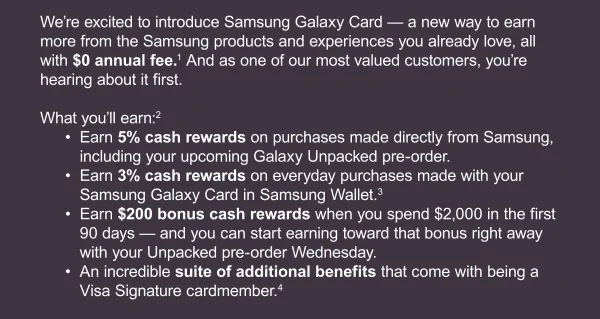
Barclays and Samsung Electronics America have officially announced the launch of the Samsung Galaxy Card, a new co-branded Visa credit card designed to integrate deeply with the Samsung mobile ecosystem. Scheduled for a public release on July 22, 2026, the card enters a highly competitive consumer credit market with a primary value proposition centered on high-yield rewards for digital transactions. The card carries no annual fee and introduces a sign-up bonus of $200 for new cardholders who meet a $2,000 spending threshold within the first 90 days of account opening. While the entry-level bonuses are comparable to other mid-tier credit products, the defining feature of the Samsung Galaxy Card is its uncapped 3% cash rewards on all eligible purchases made through the Samsung Wallet application.
The rollout began on July 20, 2026, when Samsung began distributing pre-qualification invitations via email to existing Samsung Account holders. These invitations allowed long-term users of the company’s hardware and software services to assess their eligibility ahead of the general public launch. By partnering with Barclays, a major global financial institution with a significant presence in the U.S. co-branded card sector, Samsung aims to convert its massive smartphone user base into a dedicated financial services audience.
The 3% Reward Structure and Samsung Wallet Integration
The core appeal of the Samsung Galaxy Card lies in its aggressive reward structure for mobile payments. According to the Reward Rules outlined in the Barclays Terms and Conditions, cardholders earn a flat 3% cash back on every dollar spent on eligible purchases, provided those purchases are processed through Samsung Wallet. Unlike many competitors that place annual or quarterly ceilings on high-percentage categories, the Samsung Galaxy Card offers these rewards on an uncapped basis.
The official documentation states that as long as the rewards program continues and the account remains in good standing, there is no limit to the total cash rewards a user can accumulate. Furthermore, these rewards do not expire, providing a long-term incentive for users to shift their primary spending to the Samsung digital interface. This 3% rate applies specifically to transactions where the Samsung Galaxy Card is the selected payment method within the Samsung Wallet app at the time of purchase.
However, the terms and conditions specify strict parameters for what constitutes an "eligible purchase." To qualify for the 3% rate, merchants must submit transactions using specific merchant category codes (MCC) and merchant identifiers. Barclays has noted that it is not responsible for transactions that are incorrectly coded by merchants. Furthermore, the 3% incentive is exclusive to the Samsung Wallet; if a cardholder uses a different digital wallet, such as Apple Pay or Google Pay, or uses a physical version of the card at a terminal that does not support Samsung Wallet, the transaction will not earn the elevated reward rate.
Timeline of the Launch and Market Positioning
The launch of the Samsung Galaxy Card follows a strategic timeline designed to capitalize on the increasing adoption of contactless payments. The initial outreach on July 20 served as a soft launch, targeting the most loyal segment of the Samsung ecosystem. The broader public availability on July 22 marks a significant expansion of Samsung’s "Samsung Money" and broader fintech initiatives, which have been evolving since the 2020 launch of Samsung Money by SoFi.
Market analysts suggest that the timing of this release is a direct response to shifts in the rewards landscape. Historically, the U.S. Bank Altitude Reserve was a favored choice for mobile wallet enthusiasts, offering 3x points on mobile payments. However, as that product and others have seen adjustments to their value propositions, a gap appeared in the market for a high-yield, uncapped mobile wallet card. The Samsung Galaxy Card appears positioned to fill this void, specifically for the Android-using demographic that has lacked a direct equivalent to the integrated experience offered by the Apple Card.
Technical Limitations and Exclusionary Clauses
While the 3% reward rate is the headline feature, the fine print reveals several exclusions typical of high-yield rewards cards. The terms stipulate that rewards are earned in the single highest applicable category per transaction, meaning rates cannot be combined or stacked. Additionally, purchases made through third-party intermediaries—including online marketplaces, resellers, or third-party payment accounts—may be ineligible for the 3% rate even if the Samsung Galaxy Card is used.
Standard financial transactions are also excluded from the definition of "Net Purchases." These include:
- Balance transfers and cash advances.
- Cash equivalent transactions, such as money orders, traveler’s checks, and foreign currency.
- Peer-to-peer (P2P) payment app transactions (e.g., Venmo or Cash App).
- Lottery tickets and gaming transactions.
- Fees, interest charges, and any unauthorized or fraudulent purchases.
The forfeiture of rewards is another critical area for consumers to monitor. Cash rewards earned can be forfeited if the account is closed due to delinquency, default, or if the account is no longer in "Good Standing" as defined by Barclays. This emphasizes the necessity for cardholders to maintain consistent payment histories to realize the long-term benefits of the uncapped rewards.
Strategic Partnership: Barclays and Samsung
The collaboration between Barclays and Samsung reflects a broader trend in the banking industry where traditional lenders provide the "plumbing" for tech-driven consumer brands. Barclays has a robust history of managing co-branded portfolios for major entities such as American Airlines, JetBlue, and various retail giants. By taking on the Samsung Galaxy Card, Barclays secures a high-volume channel for new account acquisitions.
For Samsung, the card serves as a "stickiness" mechanism. By offering 3% cash back exclusively through Samsung Wallet, the company incentivizes users to stay within its hardware ecosystem. Because Samsung Wallet is only available on Samsung Galaxy devices, cardholders are effectively incentivized to continue purchasing Samsung smartphones and wearable technology in the future to maintain access to their primary payment method and reward engine.
Competitive Analysis: Samsung vs. Apple and Traditional Banks
The Samsung Galaxy Card’s 3% uncapped mobile wallet reward is a bold move when compared to the Apple Card, which offers 3% only at select merchants and 2% on general Apple Pay transactions. By offering 3% across the board for all Samsung Wallet transactions, Samsung is effectively undercutting its primary rival in the premium smartphone space.
Furthermore, traditional "flat-rate" cards usually top out at 2% cash back (such as the Wells Fargo Active Cash or the Citi Double Cash). The 1% difference, while seemingly small, represents a 50% increase in reward yield for the consumer, which is significant for high-spenders. For a household that spends $30,000 annually through mobile wallets, the Samsung Galaxy Card would yield $900 in cash back, compared to $600 from a standard 2% card.
Industry experts believe this move may force other issuers to reconsider their mobile wallet strategies. As physical credit cards become less frequently used in favor of NFC-enabled devices, the "mobile wallet" category is becoming the new "general spend" category.
Implications for the Fintech Landscape
The introduction of the Samsung Galaxy Card is a clear indicator that the "platformization" of finance is accelerating. In this model, the financial product is not just a tool for credit but a component of a larger digital lifestyle. The integration of the card into the Samsung Wallet allows for real-time tracking of spending, immediate reward posting, and a seamless user interface that mimics the simplicity of the Galaxy operating system.
However, the success of the card will depend on merchant adoption of contactless payment terminals. While NFC adoption in the United States has reached record highs—with most major retailers and small businesses now supporting "tap-to-pay"—there remain pockets of the economy, particularly in the sit-down restaurant sector and certain service industries, where physical card swipes are still the norm. In these instances, the Samsung Galaxy Card loses its competitive edge, reverting to a lower base reward rate (typically 1%) for non-wallet transactions.
Conclusion and Future Outlook
The Samsung Galaxy Card represents a significant milestone in the evolution of the Samsung Wallet. By offering a market-leading 3% uncapped reward rate, Samsung and Barclays are making a play for the "top of wallet" status among millions of Android users. The $200 sign-up bonus and the absence of an annual fee lower the barrier to entry, making it an attractive option for both casual spenders and rewards optimizers.
As the card officially launches on July 22, 2026, the financial industry will be watching closely to see if this aggressive reward model is sustainable. If successful, it could signal a new era of co-branded cards where the primary category for rewards is the technology platform itself rather than specific retail sectors. For now, the Samsung Galaxy Card stands as one of the most competitive offerings for consumers who have embraced the transition to a cashless, mobile-centric economy.




 Anjar Salim
 Chandra Hamzah
 Tatiana Tantri Indah Sari
 Lukman Taruna Persada Ramadan
