
 Tatiana Tantri Indah Sari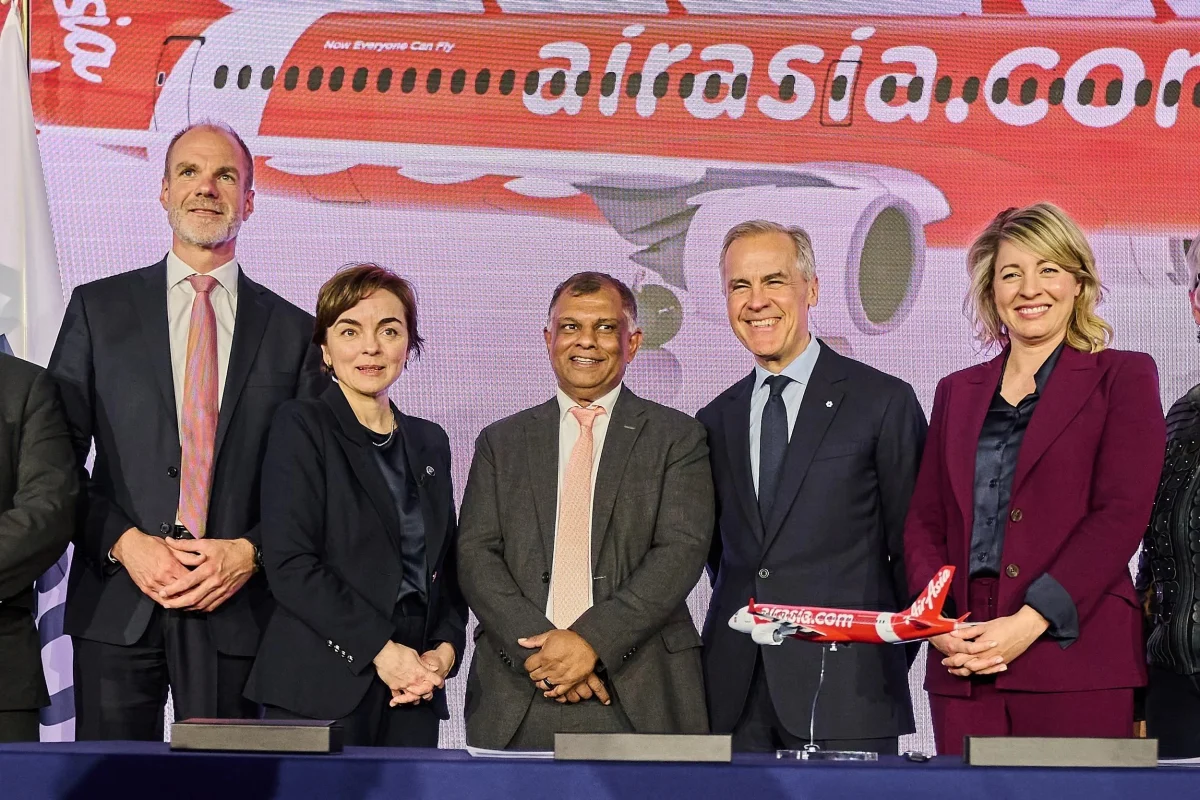
KUALA LUMPUR & MIRABEL, QUEBEC – AirAsia, the prominent Southeast Asian low-cost carrier, has announced a monumental deal for 150 Airbus A220 aircraft, an agreement valued at an estimated $19 billion based on list prices. This landmark transaction represents the largest single firm order ever placed for the A220 jet family, a significant endorsement of Airbus’s modern narrow-body offering and a strategic pivot for AirAsia, historically a staunch operator of the larger A320 family. Furthermore, the airline is set to become the launch customer for a new, high-density cabin configuration of the A220, designed to accommodate 160 seats, underscoring its commitment to maximizing efficiency and capacity within the smaller jet segment.
The announcement was made during a high-profile event in Mirabel, Quebec, the primary manufacturing hub for the A220 program. Tony Fernandes, CEO of Capital A, the parent company of AirAsia Aviation Group, seized the opportunity to publicly advocate for the development of a stretched version of the aircraft, commonly referred to as the A220-500. Fernandes articulated a clear vision for an A220 variant capable of carrying approximately 180-185 passengers, effectively bridging the capacity gap between the current A220-300 and smaller iterations of the A320 family. Directly addressing Lars Wagner, CEO of Airbus Commercial Aircraft, Fernandes stated, "We really hope that you will build the A220-500, which is 185 seats. That’s the aircraft we really want. If they build that aircraft, AirAsia will buy another 150 of these aircraft as well… This is a $19 billion deal, and we are talking about potentially doubling it." This bold declaration not only highlighted AirAsia’s long-term fleet aspirations but also presented a compelling case for Airbus to invest in further expanding the A220 product line.
A Strategic Pivot: Diversifying AirAsia’s Fleet
For over two decades, AirAsia has built its formidable low-cost empire predominantly on the backbone of the Airbus A320 family. Its current fleet, primarily comprising A320ceos and A320neos, has enabled the airline to connect a vast network across Asia, providing affordable air travel to millions. The decision to introduce the A220 marks a notable diversification strategy, signaling AirAsia’s intent to penetrate new markets and optimize operations on routes that may not warrant the larger capacity of an A320.
The A220, known for its superior fuel efficiency, advanced aerodynamics, and passenger comfort in the 100-160 seat segment, offers a compelling proposition for airlines seeking to serve thinner routes or increase flight frequencies on existing ones without incurring the higher operating costs associated with larger aircraft. For AirAsia, the 160-seat configuration, tailored specifically to its operational model, promises to deliver optimal seat-mile costs, a critical metric for low-cost carriers. This custom configuration likely involves a denser seating arrangement than typical A220 layouts, maximizing revenue potential while still benefiting from the aircraft’s inherent efficiencies. The A220-300, which AirAsia has ordered, typically seats between 130 and 160 passengers in a standard two-class configuration, or up to 160 in a single-class layout. AirAsia’s commitment to a 160-seat design pushes the upper limit, demonstrating a focus on maximizing payload within the aircraft’s operational envelope.
The Call for the A220-500: Bridging the Capacity Gap
Tony Fernandes’s impassioned plea for the A220-500 underscores a significant market demand for an aircraft that precisely fits between the largest A220-300 and the smallest A320 family variants, specifically the A319neo (typically 140-160 seats) and the A320neo (150-180 seats). An A220-500 with 180-185 seats would offer a more direct, modern, and potentially more efficient competitor to older A320ceo models and even some A320neo configurations, particularly on routes where demand is robust but not consistently at the peak levels required for a full A320neo.
The strategic advantage for AirAsia in operating an A220-500 would be substantial. It could allow the airline to further optimize its network, serving high-demand routes with an aircraft that offers lower trip costs than an A320, while still providing adequate capacity. This flexibility is crucial for a low-cost carrier operating in diverse markets with varying passenger loads and route lengths. Fernandes’s offer of an additional 150 aircraft order for the -500 variant is a powerful incentive, demonstrating a massive potential market for Airbus should it decide to proceed with the development. Such an order would not only solidify the A220 program’s future but also significantly expand its addressable market.
The A220 Program: From CSeries to Global Contender
The Airbus A220 program has a storied history, originating as Bombardier’s CSeries. Launched as a direct competitor to regional jets and smaller narrow-bodies, the CSeries aircraft (initially CS100 and CS300) quickly gained a reputation for its advanced technology, including Pratt & Whitney PW1500G geared turbofan engines, which offered significant fuel savings (up to 20% better than previous generation aircraft) and reduced noise levels. However, Bombardier faced substantial financial challenges and production delays, leading to a complex ownership transition.
In 2018, Airbus acquired a majority stake in the CSeries program, subsequently rebranding it as the A220 family (A220-100 and A220-300). This acquisition was a strategic masterstroke for Airbus, allowing it to fill a critical gap in its product portfolio below the A319neo, while simultaneously bolstering its competitive position against Embraer’s E-Jet E2 family and Boeing’s 737 MAX 7. Under Airbus’s stewardship, the A220 program has seen renewed momentum, with increased production rates and a growing order book from diverse customers worldwide, including major North American carriers like Delta Air Lines and JetBlue, as well as European operators like Air France.
The A220-300, the larger variant ordered by AirAsia, boasts a typical range of up to 3,400 nautical miles (6,300 km), making it suitable for a wide array of intra-regional routes. Its advanced materials, including composites, contribute to its lighter weight and enhanced fuel efficiency, a key factor in reducing airlines’ operational costs and environmental footprint. The cabin design, featuring larger windows and spacious overhead bins, also enhances the passenger experience, a factor increasingly important even for low-cost carriers.
Timeline and Context of AirAsia’s Fleet Evolution
AirAsia’s journey began in 2001, transforming from a debt-laden Malaysian airline into a leading low-cost carrier under Tony Fernandes’s leadership. Its initial fleet strategy centered on the Boeing 737, but a pivotal decision in 2005 saw the airline commit exclusively to the Airbus A320 family, with an initial order for 60 aircraft. This commitment grew exponentially over the years, culminating in hundreds of A320ceo and A320neo orders, establishing AirAsia as one of Airbus’s largest customers globally for the A320 family.
The introduction of the A220 marks the first significant departure from this single-aircraft-family strategy in nearly two decades for AirAsia’s short-haul operations. While AirAsia X, its long-haul affiliate, operates Airbus A330s, the core short-haul network has remained exclusively A320. This move reflects a maturing market and a more nuanced approach to fleet planning, acknowledging that a "one-size-fits-all" strategy may no longer be optimal for all segments of its vast network. The timing also aligns with a post-pandemic recovery period, where airlines are re-evaluating their networks and seeking maximum efficiency and flexibility.
Financial and Operational Implications of the Deal
A $19 billion deal, even at list prices which are typically subject to significant discounts for bulk orders, represents a substantial capital expenditure for AirAsia. The financing of such an extensive order will involve a mix of direct purchases, lease agreements, and sale-and-leaseback transactions, common practices in the airline industry to manage financial outlays. The gradual delivery schedule of 150 aircraft over several years will allow AirAsia to integrate the new type into its operations progressively, spreading the financial burden and operational adjustments.
Operationally, the A220 will enable AirAsia to open new, thinner routes that might be uneconomical with an A320. This could include secondary cities within its existing markets or entirely new destinations that previously lacked sufficient demand for a larger jet. The A220’s smaller capacity also allows for increased frequency on certain routes, offering passengers more choice and convenience, which can be a competitive advantage. The aircraft’s superior fuel efficiency translates directly into lower operating costs per trip, a crucial factor for a low-cost carrier striving to maintain competitive fares.
However, introducing a new aircraft type also presents challenges, including the need for new pilot training programs, maintenance infrastructure, and spare parts inventories. AirAsia’s decision suggests that the long-term benefits of fleet diversification and enhanced operational flexibility outweigh these initial integration costs. The commonality in cockpit design and systems between Airbus aircraft families, while not as extensive between the A220 and A320 as within the A320 family itself, may offer some degree of familiarity for pilots and maintenance crews, potentially easing the transition.
Airbus’s Response and the Future of the A220-500
Airbus, while undoubtedly pleased with AirAsia’s monumental A220 order, will weigh Tony Fernandes’s push for the A220-500 carefully. Developing a new aircraft variant is a multi-billion dollar undertaking, requiring extensive engineering, certification, and a robust business case. The A220-500 concept has been discussed within industry circles for several years, with analysts suggesting it could further enhance the A220’s market appeal.
The challenge for Airbus lies in balancing the potential market demand for a larger A220 with the risk of cannibalizing sales of its existing A319neo and A320neo models. While the A220-500 would offer superior efficiency in its class, particularly for shorter to medium-haul routes, a larger A220 could encroach on the lower end of the A320neo market. Lars Wagner and the Airbus leadership team will need to conduct thorough market studies, evaluate production capabilities, and assess the return on investment for such a significant development. However, a potential order for another 150 aircraft from a major operator like AirAsia presents a compelling argument that cannot be easily dismissed. Such an order would provide a strong anchor for the A220-500 program, significantly de-risking its development.
Competitive Landscape and Broader Market Impact
AirAsia’s massive A220 order reverberates across the competitive landscape of the regional jet and smaller narrow-body market. It represents a significant win for Airbus against its primary competitor in this segment, Embraer, which offers the E-Jet E2 family (E190-E2 and E195-E2) as highly efficient alternatives in the 100-150 seat category. While Embraer has secured orders from various airlines globally, AirAsia’s commitment to the A220 underscores Airbus’s growing dominance in this space since the CSeries acquisition.
Boeing, with its 737 MAX 7, targets a slightly larger capacity segment, typically seating 138-153 passengers, and has faced its own challenges with the MAX program. The A220, therefore, offers airlines a modern, purpose-built aircraft specifically designed for the lower end of the narrow-body market, providing an alternative that many operators are finding increasingly attractive for its blend of efficiency, comfort, and operational flexibility.
The implications for the broader aviation industry are also significant. This deal reinforces the trend towards more fuel-efficient and versatile aircraft, driven by environmental concerns, fluctuating fuel prices, and the need for airlines to optimize their networks in a post-pandemic world. It highlights the growing importance of the 100-180 seat segment, which provides critical connectivity for secondary cities and under-served markets, fostering economic growth and accessibility.
In conclusion, AirAsia’s historic order for 150 Airbus A220 aircraft marks a pivotal moment for both the airline and the A220 program. It signals AirAsia’s strategic intent to diversify its fleet, optimize its network with a highly efficient aircraft, and aggressively pursue new growth opportunities. Simultaneously, Tony Fernandes’s public advocacy for the A220-500 places a spotlight on a potential future variant that could redefine the lower end of the narrow-body market and secure another massive order for Airbus, underscoring the dynamic interplay between airline vision and aircraft manufacturer innovation in shaping the future of air travel.




 Anjar Salim
 Chandra Hamzah
 Budi Mulyono

