
 Budi Mulyono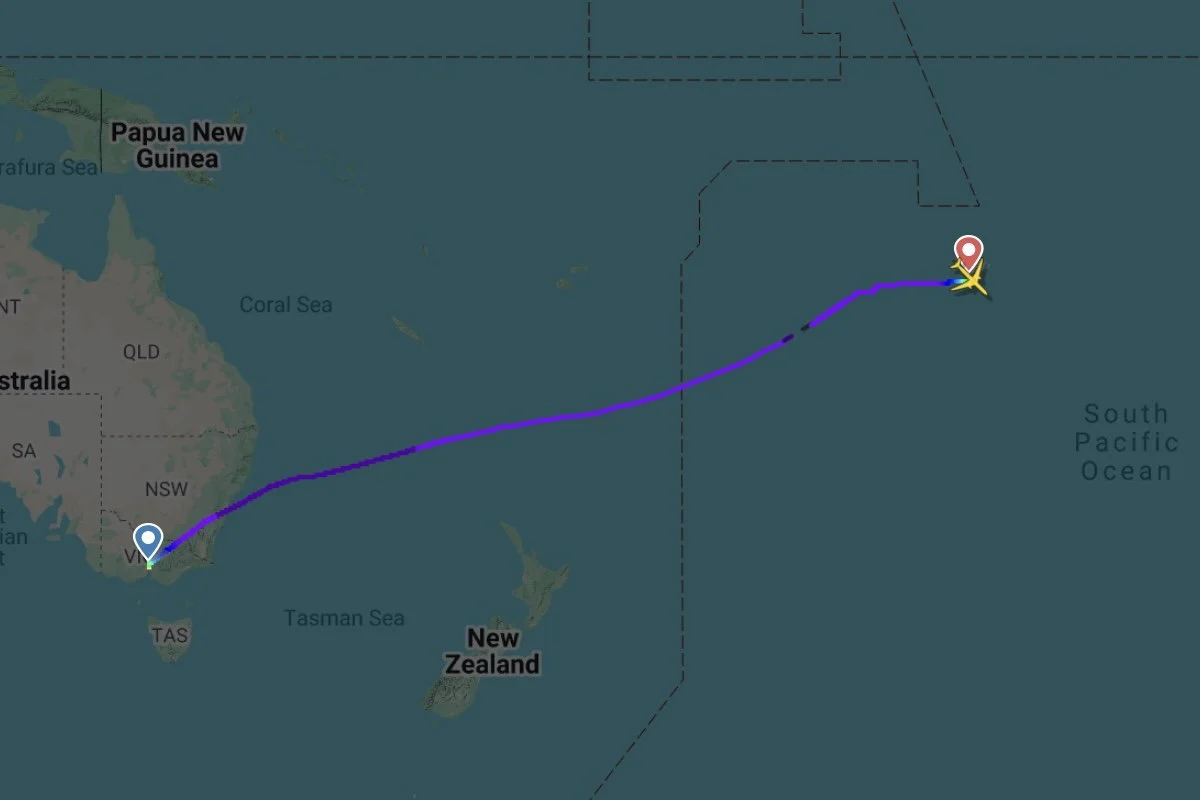
Qantas flight QF21, a nonstop service from Melbourne Airport (MEL) to Dallas-Fort Worth International Airport (DFW), was forced to make an emergency diversion to Faa’a International Airport (PPT) in Papeete, Tahiti, on May 15, 2026, following a violent outburst by a passenger. The incident, which reportedly included the physical assault and biting of a flight attendant, resulted in the perpetrator being forcibly removed from the aircraft, placed in the custody of French Polynesian authorities, and issued a lifetime ban from Australia’s national carrier.
The flight, operated by a Boeing 787-9 Dreamliner, is recognized as one of the longest commercial aviation routes in the world, spanning approximately 8,992 miles (14,471 kilometers). Under standard conditions, the eastbound journey requires approximately 15 hours of flight time. However, the May 15th service was interrupted approximately four hours into the trans-Pacific crossing when a male passenger began exhibiting erratic and highly disruptive behavior.
Chronology of the Incident
The journey began with a delay at Melbourne Airport, with the aircraft departing nearly two hours behind its scheduled time. Despite the late start, the initial phase of the flight proceeded without incident as the Boeing 787-9 climbed to its cruising altitude and headed northeast across the Pacific Ocean.
According to passenger accounts and available flight data, the disruption began roughly four hours after takeoff. A male passenger, who appeared to be significantly intoxicated or under the influence of an unknown substance, began using loud, abusive language directed at both fellow travelers and the cabin crew. Video footage captured by passengers shows a senior flight attendant attempting to de-escalate the situation, maintaining a professional and calm demeanor while asking the individual to return to his seat and cease his disruptive behavior.
The situation escalated when the passenger became physically combative. While the full extent of the physical struggle was not captured in a single continuous video, internal communications sent via the Aircraft Communications Addressing and Reporting System (ACARS) confirmed a grave development. A message sent from Qantas operations to the flight deck crew requested the staff identification number of a crew member who had been bitten during the altercation. The message also requested the seat numbers of several passengers who had stepped in to assist the cabin crew in restraining the individual.
Faced with a non-compliant passenger who posed a direct threat to the safety of the crew and the security of the flight, the captain made the decision to divert to the nearest viable airport. At the time of the decision, the aircraft was positioned over the South Pacific, making Papeete, Tahiti, the most logical choice for an emergency landing.
Diversion and Operational Impact
The Boeing 787-9 touched down in Papeete approximately seven hours after departing Melbourne. Upon arrival, the aircraft was met by local law enforcement officers who boarded the plane and took the disruptive passenger into custody. The individual was reportedly detained in a Tahiti jail cell pending further investigation by local and international authorities.
The aircraft remained on the ground in Papeete for approximately one hour. During this time, the crew managed the administrative requirements of the diversion, and the injured crew member received preliminary assessment. Despite the gravity of the incident, the flight was cleared to continue its journey to Dallas.
The secondary leg of the flight, from Papeete to Dallas-Fort Worth, took just under nine hours. Remarkably, due to favorable tailwinds and the efficiency of the ground turnaround in Tahiti, the aircraft arrived at DFW only three hours behind its original scheduled arrival time. While the delay was minimized, the operational costs of such a diversion are substantial.
Industry analysts estimate that a trans-Pacific diversion of a wide-body aircraft like the Boeing 787-9 can cost an airline between $100,000 and $250,000. These costs include additional fuel burn (and the potential need to dump fuel to reach a safe landing weight), landing fees at a non-scheduled airport, ground handling charges, and the potential for crew duty-time violations which could necessitate a complete crew swap in more complex scenarios.
Official Response and Legal Consequences
Qantas has maintained a firm stance regarding the incident. In a statement following the event, the airline confirmed that the passenger has been placed on a "no-fly list" for life, effective immediately. This ban extends to all Qantas Group flights, including Jetstar.
"The safety of our customers and our crew is our number one priority," a Qantas spokesperson stated. "We have zero tolerance for any form of abusive or disruptive behavior on board our aircraft. We are providing support to our crew member who was injured during this incident and thank the passengers who assisted during the flight."
The legal ramifications for the passenger are expected to be severe. Under the Tokyo Convention and subsequent aviation treaties, the state in which the aircraft is registered (Australia) and the state where the aircraft lands (French Polynesia/France) both have jurisdictions that can apply. Physical assault on a crew member is a federal offense in many jurisdictions and can carry significant prison sentences and heavy fines. Additionally, Qantas may pursue civil litigation to recover the costs associated with the unscheduled diversion.
Technical and Route Context: The MEL-DFW Service
The Melbourne to Dallas route is a flagship service for Qantas, utilizing the advanced capabilities of the Boeing 787-9 Dreamliner. The aircraft is designed for ultra-long-haul efficiency, featuring improved cabin pressure and humidity levels to reduce the effects of jet lag. However, the extreme duration of the flight—often exceeding 15 hours—presents unique challenges for crew managing passenger behavior.
In an environment where passengers are confined for over half a day, the consumption of alcohol is closely monitored. This incident has reignited discussions within the aviation industry regarding the "duty of care" and the service of alcohol. While it remains unclear whether the passenger in question consumed alcohol primarily on the ground or during the flight, the incident highlights the volatility that can occur when substance use intersects with the stresses of long-duration travel.
Broader Industry Trends: The Rise of Unruly Passengers
This diversion is part of a concerning global trend. According to data from the International Air Transport Association (IATA), there has been a significant uptick in reported incidents of unruly passengers over the last several years. In 2022 and 2023, IATA reported a 47% increase in incidents compared to pre-pandemic levels.
The nature of these incidents ranges from non-compliance with safety instructions to physical aggression and assault. Industry experts point to several contributing factors, including:
- Increased Travel Stress: Post-pandemic travel has been characterized by higher costs, crowded terminals, and frequent delays, contributing to shorter tempers among passengers.
- Alcohol and Substance Abuse: A high percentage of "Level 3" (life-threatening or physical assault) incidents involve the influence of alcohol or drugs.
- Mental Health Factors: The isolated environment of a pressurized cabin can exacerbate underlying mental health conditions or episodes of psychosis.
Aviation authorities worldwide have been pushing for stricter prosecution of such offenders. The Montreal Protocol 2014 (MP14) was specifically designed to strengthen the legal powers of states to prosecute unruly passengers, closing loopholes that previously allowed offenders to escape punishment if the aircraft was not registered in the country where it landed.
Impact on Crew and Safety Protocols
The physical assault of a crew member—particularly a bite—carries health risks and psychological trauma. Flight attendants are trained in "Crew Resource Management" (CRM) and conflict de-escalation, but they are not law enforcement officers.
"Our crews are trained to handle difficult situations, but they should never have to face physical violence in the workplace," said a representative from the Flight Attendants’ Association of Australia. "This incident in Tahiti is a stark reminder of the risks our members take when they step on board. We support the harshest possible penalties for individuals who jeopardize the safety of a flight."
The use of "restraint kits," which include plastic flex-cuffs, is standard on long-haul Qantas flights. In this instance, the assistance of passengers was vital in securing the individual until the aircraft could safely reach Tahiti.
Conclusion
The diversion of Qantas flight QF21 serves as a high-profile example of the disruptions caused by air rage and the serious consequences that follow. While the Boeing 787-9 eventually reached its destination in Dallas, the lives of hundreds of passengers were disrupted, a crew member was injured, and an airline incurred massive unnecessary expenses.
As the legal process unfolds in Papeete, the aviation industry continues to grapple with how to best protect staff and passengers from a small minority of travelers who refuse to adhere to basic standards of conduct. For the passenger now facing the French Polynesian legal system and a lifetime ban from Australia’s largest airline, a moment of aggression has resulted in a permanent alteration of his ability to travel internationally and a likely criminal record.


 Chandra Hamzah
 Gabriela Annisa
 Tatiana Tantri Indah Sari
 Anjar Salim