
 Budi Mulyono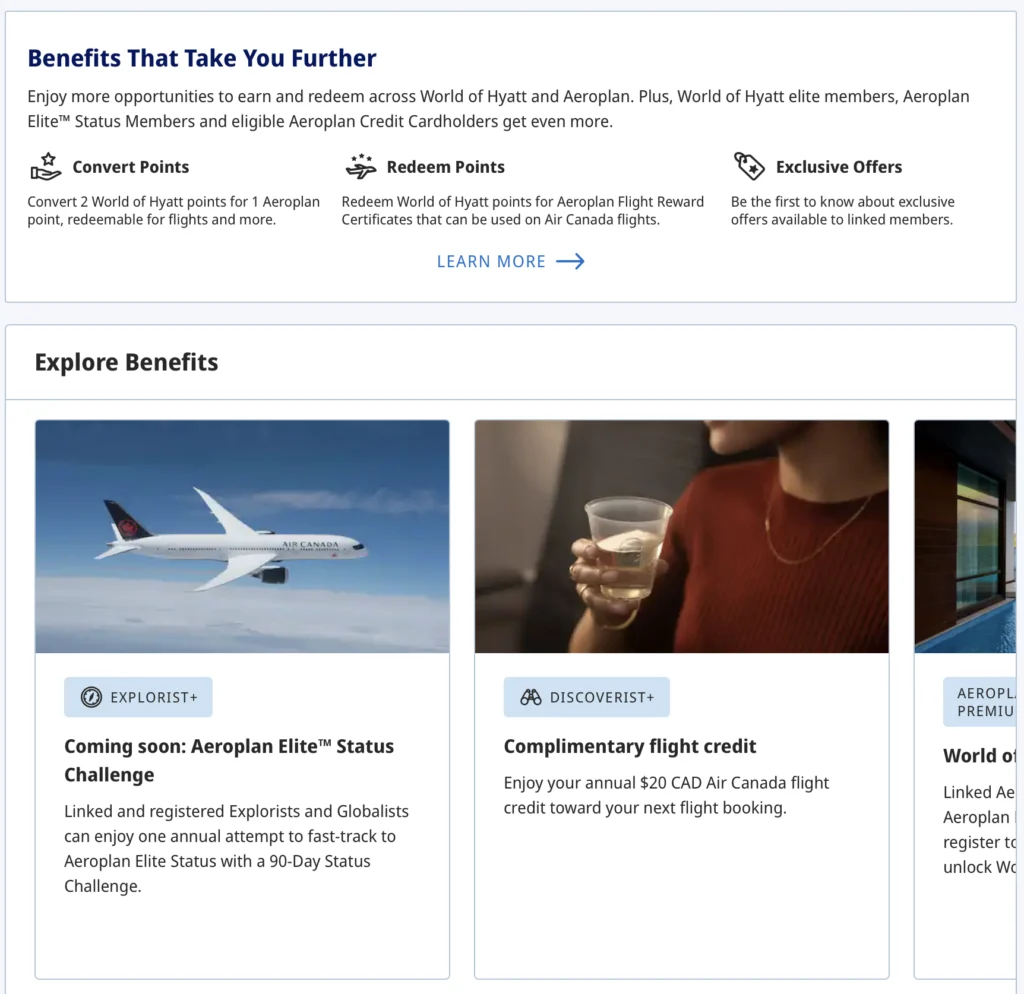
The landscape of travel loyalty programs has historically been defined by transactional relationships, where airlines and hotel chains offer marginal benefits such as point transfers or minor reciprocal perks. However, the newly unveiled partnership between World of Hyatt and Air Canada’s Aeroplan marks a significant departure from this traditional formula. By integrating their ecosystems, the two entities have created a multi-layered framework that influences how members earn, redeem, and achieve elite status across both the hospitality and aviation sectors. This collaboration moves beyond the standard "points-for-miles" exchange, aiming instead to capture a greater share of the high-value traveler’s total spend through deep systemic integration.
A Paradigm Shift in Loyalty Integration
Most hotel and airline partnerships function as peripheral benefits. Travelers might earn a few hundred miles for a hotel stay or transfer points at a suboptimal ratio to top off an account for a specific award. These arrangements rarely dictate consumer behavior. The Hyatt-Aeroplan alliance is designed differently, focusing on "engagement-led loyalty" rather than simple "transactional loyalty."
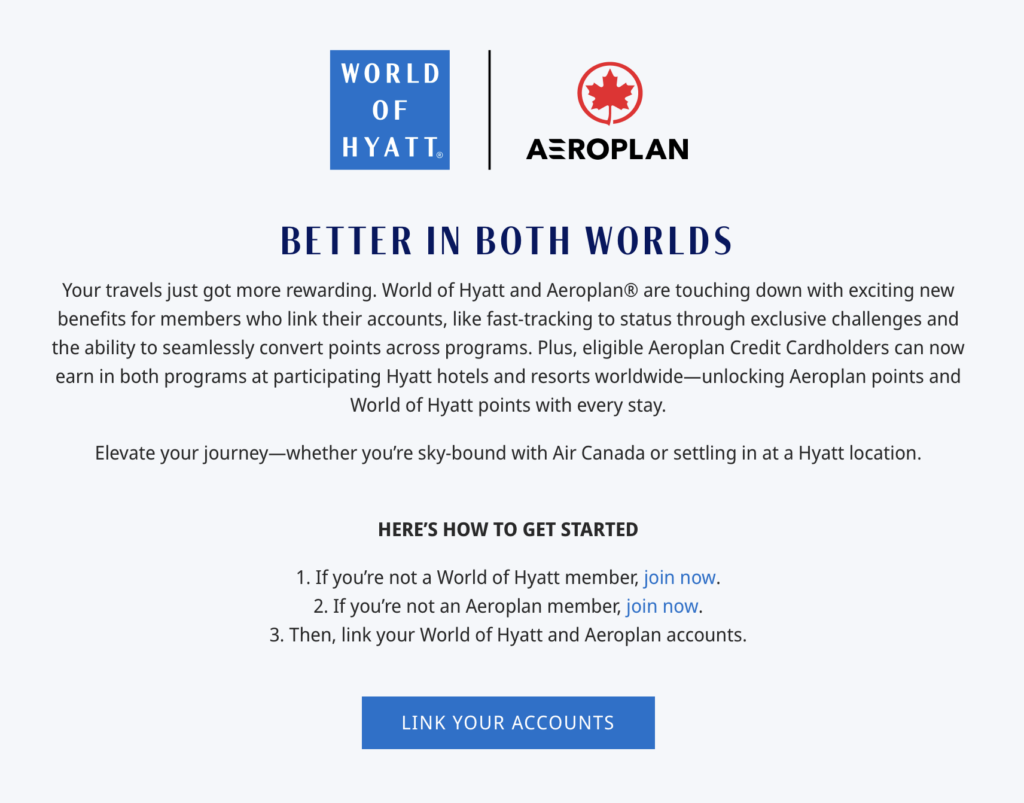
The core of this partnership lies in the creation of a shared ecosystem. Rather than viewing a flight and a hotel stay as two separate events, the programs now treat them as a single, continuous journey. This is achieved through account linking, which serves as the foundational step for members to access a suite of reciprocal benefits. Once accounts are connected, the data sharing between World of Hyatt and Aeroplan allows for a more personalized and rewarding experience, incentivizing members to remain within this specific network of partners.
Detailed Breakdown of Reciprocal Redemption Options
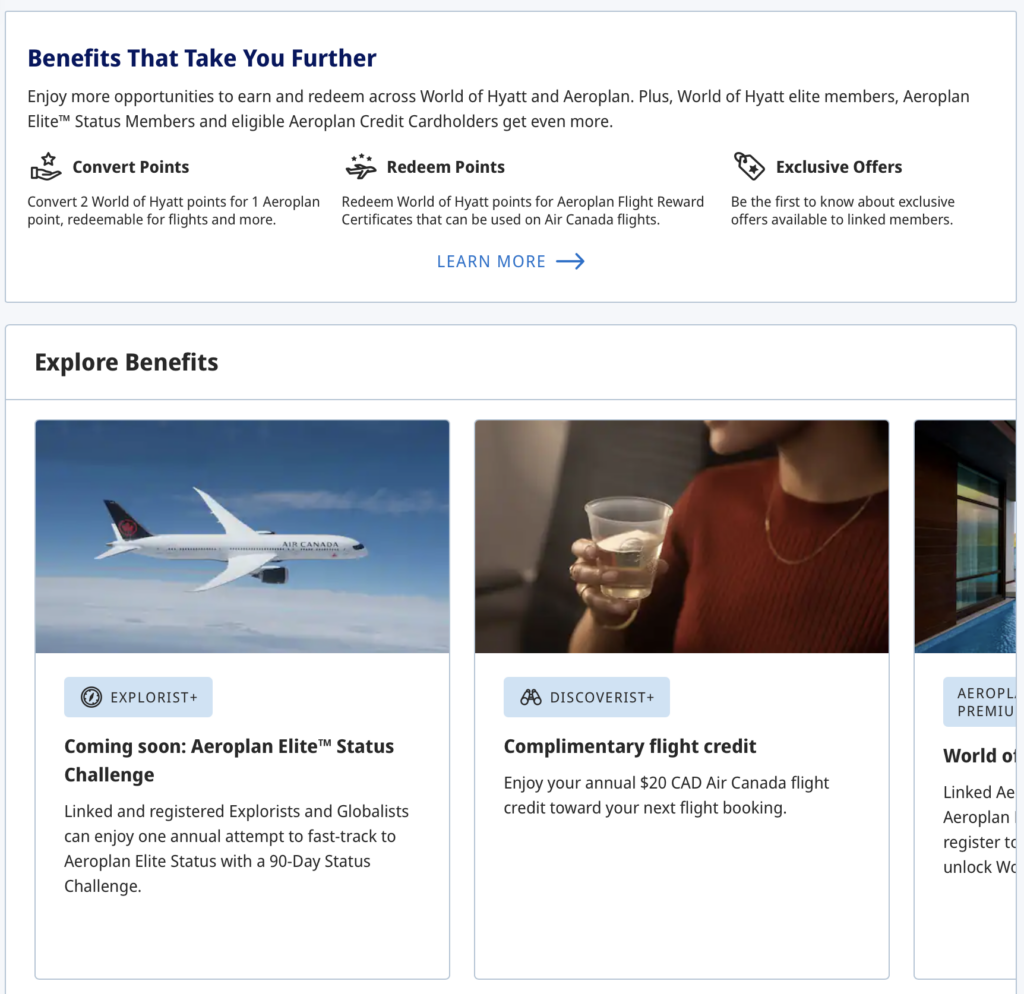
The most tangible aspect of the partnership is the introduction of new redemption pathways that allow members to use one currency for the other’s primary service.

Aeroplan Points for Hyatt Free Night Awards
In a move that bypasses the volatility of dynamic pricing, Aeroplan members can now redeem their points for Hyatt Free Night Award certificates. This is structured around Hyatt’s established award chart rather than a fixed cent-per-point conversion.
- Category 1–4 Certificates: These can be redeemed for 25,000 Aeroplan points.
- Category 1–7 Certificates: These will be available for a higher point requirement, targeting Hyatt’s luxury portfolio, including brands like Park Hyatt and Andaz.
This structure preserves the value proposition for Hyatt loyalists. Because a Category 4 hotel in a high-demand market like New York or Tokyo can often exceed $400 USD per night, a 25,000-point redemption represents a significant value—often exceeding the standard 1.5 to 2.1 cents per point valuation typically assigned to Aeroplan miles.
Hyatt Points for Aeroplan Flight Rewards
Conversely, Hyatt members can now access Aeroplan Flight Reward Certificates. This allows Hyatt loyalists to utilize their hotel points to subsidize or fully cover air travel on Air Canada and its more than 40 airline partners. This is particularly relevant for those looking to book premium cabin travel on Star Alliance carriers such as Lufthansa, ANA, or Singapore Airlines, where Aeroplan’s lack of fuel surcharges on partner awards makes the points exceptionally valuable.
Reciprocal Earning and Transfers
While the certificates represent the most innovative aspect, the partnership also maintains traditional earning flexibility. Aeroplan members can opt to earn 500 Aeroplan points per stay at Hyatt properties in lieu of Hyatt points. Furthermore, a 2:1 transfer ratio has been established in both directions. While transfers are generally less efficient than direct redemptions, they provide a necessary "top-up" mechanism for members who are just short of a specific award threshold.
The Strategic Fast-Track to Elite Status
For many frequent travelers, the "Status Challenge" is the highlight of this announcement. World of Hyatt’s Globalist status is widely regarded as one of the most rewarding tiers in the industry, offering complimentary breakfast, lounge access, significant room upgrades (including standard suites), and waived resort fees. Traditionally, Globalist status requires 60 qualifying nights in a calendar year—a high barrier to entry.

Under the new partnership, eligible Aeroplan Elite members and certain premium credit cardholders can participate in a streamlined qualification process:
- Discoverist Status: Attainable after 4 qualifying nights.
- Explorist Status: Attainable after 10 qualifying nights.
- Globalist Status: Attainable after 20 qualifying nights within the promotional period.
By reducing the requirement for Globalist status from 60 nights to 20, Hyatt and Aeroplan are aggressively targeting "free agent" travelers who may currently hold status with Marriott Bonvoy or Hilton Honors. This move is expected to drive significant occupancy to Hyatt properties during the challenge period as travelers scramble to secure high-tier benefits for the following year.
Chronology and Context: The Evolution of Aeroplan and Hyatt
To understand the significance of this partnership, one must look at the recent trajectories of both brands.
Air Canada’s Aeroplan underwent a massive transformation in 2020. After Air Canada reacquired the program from Aimia, it was rebuilt from the ground up with a focus on flexibility and partner breadth. Since then, Aeroplan has added more airline partners than any other frequent flyer program in the world and introduced features like family sharing and "Points + Cash" redemptions.
World of Hyatt, while smaller in footprint than giants like Marriott or Hilton, has focused on a "quality over quantity" strategy. Hyatt has expanded its portfolio through strategic acquisitions, such as Two Roads Hospitality and Apple Leisure Group, while maintaining a transparent, chart-based loyalty program. The partnership with Aeroplan is a logical extension of Hyatt’s desire to increase its visibility in international markets, particularly Canada and the Asia-Pacific region, where Star Alliance has a dominant presence.
Regional Implications: Canada and the Indian Market
While the partnership is global, certain nuances apply to specific regions. In Canada, the integration is deepest through co-branded credit cards issued by TD, CIBC, and American Express. Canadian cardholders of premium Aeroplan products will receive automatic Hyatt Discoverist status and earn elite qualifying night credits through their daily spend.
For the Indian market, the partnership is equally relevant. Aeroplan has become a favorite among Indian "points and miles" enthusiasts due to its partnership with major Indian banks and its ability to book Air India flights with ease. As Hyatt continues to expand its footprint in India—with new properties in business hubs and leisure destinations like Goa and Rishikesh—the ability to earn Aeroplan points on Hyatt stays provides a localized benefit for Indian travelers who frequently fly Star Alliance carriers.
Industry Analysis: The Rise of Loyalty Ecosystems
Market analysts suggest that this partnership is a response to the increasing "platformization" of travel. In an era where Google Travel and Expedia dominate the search phase, direct loyalty programs must offer more than just a free room or flight; they must offer a seamless ecosystem.
By aligning, Hyatt and Aeroplan are creating a defensive moat against competitors. A traveler who is 15 nights into a 20-night Globalist challenge via Aeroplan is unlikely to book a Marriott or a Hilton, even if it is more convenient. Similarly, a traveler who has just redeemed Aeroplan points for a Hyatt Category 7 stay is more likely to continue flying Air Canada or its partners to replenish their balance.
Conclusion and Outlook
The Hyatt x Aeroplan partnership represents a sophisticated evolution in loyalty marketing. By focusing on deep integration—ranging from reciprocal status challenges to unique certificate-based redemptions—the two companies have set a new benchmark for how airlines and hotels can collaborate.
For the consumer, the benefits are clear: more ways to use points, a faster path to elite benefits, and a more cohesive travel experience. For the industry, it serves as a case study in how smaller, high-value players can combine their strengths to compete effectively against larger, more ubiquitous competitors. As the travel industry continues to recover and evolve, these types of cross-sector alliances are likely to become the new standard for driving long-term customer retention.




 Anjar Salim
 Chandra Hamzah
 Tatiana Tantri Indah Sari
 Lukman Taruna Persada Ramadan
