
 Diana Nuri Rohmawati
The consumer drone market has undergone a significant transformation since aerial photography transitioned from a specialized industrial tool into a mainstream consumer hobby. For years, the standard architecture of a recreational flying camera remained virtually unchanged: a quadcopter chassis equipped with a single-axis or three-axis mechanical gimbal stabilizing a forward-facing camera. While this design has yielded breathtaking cinematic content for global travelers, road-trippers, and documentary filmmakers alike, it inherently limits spontaneity. Pilots have long been forced to commit to a specific trajectory and composition in real-time, often missing dynamic action occurring just outside the camera’s field of view.
Entering the market in late 2025, the Antigravity A1 was developed to address these operational constraints by rendering the traditional mechanical gimbal obsolete for a vast segment of content creators. By introducing a dual-lens 360-degree capture system, the A1 records its environment in every direction simultaneously. This technological shift introduces a "fly now, frame later" workflow, altering the traditional pilot experience into one that mirrors directing a virtual camera within a pre-recorded digital environment. Industry analysts and early hardware testers have closely monitored the adoption rate of this technology, noting its potential to permanently shift expectations in portable aerial documentation.
Chronology and Market Positioning
The development of the Antigravity A1 follows a broader trajectory in consumer electronics toward spatial capture and software-driven post-production flexibility. While 360-degree action cameras popularized the concept of reframing footage after an event takes place, integrating this technology onto an unstable, high-velocity aerial platform presented significant engineering challenges. Traditional 360 cameras required bulky stitching software and often suffered from severe vibration artifacts when mounted on flying chassis.
Antigravity spent the two years preceding the late 2025 launch refining proprietary stabilization algorithms and optical configurations capable of handling the vibrational frequencies of a quadcopter. Upon its release, the A1 positioned itself not merely as an alternative to existing aerial systems, but as a direct challenge to single-lens drones dominating the sub-250-gram category. By prioritizing omnidirectional capture over traditional forward-facing optics, the manufacturer targeted solo creators, travel vloggers, and independent filmmakers seeking to maximize efficiency without expanding their equipment payloads.
Hardware Engineering and Specifications
At the core of the Antigravity A1’s hardware architecture is its dual-lens configuration. Eschewing the conventional single forward-facing camera, the A1 incorporates two ultra-wide-angle lenses positioned symmetrically on the top and bottom of the central fuselage. Each lens captures a 200-degree field of view, creating a comprehensive 400-degree total capture area. The overlapping visual data is stitched together seamlessly in processing, while proprietary algorithms digitally remove the drone’s chassis from the final exported file. This process creates the distinct visual illusion of a self-supported camera floating independently in mid-air.
Imaging performance is driven by dual 1/1.28-inch CMOS sensors. While professional-grade cinema drones often utilize larger 1-inch sensors, the A1’s sensors are substantially larger than those typically found in standard 360-degree action cameras. This scale provides measurable benefits in low-light environments and expands dynamic range, allowing the system to preserve highlight and shadow details during high-contrast scenarios, such as direct midday sunlight.
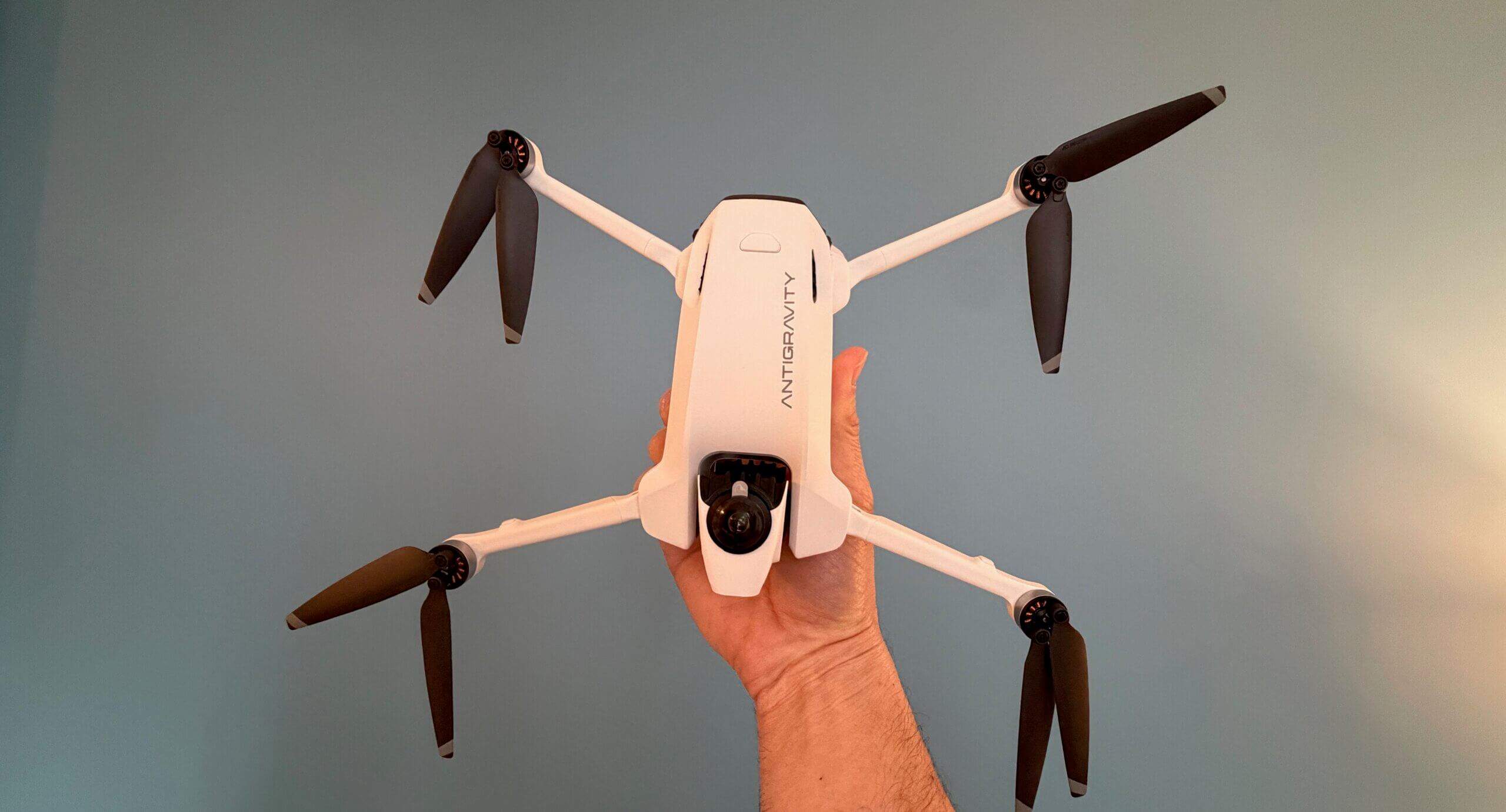
Physical durability and weight regulation formed a critical boundary for the engineering team. Regulatory frameworks in numerous aviation jurisdictions worldwide mandate strict registration and operational licensing for any unmanned aerial vehicle weighing 250 grams or more. Antigravity engineered the A1 to weigh precisely 249 grams when equipped with its standard intelligent flight battery. This design choice exempts users from commercial registration requirements in key global markets, lowering the barrier to entry for international travelers.
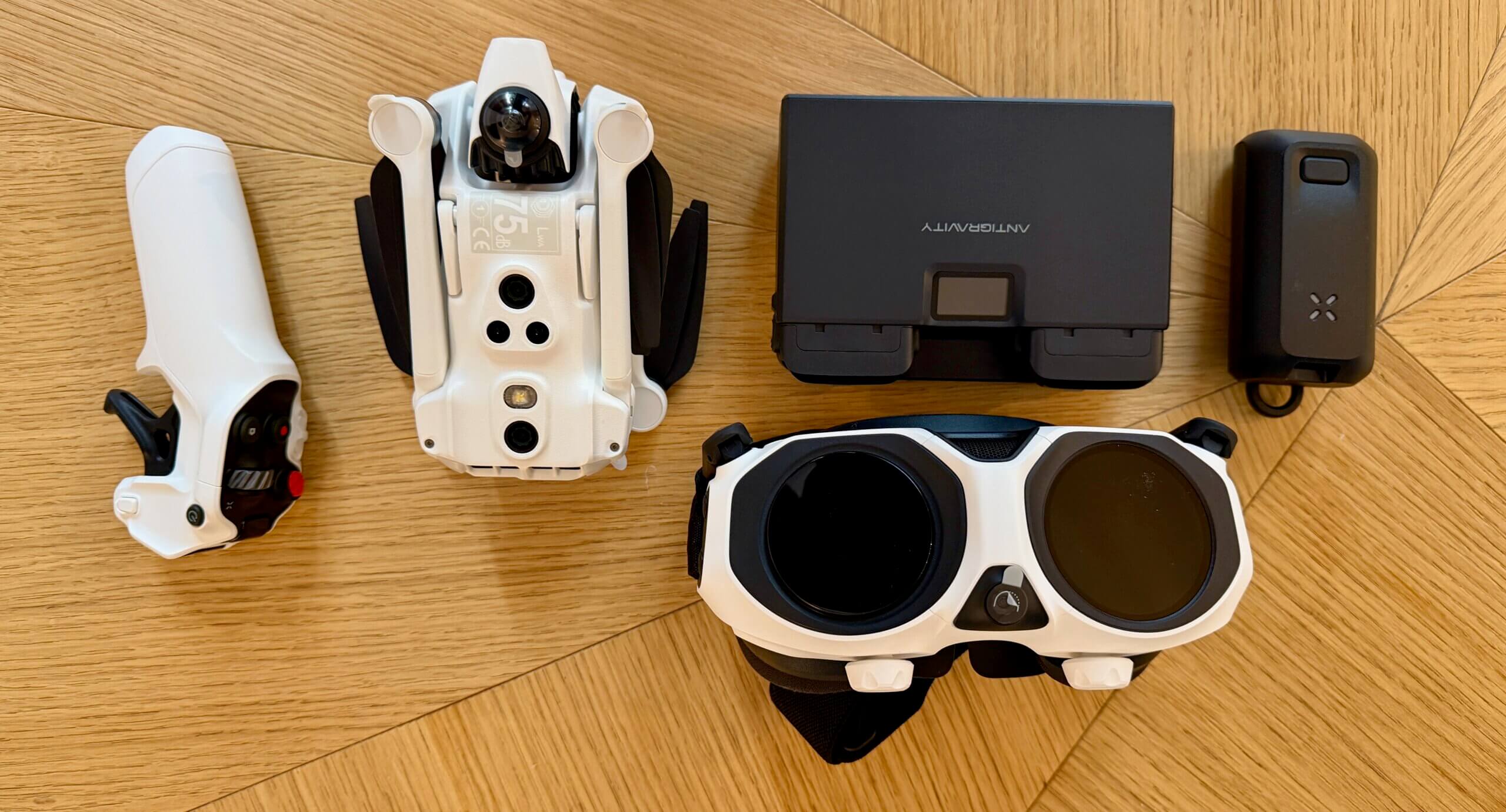
The structural integrity of the fuselage relies on a high-grade carbon-fiber-reinforced polymer. This composite material offers an improved strength-to-weight ratio compared to the acrylonitrile butadiene styrene (ABS) plastics common in budget-tier drones. Folding mechanisms utilize tactile, positive-click hinges designed to withstand the rigors of frequent deployment in field conditions. When folded, the chassis approximates the footprint of a modern smartphone, though with a thicker profile to accommodate the dual-lens assemblies.
Flight Dynamics and Control Systems
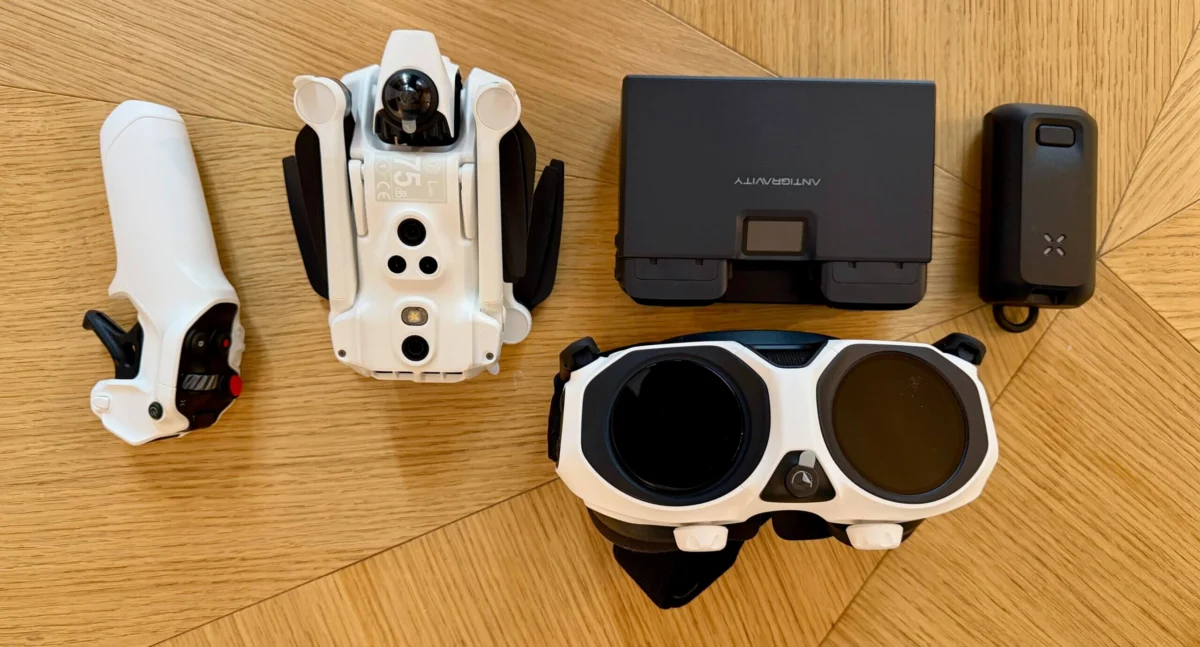
Piloting the Antigravity A1 diverges markedly from operating a standard fixed-camera drone, primarily due to the integration of specialized vision goggles and motion-tracking control peripherals.
The accompanying vision goggles incorporate dual 4K micro-OLED displays operating at a 120Hz refresh rate. By combining low signal latency with integrated head-tracking sensors, the goggles synchronize the visual feed with the user’s natural head movements. When a pilot looks downward or pans to the side, the viewing angle shifts dynamically within the 360-degree recorded sphere. This configuration provides spatial awareness that cannot be replicated by a fixed-camera monitor.
Control inputs are managed through a single-handed motion controller designed around intuitive spatial mechanics. Steering is accomplished by pointing the controller in the desired flight vector and depressing a trigger for acceleration, while wrist tilting executes banking maneuvers and climbs. For operators requiring traditional precision, the system also supports a conventional "Mode 2" dual-stick controller. However, field evaluations indicate that the fluid nature of the motion controller satisfies the operational requirements of most non-acrobatic users.
The flight profile of the A1 aligns with a "cinewhoop" design philosophy, emphasizing stability and predictable handling over high-speed racing agility. With a maximum operational velocity of approximately 36 miles per hour, the aircraft is well-suited for tracking moving subjects such as cyclists or automotive traffic. Integrated safety features include "Turtle Mode," an automated recovery protocol that utilizes the propellers to flip the aircraft upright if it lands inverted, minimizing the need for manual retrieval in restricted areas.
Optical Output and Post-Production Workflow
A primary point of discussion surrounding the A1 involves its marketing designation of "8K Resolution." In conventional digital imaging, an 8K resolution claim denotes a rectangular 16:9 frame where all pixels contribute to a single fixed perspective. In a 360-degree capture system, those pixels are distributed across a spherical canvas. When an operator "reframes" the spherical footage into a standard flat export, the resulting video represents a cropped window of the total recorded data.
To accommodate varying post-production requirements, the A1 offers multiple color profiles. A "Vivid" preset supplies saturated, high-contrast color science intended for immediate publication on social media platforms. Alternatively, a 10-bit "Log" profile provides professional editors with a flat color curve designed for advanced color grading and matching with external cinema cameras. Stabilization is managed via Antigravity’s proprietary "FlowState" algorithms, which maintain horizon stability even when operating in crosswinds exceeding 20 miles per hour.
Workflow integration is facilitated through the "Antigravity Studio" application. The software enables wireless footage transfer speeds up to 80MB/s and allows users to reframe video files by manipulating their mobile device’s built-in gyroscope. Additionally, an AI-driven "Auto-Frame" utility analyzes recorded clips to identify primary subjects, automatically generating a dynamic edit path that keeps points of interest centered throughout the sequence.
Power Management and Operational Efficiency
Battery limitations remain a universal constraint within the consumer drone sector. The A1 is powered by a standard Intelligent Flight Battery rated for a theoretical maximum flight duration of 24 minutes. In practical field testing under moderate wind conditions and continuous recording, operational times typically range between 19 and 20 minutes.
Despite these durations, the practical utility per flight is amplified by the omnidirectional capture capability. Because operators are not restricted to a single pre-determined camera angle, a single flight can yield multiple distinct framing options that would otherwise require three or more separate flights with a traditional fixed-lens drone. For extended operations, an optional "Pro Battery" extends flight times to approximately 39 minutes, though the additional weight increases the total aircraft mass beyond the 249-gram regulatory threshold and slightly alters handling dynamics.
Broader Industry Implications
The introduction of the Antigravity A1 highlights a broader transition within digital media production toward algorithmic reframing and post-capture composition. By decoupling the act of piloting from the act of framing, the technology mitigates the cognitive load traditionally placed on solo operators.
While the hardware compromises on absolute sensor size and edge-to-edge optical sharpness compared to heavy-lift professional cinema drones, its design priorities reflect the demands of modern content creators who value rapid deployment, regulatory compliance, and creative flexibility. As software reframing tools continue to mature, the A1 serves as a benchmark for how omnidirectional capture can reshape portable aerial cinematography.



 Gabriela Annisa

 Lukman Taruna Persada Ramadan

 Tatiana Tantri Indah Sari

 Anjar Salim


 Dwi Wanna
