
 Chandra Hamzah
Carnival Cruise Line has once again updated its customer loyalty program, this time focusing on its Milestones program, which rewards guests for their time spent at sea. This latest adjustment follows significant controversy and widespread confusion surrounding the recent overhaul of its VIFP (Very Important Fun Person) Club into the new Carnival Rewards program. The cruise line has officially released details of the updated Milestones program, which now bases rewards on total sailing days rather than the number of cruises taken, a shift that has, so far, generated more bewilderment than acclaim from its dedicated passenger base.
The announcement comes at a critical juncture for Carnival, as it grapples with customer dissatisfaction stemming from the broader Carnival Rewards initiative. The previous VIFP program was well-established and understood by loyal cruisers, who often planned their vacations around earning specific tiers and benefits. The transition to Carnival Rewards, which incorporates a points-based system alongside tiered status, has been met with criticism for its perceived complexity and a potential dilution of previously enjoyed perks. The addition of a revamped Milestones program, now tied to a different metric, has amplified this sense of disorientation among frequent travelers.
Background: The Evolution of Carnival’s Loyalty Programs
Carnival Cruise Line has historically recognized and rewarded its loyal clientele through various programs. The VIFP Club, in particular, had been a cornerstone of its customer retention strategy for years. This program was designed with clear tiers—Blue, Red, Gold, Platinum, and Diamond—each offering escalating benefits such as priority check-in, onboard credits, and exclusive events. The progression through these tiers was primarily based on the number of cruises completed. For example, reaching Gold status required 25 cruises, while Diamond status demanded 100 cruises.
Complementing the VIFP Club was the Milestones program, which provided additional rewards and recognition for specific achievements in sailing duration. This program was designed to acknowledge the cumulative time guests spent enjoying Carnival’s offerings, offering tangible benefits for long-term engagement. Historically, these milestones often coincided with cruise count achievements, creating a dual system of recognition.
The decision to transition to Carnival Rewards marked a significant departure from this established model. The new program aims to consolidate various aspects of customer engagement into a unified system. Under Carnival Rewards, guests earn points for every dollar spent on board and on pre-cruise purchases, which can then be redeemed for a variety of rewards, including discounts, onboard credits, and even free cruises. Alongside the points system, tiered status (which seems to have absorbed elements of the old VIFP tiers) is still a component, although the exact mechanics and how they interact with points are still being clarified for many.
The Shift to Sailing Days: A New Metric for Recognition
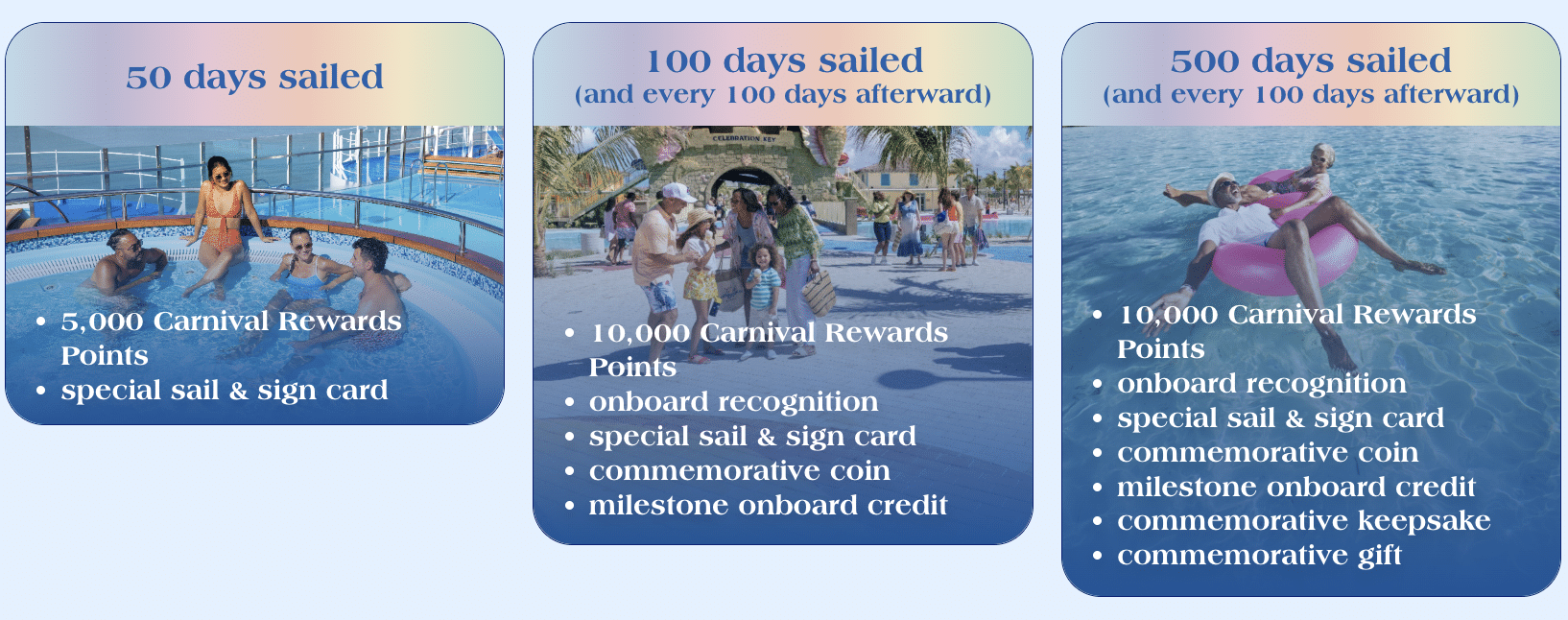
The latest iteration of the Milestones program represents a fundamental change in how Carnival acknowledges its most dedicated passengers. Previously, Milestones were often tied to the number of cruises completed, mirroring the VIFP tier structure. However, the new system explicitly shifts the focus to "total sailing days." This means that a guest who takes a single, long, 14-day cruise will now contribute significantly more towards their Milestones than someone who has completed multiple shorter, perhaps 3- or 4-day, sailings.
This alteration has sparked debate among cruisers. Proponents suggest that rewarding total days at sea is a more equitable approach, acknowledging the sustained commitment and revenue generated by longer voyages. Critics, however, point out that this change may disadvantage those who prefer shorter, more frequent getaways, or those with limited vacation time who cannot embark on extended itineraries. The perceived value of a "milestone" may also change, as the cumulative nature of days at sea could take longer to achieve for some, while potentially accelerating progress for others.
Unpacking the Confusion: Key Areas of Uncertainty
The primary driver of passenger frustration is the perceived lack of clarity and the feeling of being overwhelmed by simultaneous program changes. The Carnival Rewards system itself has been a source of confusion, with many questions arising about how points are earned, their exact value, and how they interact with existing loyalty status. Adding a fundamentally different Milestones program on top of this has, understandably, left many cruisers scratching their heads.
Carnival has acknowledged these concerns and has stated its intention to release more comprehensive information, including a detailed Q&A document, to address the ambiguities. However, until such official clarifications are fully disseminated and understood, speculation and confusion persist.
Here’s a breakdown of what is known and what remains unclear:
Previous Milestones Program:
- Basis: Primarily tied to the number of cruises completed.
- Rewards: Typically included gifts, special acknowledgments, and sometimes exclusive onboard experiences. The exact nature of these rewards often scaled with the number of cruises.
- Integration: Often aligned with VIFP tier status, meaning certain cruise count milestones might also correspond to reaching a new VIFP level.
New Milestones Program:
- Basis: Now explicitly based on total sailing days.
- Rewards: Details are still emerging, but it is understood that these will continue to be tangible benefits and acknowledgments for accumulated time at sea. The specific rewards for each new "day threshold" are anticipated to be detailed in upcoming official communications.
- Integration with Carnival Rewards: The precise relationship between achieving Milestones and the broader Carnival Rewards points and tier system is a significant area of confusion. For example, will achieving a certain number of sailing days automatically grant bonus points, influence tier status, or unlock specific redemption options? The lack of clarity here is a major point of contention.
The Question of Reward Value: Points vs. Days
A critical aspect of any loyalty program is the perceived value of the rewards. In the case of Carnival Rewards, the value of the points earned is a subject of ongoing discussion. While Carnival has indicated that points can be redeemed for various onboard benefits and discounts, the conversion rate and the overall "worth" of these points are not immediately transparent to all users. This opacity can lead to a feeling that the rewards are less valuable or harder to attain than they appear.
The new Milestones program, by shifting to sailing days, introduces a different kind of value proposition. The value here is less about a direct transactional exchange (like points for discounts) and more about recognition and accumulating status for sustained patronage. The question then becomes: how do these "day-based" rewards compare in perceived value to the previously cruise-count-based rewards, and how do they complement the points-based Carnival Rewards system?
Analyzing the Implications: A Strategic Shift?
The dual changes to the loyalty program suggest a strategic shift by Carnival Cruise Line. The move to a points-based system like Carnival Rewards is a common practice in the travel industry, aiming to capture revenue across a wider range of customer spending, not just cruise bookings. It allows for more granular tracking of customer engagement and spending habits, potentially enabling more personalized marketing and offers.
The adjustment of the Milestones program to sailing days could be an attempt to incentivize longer, more lucrative itineraries. Longer cruises generally represent a higher spend per passenger, both on the cruise fare and onboard expenses. By rewarding cumulative days at sea, Carnival might be encouraging passengers to opt for these longer voyages over shorter, more frequent trips.
However, this strategy carries inherent risks. If the transition is not managed with exceptional clarity and transparency, it can alienate a significant portion of the loyal customer base. The confusion and potential perception of reduced value can lead to decreased loyalty and a shift in preference towards competitors whose programs are perceived as more straightforward and rewarding.
Carnival’s Response and Future Outlook
Carnival Cruise Line has historically been responsive to customer feedback, though sometimes with a lag. The ongoing dialogue and expressed confusion surrounding Carnival Rewards and the new Milestones program indicate a need for proactive and clear communication from the cruise line. The promise of a detailed Q&A and further information suggests that Carnival is aware of the issues and is working to address them.
The success of these program changes will ultimately hinge on Carnival’s ability to:
- Clearly Articulate Program Mechanics: Providing simple, easy-to-understand explanations of how both Carnival Rewards and the Milestones program function, including earning rates, redemption values, and the interplay between the two.
- Demonstrate Tangible Value: Ensuring that the rewards offered through both programs are perceived as valuable and achievable by a broad spectrum of their loyal guests.
- Provide Accessible Support: Offering readily available customer service channels to answer questions and resolve issues related to the new programs.
The coming weeks and months will be crucial for Carnival in rebuilding trust and ensuring that its most loyal guests feel appreciated and understood under the new loyalty framework. The cruise line’s ability to navigate this period of adjustment will be a significant factor in maintaining its strong standing within the competitive cruise industry. As more details are released, the true impact and perceived fairness of these changes will become clearer, shaping the future of customer loyalty for Carnival Cruise Line.




 Anjar Salim
 Tatiana Tantri Indah Sari
 Budi Mulyono
 Lukman Taruna Persada Ramadan
