
 Tatiana Tantri Indah Sari
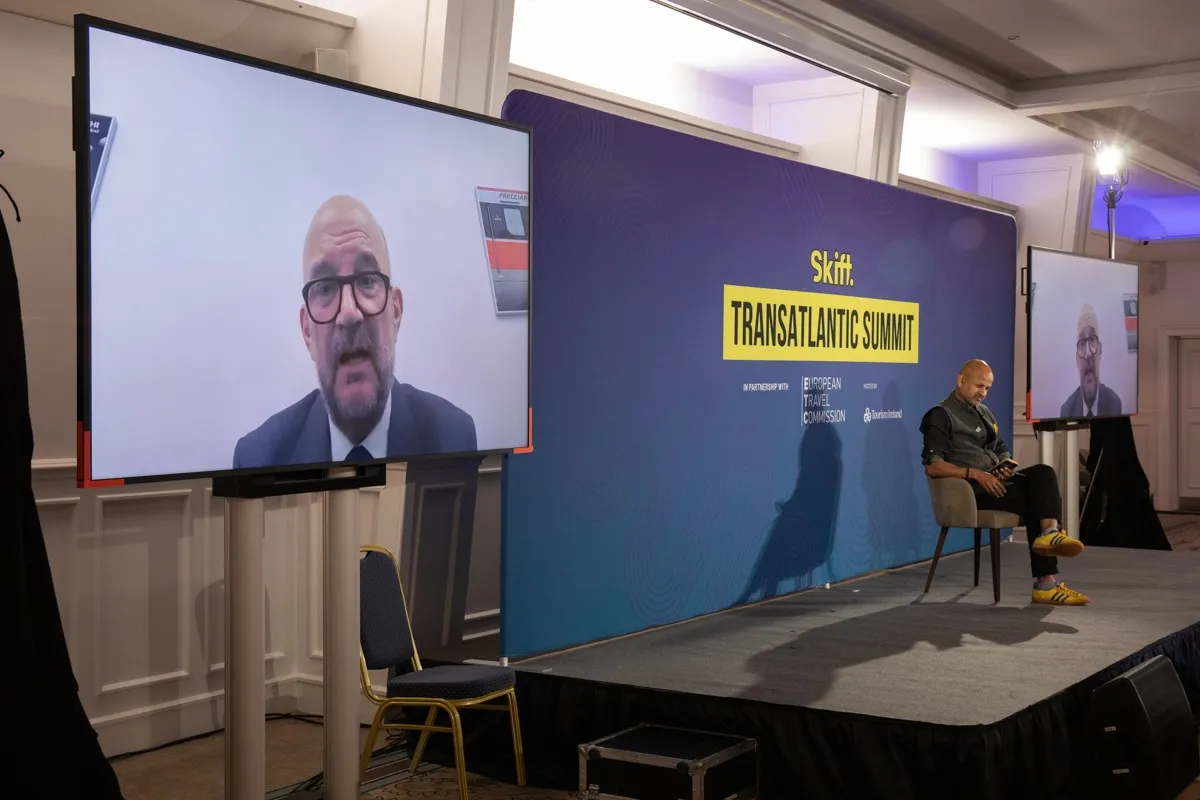
Speaking via video from the Italian offices of train manufacturer Hitachi on October 15, 2026, Certares founder and senior managing director Greg O’Hara delivered a clear message regarding the future of European mobility: private equity is heavily betting on an enforced modal shift from air to rail. Addressing attendees at the Skift Transatlantic Summit in Dublin during a session titled "Where Transatlantic Travel Capital Goes Next," O’Hara outlined an investment thesis driven primarily by looming government regulations and shifting environmental priorities across the European Union and the United Kingdom.
According to O’Hara, Certares has already deployed approximately $2.3 billion into European and UK rail infrastructure and assets. This capital allocation is not merely a hedge against traditional energy costs or carbon pricing mechanisms; it is an active strategic alignment with legislative trends that seek to phase out short-haul commercial aviation where viable high-speed rail alternatives exist. O’Hara pointed directly to France as the template for broader continental policy, noting that regulatory frameworks are increasingly weaponized to restrict short-haul flights in favor of train travel.
Legislative Precedents and the French Model
The intersection of climate policy and commercial transportation has moved from theoretical debate to statute in several parts of Europe. France has served as the vanguard for this movement. Under a controversial and closely watched law implemented in recent years, domestic air travel is legally barred on routes where a direct train journey takes less than two hours and thirty minutes. Although the legislation includes specific carve-outs for connecting flights—ensuring that long-haul international travelers can still access domestic feeders under certain conditions—the core mandate remains absolute for point-to-point domestic itineraries.
This legislative milestone has fundamentally altered the calculus for transport investors. For decades, private equity firms viewed European rail as a heavily state-subsidized, low-margin, and bureaucratic sector largely closed to private capital. However, evolving mandates that penalize or outright ban short-haul aviation have artificially engineered a captive market for rail operators.
"So we like trains because France has passed a law, and other European countries are going to pass a law that if it’s within a certain distance, you can’t fly there anymore," O’Hara stated during his Dublin appearance.
The policy shift in France is widely anticipated to cascade across other Western and Central European nations. Governments in Germany, Austria, and Spain are facing mounting pressure from environmental advocacy groups and legislative coalitions to adopt similar measures. As carbon reduction targets under the European Green Deal grow increasingly stringent, transportation ministries are looking at short-haul aviation as a prime target for emissions reductions. By forcing travelers off regional aircraft and onto high-speed rail networks, European regulators are effectively guaranteeing baseline passenger volumes for private rail operators.
The Certares Strategy: Backing Rail Challengers
O’Hara’s investment strategy leverages this regulatory tailwind by targeting challengers to entrenched national monopolies. During his address, he highlighted a major centerpiece of the firm’s European transport portfolio: the development of a high-speed rail competitor to France’s state-owned operator, SNCF.
"The plan is we own the challenger railway to SNCF in high-speed rail in France," O’Hara explained, emphasizing the firm’s partnership with Italy’s state-owned railway, Ferrovie dello Stato Italiane.
The strategy of backing challenger brands mirrors the liberalization of the European aviation market in the late 1990s and 2000s, which gave rise to low-cost carriers like Ryanair and EasyJet. By introducing private competition into monopolized or state-run rail corridors, investors like Certares aim to modernize rolling stock, improve passenger experience, and capture market share as state-owned networks struggle to meet growing capacity demands.
The involvement of Ferrovie dello Stato Italiane as a partner underscores the cross-border consolidation and expertise sharing that now characterizes European rail liberalization. Following the European Union’s Fourth Railway Package, which officially opened domestic passenger rail markets to competition across member states, foreign operators have increasingly looked to cross borders. Italian operators have already found success running high-speed services in other markets, such as Spain and France, proving that consumer demand exists for alternatives to national flag carriers.
Broader Investment Dynamics and Transatlantic Capital Flows
The Skift Transatlantic Summit panel provided a broader lens on how private equity views the global travel and tourism ecosystem in late 2026. While traditional hospitality, aviation, and tour operations continue to attract substantial capital, infrastructure assets that benefit from structural regulatory shifts have emerged as favored defensive plays for institutional investors.
With $2.3 billion committed to rail, Certares has positioned itself at the intersection of infrastructure investing and consumer travel. This dual identity allows the firm to pitch rail investments not merely as consumer discretionary plays, but as essential infrastructure backed by public policy mandates. As governments legislate against short-haul flights, the downside risk for rail investments diminishes significantly, creating a predictable cash-flow profile that appeals to large institutional limited partners, such as pension funds and sovereign wealth entities.
Furthermore, O’Hara’s commentary touches upon a broader structural transformation in how European citizens move across borders. The European Union’s commitment to achieving climate neutrality by 2050 places an existential squeeze on the aviation sector. With sustainable aviation fuels (SAFs) remaining expensive, supply-constrained, and technologically immature for widespread short-haul deployment, regulatory bans and modal shifts represent the most immediate pathway for governments to meet interim emissions reduction targets.
Industry Reactions and Competitive Implications
The aggressive push by private equity into high-speed rail has not gone unnoticed by traditional aviation stakeholders. Commercial airlines, particularly those reliant on short-haul European feeder networks, have expressed growing concern over the cumulative impact of flight bans, rising airport taxes, and escalating carbon credit costs.
Representatives from legacy carriers have repeatedly argued that blanket bans on short-haul routes can create unintended consequences, including lower overall connectivity for regional economies and increased strain on ground transport networks that may not possess the immediate capacity to absorb displaced air passengers. Moreover, airlines point out that modern narrowbody fleets deployed on short routes are already undergoing continuous efficiency upgrades, and they contend that capital would be better spent accelerating the production of zero-emission aircraft rather than legislating market exits.
Conversely, environmental groups and rail advocacy organizations have hailed the Certares-backed investments as a validation of the modal shift strategy. Groups such as Transport & Environment have long argued that billions in public and private capital must be redirected from aviation to rail networks to build a truly interconnected, continent-wide high-speed transit system. From their perspective, private equity participation brings much-needed operational agility, customer service innovation, and capital depth that can accelerate the expansion of cross-border rail links.
Economic and Strategic Implications for the Future of Mobility
The implications of O’Hara’s disclosures at the Skift Transatlantic Summit extend far beyond corporate balance sheets. They signal a permanent maturation of the European transport landscape, where the traditional boundaries separating aviation, rail, and private equity are increasingly blurred.
As more European nations draft legislation mirroring France’s 2.5-hour flight ban rule, the addressable market for high-speed rail will expand exponentially. Cities that were once economically dependent on regional air links will be forced to integrate into transnational high-speed rail corridors. For private equity firms like Certares, the billions already deployed represent an early-mover advantage in a sector transitioning from public utility to competitive commercial enterprise.
However, challenges remain. Scaling challenger railway operations requires navigating complex cross-border regulatory approvals, securing access to congested railway tracks, and managing interoperability issues between different national signaling systems, such as the European Train Control System (ETCS). Operational hurdles, combined with labor relations in heavily unionized European transport sectors, will test the execution capabilities of private investors.
Nevertheless, the overarching trajectory is clear. Driven by stringent environmental legislation, political pressure, and shifting consumer expectations, the era of unconstrained short-haul flying in Europe is drawing to a close. Capital is following the regulatory tide, and as Greg O’Hara’s remarks in Dublin demonstrated, the future of European regional mobility is being laid out one high-speed track at a time.




 Gabriela Annisa

 Lukman Taruna Persada Ramadan

 Anjar Salim

 Dwi Wanna
