
 Walid Sujud Trenggono
The intersection of modern professional demands, solo parenting, and systemic burnout has increasingly driven individuals to seek radical departures from their daily environments. For one entrepreneur juggling dual business ventures, familial caregiving, and chronic digital connectivity, a poignant intervention by her young son served as the catalyst for an international journey. The resulting expedition to the Kingdom of Bhutan offers a case study in the implementation of Gross National Happiness (GNH), contrasting hyper-capitalist consumer paradigms with a society explicitly engineered around ecological preservation, communal welfare, and psychological equilibrium.
Main Facts and Geographic Context
Nestled in the eastern Himalayas between the geopolitical and economic giants of China and India, Bhutan spans roughly 38,394 square kilometres with a population of approximately 760,000 to 780,000 citizens. Unlike its neighbors, the landlocked kingdom was never colonized, retaining a distinct cultural autonomy that heavily informs its governance model.
Bhutan is distinguished globally by its status as the world’s first carbon-negative country, an achievement codified in its constitution, which mandates that at least 60 percent of the national territory remain under forest cover indefinitely. The country’s urban landscapes deliberately eschew Western commercial markers—such as fast-food franchises, billboards, and traffic lights—in favor of traditional architectural regulations and pedestrian-prioritized streets where speed limits in urban centers rarely exceed 20 kilometers per hour.
Foreign tourism was strictly restricted until 1974, and the introduction of television and the internet did not occur until 1999. Today, tourism is carefully regulated through a Sustainable Development Fee (SDF) levied on international visitors, designed to filter out mass tourism in favor of high-value, low-impact cultural exchange.
Chronology of the Expedition and Immersive Cultural Immersion
The journey commenced with an arrival at Paro International Airport, widely regarded as one of the most challenging aviation descents globally due to its surrounding 5,500-meter peaks and narrow valley approach. Transitioning from the tarmac—where incoming passengers frequently experience a profound sensory pause amidst the high-altitude topography—the itinerary bypassed standard commercial tourist hubs in favor of remote, community-integrated experiences.
Phase one of the immersion involved a multi-hour ascent into the rugged terrain leading to the 12th-century Dodedrak Monastery. Situated far beyond vehicular infrastructure, the monastic site serves as an educational and spiritual institution where burgundy-robed monks preserve ancient scriptural traditions. The nocturnal immersion in evening prayers, underscored by the resonance of acoustic chanting and butter-lamp illumination, provided a visceral introduction to the nation’s spiritual architecture.
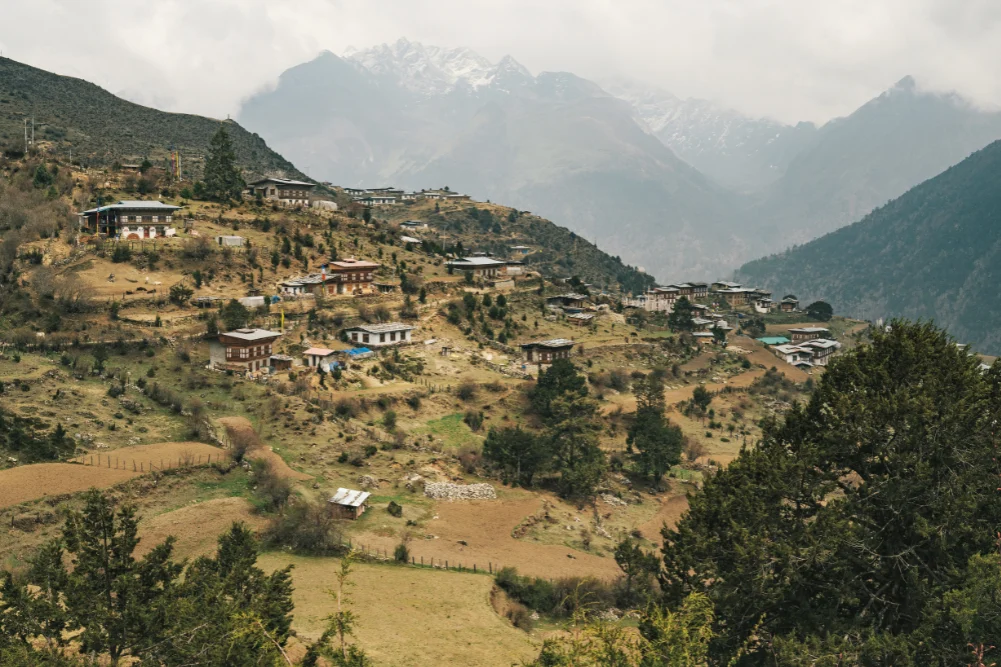
Phase two extended deeper into the Himalayas to Laya, one of the highest permanently inhabited settlements on Earth, positioned at an altitude of approximately 3,800 meters. Accessible exclusively via foot or pack animal, Laya is home to roughly 1,600 indigenous Layap people of Tibetan ancestry. During this segment, the traveler resided within a traditional stone dwelling, participating in local subsistence routines and observing the rare Bumkor Festival, a biennial community gathering centered on agricultural fertility, ancestral continuity, and synchronized communal dance.
The itinerary concluded with a visit to the Gasa hot springs, regionally recognized for their therapeutic properties and historic attribution to 13th-century spiritual figures. Engagement with local citizens, including medical professionals and agrarian workers utilizing the public bathhouses, reinforced the accessibility of wellness infrastructure across socio-economic strata.
Supporting Data and the Philosophy of Gross National Happiness
At the core of Bhutanese governance is the philosophy of Gross National Happiness (GNH), a term coined in 1972 by the fourth King of Bhutan, Jigme Singye Wangchuck. Abandoning purely GDP-driven economic metrics, GNH operates on the premise that spiritual, physical, and psychological well-being are co-equal responsibilities of the state.
The GNH Index evaluates national progress across nine distinct domains:
- Psychological well-being
- Health
- Education
- Time use
- Cultural diversity and resilience
- Good governance
- Community vitality
- Ecological diversity and resilience
- Living standards
Every legislative proposal, infrastructure project, and foreign investment must undergo rigorous scrutiny through the GNH screening tool. If a policy risks compromising cultural preservation, environmental integrity, or community cohesion, it is systematically rejected or revised. According to comprehensive national surveys conducted by the Centre for Bhutan Studies and GNH Research, approximately half of the population reports being either extensively or deeply happy, even amidst infrastructural limitations and developing-nation economic indicators.
Furthermore, public services reflect this philosophical foundation. Healthcare and education are provided universally and free of charge by the state. The societal framework emphasizes a matriarchal inclination toward collective care, where civic responsibility—epitomized by the foundational ethos of community support during construction projects and agricultural cycles—is instilled from early childhood.
Official Perspectives and Anthropological Insights
Local guides and community members articulate a worldview markedly divergent from Western consumerist models. Pema Wangchuk, a local Bhutanese guide, notes the profound psychological alignment between the populace and their environment, describing the high-altitude settlements as spaces where "the earth touches the sky."
Conversations with elder community members, such as local matriarchs hosting travelers in traditional woodfire-heated kitchens, highlight a philosophy of sufficiency. Economic contentment is frequently measured not by asset accumulation or surplus consumption, but by basic security, such as food stability and community safety. Anthropologists studying the region point out that Bhutan’s institutionalized contemplation of mortality—encouraging citizens to reflect on impermanence multiple times daily—serves to reduce existential anxiety rather than foster morbidity, aligning psychological resilience with everyday life.
Broader Socio-Economic Impact and Implications
The global implications of Bhutan’s development model are increasingly relevant as advanced economies grapple with intersecting crises of mental health epidemics, occupational burnout, and ecological degradation. Economists and public health researchers frequently look to Bhutan to evaluate the viability of post-growth economic models.
While Bhutan faces contemporary challenges—including youth emigration driven by employment aspirations, rising national debt, and the transition into a digital global economy—its foundational insistence on balancing technological integration with cultural preservation offers a viable alternative to unbridled industrialization.
For the individual traveler returning from the Himalayan kingdom, the experience underscores a broader sociological reality: sustainable personal wellness cannot be achieved merely through brief recreational respites within high-pressure environments, but requires a fundamental recalibration of one’s relationship with time, community consumption, and psychological expectation. The integration of Bhutanese principles into post-travel daily life demonstrates that systemic societal values can successfully recalibrate individual consciousness, offering a blueprint for navigating modern professional and personal demands with intentionality and presence.




 Gabriela Annisa

 Lukman Taruna Persada Ramadan

 Tatiana Tantri Indah Sari

 Anjar Salim


 Dwi Wanna
