
 Walid Sujud Trenggono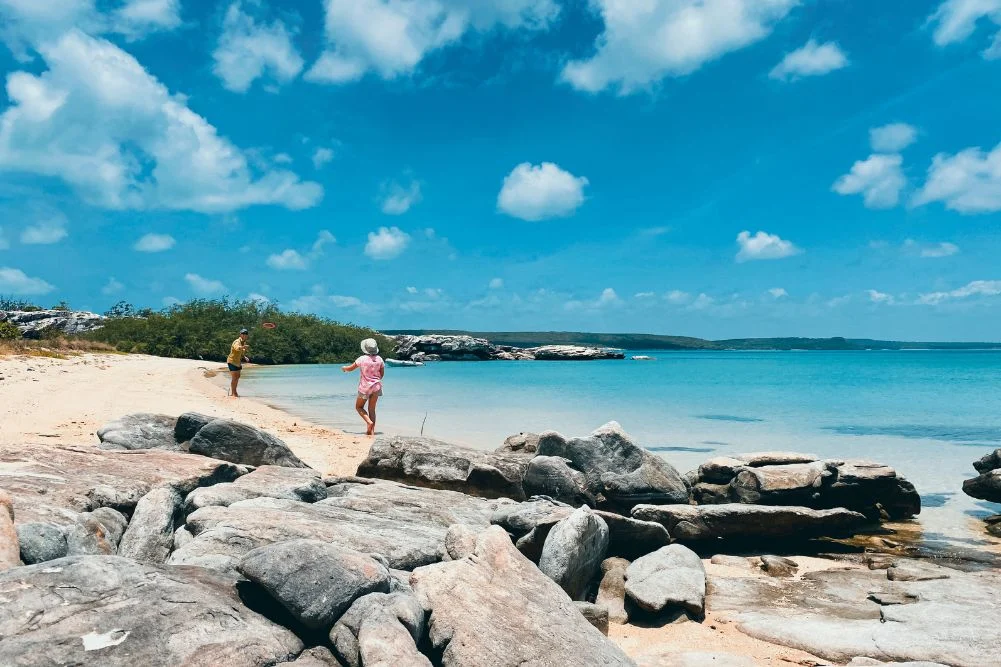
The Gove Peninsula, situated on the northeastern tip of Arnhem Land in Australia’s Northern Territory, serves as a profound intersection of ancient Indigenous culture, pre-colonial international trade, and pristine ecological diversity. While much of the Australian narrative focuses on post-1788 European settlement, the region surrounding Nhulunbuy offers physical and cultural evidence of a much older, globalized history. Through the preservation of stone arrangements at Wurrwurrwuy and the continued vibrancy of the Buku-Larrnggay Mulka Art Centre, the Yolngu people maintain a living record of a time when the Arafura Sea was a bustling highway for commerce and cross-cultural exchange.
The Wurrwurrwuy Stone Arrangements: A Pre-Colonial Archive
Located approximately 38 kilometers southeast of Nhulunbuy at Garanhan (Macassan Beach), the Wurrwurrwuy stone arrangements represent one of Australia’s most significant historical sites. Unlike the petroglyphs or rock paintings found elsewhere in the Northern Territory, these arrangements are "pictorial stone stories" laid out on the ground, meticulously constructed to document the arrival of Makassan seafarers from present-day Sulawesi, Indonesia.
Archaeological evidence and oral histories suggest that these maritime interactions began as early as the mid-1600s. The Makassan voyagers utilized the northwesterly monsoon winds to sail to the Australian coast in search of trepang (sea cucumber), a delicacy highly prized in Chinese markets. The Wurrwurrwuy site, likely finalized by Yolngu elders in the late 19th century to preserve the memory of these visits for future generations, depicts the infrastructure of this industry. Visitors to the site can observe stones arranged in the shapes of perahu (traditional sailing vessels), stone fireplaces used for boiling the sea cucumbers, and intricate fish traps.
This historical period was defined by mutual benefit rather than conquest. In exchange for the right to fish in Yolngu waters, the Makassans traded cloth, tobacco, metal tools, and dugout canoes (known as lipa-lipa). This technological exchange fundamentally altered Yolngu hunting and fishing practices, allowing for more efficient harvesting of dugongs and sea turtles.
Chronology of International Contact on the Gove Peninsula
The history of the Gove Peninsula is marked by specific milestones that highlight its role as a gateway between Australia and the Southeast Asian archipelago:
- Circa 1640: Initial contact between Makassan trepangers and the Yolngu people. This marks the beginning of over two centuries of seasonal maritime trade.
- 1803: English explorer Matthew Flinders, during his circumnavigation of Australia, encounters a Makassan fleet at Cape Wilberforce. He records the presence of Pobassoo, a Makassan captain, who describes the long-standing relationship with the local Indigenous population.
- Late 19th Century: Yolngu elders construct the Wurrwurrwuy stone arrangements to codify the history of the Makassan trade as the era of contact began to wane.
- 1906: The South Australian government (then administering the Northern Territory) imposes heavy duties and restrictive licenses on Makassan traders, effectively ending the centuries-old trade route in favor of white-owned commercial interests.
- 1962-1963: The creation of the Yirrkala Church Panels and the subsequent Bark Petitions, marking a pivotal moment in the Australian Indigenous land rights movement.
- 1988: The Mulka Museum is officially opened by former Prime Minister Gough Whitlam, providing a permanent home for the region’s sacred artifacts.
Cultural Preservation at Buku-Larrnggay Mulka
Nineteen kilometers from the Nhulunbuy town center lies Yirrkala, home to the Buku-Larrnggay Mulka Art Centre. This institution functions as a gallery, museum, and community hub, playing a critical role in the economic and cultural sovereignty of the Yolngu people. The center is renowned for its commitment to traditional techniques, particularly in the realms of bark painting and fiber art.
A central element of the region’s artistic output is the use of gunga (pandanus leaves). Artisans harvest the fresh leaves of the pandanus bush, which are then stripped, dried, and dyed using natural pigments derived from local roots and barks. Historically, these fibers were woven into nganiyal—conical mats used to protect infants from mosquitoes and the sun. Today, these weaving techniques are applied to contemporary baskets and wall hangings, which are sought after by international collectors.
The Yirrkala Church Panels and Political Agency
One of the most significant historical assets housed within the Mulka Museum is the collection of Church Panels. Painted in 1962 by elders from the Yirritja and Dhuwa moieties, these two large masonite panels were originally placed in the local Methodist church. They were designed to assert Yolngu law and ownership of the land at a time when the Australian government was preparing to grant mining leases in the area without Indigenous consent.
The panels served as a precursor to the 1963 Yirrkala Bark Petitions, the first traditional documents prepared by Indigenous Australians to be recognized by the Australian Parliament. Although the panels were at one point discarded during church renovations, they were later recovered and restored, serving as a powerful testament to the use of art as a tool for legal and political resistance.
Ecological Significance and Ecotourism: Bremer Island
Beyond the historical and cultural sites, the Gove Peninsula is a biodiversity hotspot. Bremer Island (Dhambaliya), located just off the coast, exemplifies the region’s commitment to low-impact, Indigenous-led tourism. The Banubanu Beach Retreat, a Yolngu-managed facility, operates entirely off-the-grid, utilizing solar power to minimize its environmental footprint.
The island’s isolation has made it a sanctuary for various species, particularly sea turtles. Four distinct species—Green, Flatback, Hawksbill, and Olive Ridley—utilize the white sand beaches of the peninsula for nesting. Furthermore, the nearby East Bremer Islets have been designated as the Higginson Important Bird Area. This site supports globally significant populations of Bridled Terns, Roseate Terns, and Crested Terns, and serves as the only known breeding colony for Common Noddies in the Northern Territory.
For the Yolngu, the management of these lands is overseen by the Dhimurru Aboriginal Corporation. This organization implements a permit system that regulates visitor access to sensitive areas, ensuring that tourism does not compromise the ecological integrity or the "Songlines" (cultural paths) that crisscross the landscape.
Socio-Economic Impact and Modern Context
Nhulunbuy occupies a unique position in the Northern Territory’s economy. Originally established in the 1970s to service a bauxite mine and alumina refinery, the town has had to navigate the complexities of a "boom and bust" industrial cycle. As mining operations have scaled back, there has been a concerted shift toward diversifying the economy through cultural tourism and sustainable fishing.
The local community markets, held monthly on the shores of the Arafura Sea, serve as a modern-day reflection of the Makassan-era exchanges. These gatherings bring together Indigenous musicians, artisans, and local entrepreneurs, fostering a community spirit that is increasingly reliant on local heritage rather than industrial extraction.
Analysis of Implications for Indigenous Sovereignty
The transition from an extraction-based economy to one rooted in cultural and environmental stewardship has several implications:
- Economic Autonomy: By managing sites like Banubanu and the Buku-Larrnggay Mulka Art Centre, the Yolngu people retain a greater share of the tourism dollar, reducing dependence on government subsidies or mining royalties.
- Cultural Continuity: The formalization of the stone arrangements and the museum allows for the intergenerational transfer of knowledge. As younger Yolngu generations engage with these sites, the "living history" of the Makassan trade remains a part of their contemporary identity.
- Environmental Protection: The Dhimurru permit system provides a template for how Indigenous land councils can manage high-value conservation areas. By limiting visitor numbers and enforcing strict environmental protocols, the region avoids the "over-tourism" seen in other parts of Northern Australia.
Conclusion
The Gove Peninsula stands as a reminder that Australian history is not a singular narrative of British arrival, but a complex tapestry of ancient traditions and early internationalism. The Wurrwurrwuy stone arrangements and the Yirrkala Church Panels are more than just artifacts; they are legal and historical documents that assert the enduring presence of the Yolngu people. For the modern traveler, Nhulunbuy offers a rare opportunity to witness a culture that has successfully navigated the pressures of both pre-colonial trade and modern industry, maintaining its integrity through the power of art, law, and a deep-seated connection to the land and sea.


 Anjar Salim
 Chandra Hamzah
 Tatiana Tantri Indah Sari
 Budi Mulyono

