
 Walid Sujud Trenggono
Penang’s enduring obsession with gastronomy is legendary among locals and regional travelers alike, who frequently structure their daily itineraries around culinary exploration. This cultural fixation becomes immediately apparent upon arrival, often dictating the itinerary from the moment travelers step into a local transport vehicle. For a carload of plant-based travelers navigating the island’s bustling thoroughfares, traditional anxieties surrounding dietary restrictions quickly dissipate. Penang emerges not merely as accommodating to non-meat eaters, but as a thriving vegan wonderland deeply rooted in centuries of Chinese Mahayana Buddhist traditions.
This plant-based culinary landscape, historically referred to as temple food or su zhai, originated as a disciplined dietary regimen for sixth-century monks. Over generations, this compassionate cuisine transitioned from monastic dining halls into the public sphere, embedding itself permanently into the island’s vibrant street-food culture. Today, Penang offers a culinary ecosystem where plant-based diners are not relegated to modified menu items, but rather enjoy unrestricted access to entire culinary offerings.
Historical Context and Cultural Foundations
The flourishing of veganism in Penang is closely tied to the island’s unique multicultural history. As a strategic maritime trading post, Penang absorbed diverse cultural influences, notably British colonial administration and a significant Chinese diaspora, including early communities involved in the regional trade networks of the 19th century. Despite this multicultural tapestry, the island’s Chinese heritage remains exceptionally prominent, manifested visually and socially through neighborhood watering holes, traditional clan associations, and glittering Buddhist-Taoist temples marked by fluttering yellow-and-red-silk flags.
This historical synthesis created an environment of profound religious and cultural tolerance. The culinary traditions brought by early immigrants adapted to local ingredients, utilizing soy, wheat gluten, and specialized mushroom varieties to recreate complex textures and flavors. Notably, traditional Buddhist vegetarian cooking frequently omits the five pungent spices—garlic, onions, shallots, leeks, and chives—which are traditionally believed in certain philosophical frameworks to agitate the mind, thereby emphasizing purity and balance in flavor profiles.
Spiritual Landmarks and Sacred Architecture
At the heart of Georgetown’s historical district stands Kuan Yin Teng, the Temple of the Goddess of Mercy, which serves as both a spiritual anchor and a cultural landmark. Dedicated to Kuan Yin—the most revered Buddhist deity associated with mercy, peace, good fortune, and fertility—the temple represents the architectural and spiritual continuity brought by early settlers. Constructed during the colonial era, Kuan Yin Teng remains an active site of worship where practitioners ignite joss sticks and offer pink lotus candles.
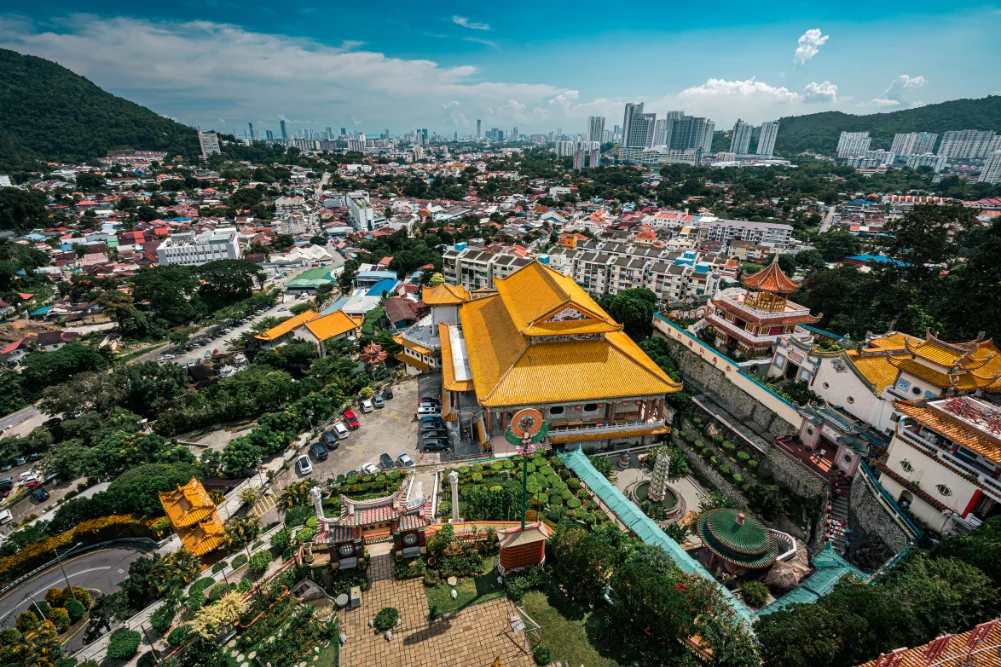
Beyond Georgetown, the island’s spiritual topography reaches its zenith at Kek Lok Si, located in Air Itam. Spanning expansive hillside terrain on Crane Hill, Kek Lok Si is recognized as Malaysia’s largest Buddhist temple complex. Founded in the late 19th century, the complex features a progression of ornate prayer halls, tranquil gardens, a tortoise liberation pond, and the commanding 36.5-m-high bronze statue of Kuan Yin that overlooks the surrounding landscape. The site reflects the monumental architectural contributions of early immigrant clans, who established religious and social institutions to preserve their dialects, customs, and community bonds upon arrival in British Malaya.
Similarly, the Han Jiang Ancestral Temple and the historic waterfront clan jetties—constructed on stilts over the sea from the mid-1800s onward—exemplify the architectural preservation efforts that secured Georgetown’s status as a UNESCO World Heritage site. These structures illustrate how early immigrant communities organized their living, working, and spiritual lives, creating enduring community frameworks that persist into the 21st century.
The Evolution of Modern Plant-Based Gastronomy
The commercial manifestation of Penang’s monastic food heritage is visible throughout Georgetown, where unpretentious eateries and hawker stalls offer sophisticated mock-meat preparations. Establishments such as Ee Beng Vegetarian Food on Lebuh Dickens and Purple Stone Vegetarian near the base of Kek Lok Si exemplify the accessible, self-service nature of local vegan dining. These venues present extensive arrays of dishes utilizing soy and wheat gluten to meticulously replicate traditional Chinese, Malay, and Nyonya flavors.
Culinary offerings include salt-and-pepper tofu, peanut satay sticks, mock duck, vegan prawn chow mein, and minced mushroom mapo tofu, alongside regional adaptations such as Nyonya Malay curry rendang, Chinese barbecued mock-pork, and vegan Mongolian lamb. Specialized techniques yield convincing culinary illusions, including crispy-skin mock-fish featuring textures that mimic flaky flesh and visual scales.
Furthermore, the island’s street-food sector accommodates diverse dietary preferences without compromising authenticity. Notable institutions like the Penang Famous Samosa stall on Queen Street—recognized in international culinary guides such as the Michelin Guide—demonstrate the high caliber of accessible, affordable vegetarian street fare available across the city. Operating from a modest sidewalk setup, the stall offers deep-fried specialties including samosas, pakodas, onion bhajis, and vadai at nominal prices, reflecting the egalitarian nature of Penang’s food culture.
Economic and Tourism Implications
The integration of heritage tourism and specialized gastronomy has positioned Penang as a premier destination for culinary tourists seeking sustainable and ethical travel experiences. Industry data indicates a rising global demand for plant-based tourism options, with travelers increasingly prioritizing destinations that seamlessly incorporate dietary inclusivity into their broader cultural offerings. Penang’s unique positioning—bridging historical preservation, religious heritage, and advanced vegan culinary arts—offers a resilient model for cultural tourism development.
Urban regeneration projects, exemplified by spaces like the Hin Bus Depot Markets, further illustrate how Penang blends historical appreciation with contemporary creative economies. Hosting weekend markets featuring organic beverages, vegan baked goods, and sustainably produced handicrafts, these modern hubs complement the traditional hawker centers and clan temples, ensuring that the island’s heritage appeals to contemporary domestic and international visitors.
Strategic Logistics and Accommodations
For travelers planning an extended stay, Penang is accessible via international flight connections through Kuala Lumpur International Airport, with regional carriers offering frequent services to Penang International Airport. While the regional climate remains tropical, warm, and humid throughout the year, meteorological patterns indicate optimal weather conditions between December and February, characterized by lower precipitation levels and moderate temperatures.
Accommodation options within Georgetown reflect the island’s architectural heritage and modernization efforts. Notable properties include Cheong Fatt Tze’s The Blue Mansion, a meticulously restored 19th-century Hakka-style courtyard mansion offering boutique lodging; the Olive Tree Hotel, situated near the airport with a focus on high-rise urban views and environmental sustainability credentials; and The Edison George Town, a restored colonial-era mansion providing historical ambiance alongside modern hospitality amenities.
Through its harmonious blend of ancient spiritual traditions, architectural preservation, and an inclusive culinary philosophy, Penang continues to serve as a significant cultural crossroads in Southeast Asia, demonstrating that historical legacy and modern dietary evolution can coexist to enrich the global travel experience.




 Gabriela Annisa

 Lukman Taruna Persada Ramadan

 Tatiana Tantri Indah Sari

 Anjar Salim


 Dwi Wanna
