
 Tatiana Tantri Indah Sari
The global travel industry is currently undergoing a profound technological transformation, driven by the rapid ascent of agentic booking systems that promise to fundamentally alter how consumers research, plan, and purchase travel itineraries. With innovative platforms such as Instinct and Muse recently entering the market and consumer adoption rates accelerating at an unprecedented pace, industry conversations are dominated by the implications of autonomous artificial intelligence. Yet, despite the pervasive discourse and substantial capital being deployed into artificial intelligence initiatives, a stark reality remains: the vast majority of traditional travel organizations are ill-prepared for the operational and structural shifts required to thrive in an agent-driven ecosystem.
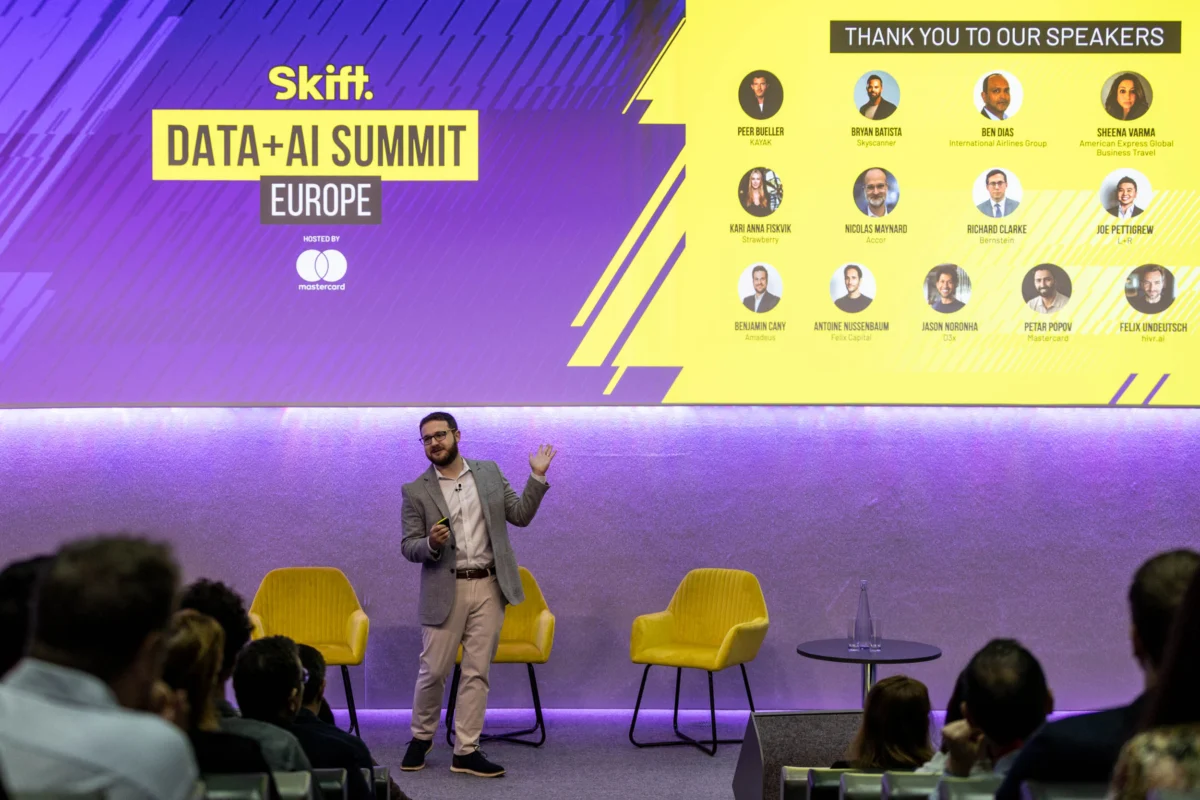
This urgent disconnect was a central theme at the recent Skift Data + AI Summit Europe, held in London on October 6, 2026. During the high-profile gathering, Seth Borko, Skift’s Head of Research, delivered a sobering assessment of the current landscape. Addressing a room of international travel executives, technology vendors, and industry strategists, Borko succinctly captured the tension of the moment, stating, “The agents are here. Almost no one [in travel] is ready for this world.”
The summit focused heavily on five critical decisions facing travel executives today. These strategic choices govern how corporations approach artificial intelligence investment, technological exploration, and commercial execution. While agentic AI bookings currently represent a small fraction of overall global travel transactions, the velocity of innovation emanating from leading AI laboratories far outpaces the traditional deployment cycles of legacy travel infrastructure. As automated systems evolve from simple conversational chatbots into fully autonomous transactional agents capable of executing complex multi-step bookings, the entire architecture of online travel agencies, hotel booking engines, and airline distribution channels faces an existential stress test.
The Evolution of Artificial Intelligence in Travel
To understand the current disruption caused by agentic booking, it is necessary to examine the rapid evolutionary trajectory of artificial intelligence within the travel sector over the past decade. The integration of digital automation into travel began decades ago with the establishment of Global Distribution Systems (GDS) in the 1960s and 70s, which transitioned manual reservation processes into electronic databases. Decades later, the advent of online travel agencies (OTAs) such as Expedia and Booking.com democratized inventory access for consumers, shifting the power dynamic from human travel agents to self-service digital platforms.
The modern generative artificial intelligence wave officially commenced in late 2022 with the widespread public release of foundational large language models. Initially, travel companies rushed to deploy basic conversational interfaces. These first-generation tools primarily functioned as enhanced search bars, allowing users to type natural language queries like, "Find me a family-friendly hotel in Rome under $200 a night." While these interfaces improved the user experience by reducing the friction of traditional faceted search filters, they still required the human user to manually review options, compare prices, navigate third-party checkout pages, and finalize transactions step-by-step.
Agentic AI represents a quantum leap beyond these early iterations. Unlike traditional generative tools that merely generate text or surface recommendations, agentic systems possess autonomy, memory, and the capacity for goal-directed execution. An agentic booking tool does not just suggest a flight and a hotel; it is authorized by the consumer to independently execute tasks across multiple fragmented platforms. If a flight is delayed, an agentic system can proactively scour alternative carriers, rebook the ticket, secure a comparable hotel room, and update the traveler’s digital calendar without requiring direct human intervention at every micro-decision point.
Platforms like Instinct and Muse are pioneering this capability by integrating directly with Application Programming Interfaces (APIs) across airlines, hotels, car rental providers, and payment processors. By leveraging persistent user profiles and deep contextual understanding, these autonomous agents can negotiate, optimize, and finalize entire journeys based on broad directives provided by the traveler.
The Skift Data + AI Summit Europe: Key Findings and Strategic Dilemmas
The urgency surrounding this technological shift reached a crescendo at the Skift Data + AI Summit Europe in London. Bringing together hundreds of executives from airlines, hospitality brands, tour operators, and travel technology providers, the event served as a reality check for an industry that has historically been slow to modernize its foundational software stacks.
The core framework of the summit centered on "Five Decisions" that executive leadership teams must make immediately to secure their market share in an agent-dominated future. These decisions address the allocation of research and development budgets, the restructuring of data pipelines, the management of brand visibility within autonomous agent recommendations, the ethical considerations of automated decision-making, and the restructuring of enterprise workforces.
Industry analysts at the summit presented proprietary data illustrating the widening gap between consumer readiness and corporate execution. According to preliminary consumer sentiment surveys discussed at the event, more than 42 percent of frequent travelers expressed a willingness to delegate routine travel booking tasks to an autonomous AI agent by the end of 2027. Conversely, internal audits of major travel brands reveal that fewer than 15 percent of legacy operators possess the modernized backend architecture required to interface seamlessly with third-party agentic protocols.
This disparity stems primarily from the architectural debt plaguing the travel sector. Most legacy booking engines rely on decades-old monolithic software systems that were never designed to communicate efficiently with external autonomous agents. While AI labs in Silicon Valley and across Europe are iterating at a blistering pace—deploying model updates on a weekly or daily basis—traditional travel enterprises often operate on multi-month software release cycles. This velocity mismatch creates a profound strategic vulnerability.
Supporting Data and Market Dynamics
The economic stakes of this transition are immense. Global travel expenditures surpassed pre-pandemic levels, reaching historic highs across both leisure and corporate sectors. Concurrently, venture capital investment in travel technology startups focused on artificial intelligence and automation has surged dramatically.
Market research data indicates that investment in travel-specific artificial intelligence applications grew by over 65 percent year-over-year leading into 2026. Despite this influx of capital, a significant portion of incumbent spending remains defensive. Many legacy hospitality and airline brands are allocating budgets toward superficial customer service bots rather than deep structural API modernization that would allow agentic systems to query and book inventory directly.
Furthermore, the economics of customer acquisition are poised for a radical inversion. For the past twenty years, travel brands have spent tens of billions of dollars on search engine optimization (SEO) and paid search advertising to capture human eyeballs on Google and other discovery platforms. In an agentic booking world, the primary consumer of travel content is no longer a human shopper browsing colorful web pages, but an autonomous software agent optimizing for price, convenience, and specific user preferences. If an AI agent executes a booking autonomously, traditional display advertising, banner ads, and glossy destination imagery lose their persuasive power. Instead, brands must compete on machine-readable attributes: transparent pricing, frictionless API connectivity, flexible cancellation policies, and rich structured data feeds.
Industry Reactions and Official Responses
Reactions from across the travel distribution ecosystem reflect a mixture of acute anxiety and cautious experimentation. Major online travel agencies and global hospitality groups have publicly acknowledged the rise of agentic commerce, though their strategic postures vary significantly.
Executives from leading hotel conglomerates have emphasized the necessity of protecting direct-booking relationships with loyal customers. Speaking on condition of anonymity due to ongoing corporate strategy formulations, a senior distribution strategist for a major international hotel chain noted, "If autonomous agents intermediate the relationship between our brand and our guests, we risk becoming an invisible commodity utility. Our primary challenge right now is ensuring that our loyalty perks, property-specific amenities, and unique value propositions are accurately parsed and valued by external AI models."
Conversely, technology-forward startups and emerging intermediaries view agentic booking as the ultimate leveling mechanism. Founders of platforms like Instinct argue that traditional booking websites have become cluttered, confusing, and hostile to genuine user convenience. By streamlining the transaction funnel into a clean, conversational, and hyper-personalized agentic interface, these new market entrants aim to capture significant share from established incumbents who are bogged down by legacy technical debt.
Airlines, meanwhile, are closely monitoring the regulatory and commercial implications of automated ticketing. Industry bodies are currently debating standardized protocols to govern how AI agents access Global Distribution Systems, manage fare classes, and handle dynamic pricing algorithms without triggering systemic market disruptions or fraudulent automated scraping activities.
Broader Impact and Implications for the Future of Travel
The maturation of agentic booking carries far-reaching implications that extend well beyond software architecture and marketing budgets. The societal and economic ramifications of this shift will touch every corner of the global tourism economy.
First, the role of human travel advisors and corporate travel managers is undergoing a fundamental redefinition. Rather than spending valuable time on transactional tasks such as checking flight availability, matching hotel dates, and processing invoice payments—activities that autonomous agents can execute in milliseconds—human professionals are increasingly shifting toward high-value experiential curation, crisis management, and complex itinerary planning for luxury or group travel. The mechanical work of booking is being automated, elevating the importance of human empathy, strategic counsel, and localized expertise.
Second, consumer trust and liability frameworks will face unprecedented legal scrutiny. When an AI agent autonomously books a complex, multi-city international journey on behalf of a user, questions of accountability inevitably arise. If an algorithmic miscalculation results in a missed connection, an invalid visa requirement, or a non-refundable financial loss, determining liability among the consumer, the AI developer, the distribution platform, and the travel supplier remains a complex legal gray area. Regulatory bodies in the European Union and the United States are beginning to examine the parameters of automated commercial transactions, signaling that stricter compliance standards may soon govern AI-driven commerce.
Finally, the competitive landscape of the travel industry is bracing for a wave of consolidation. Companies that successfully bridge the technological divide—modernizing their data infrastructure, opening robust APIs for agentic integration, and adapting their value propositions for machine-driven discovery—stand to capture extraordinary market dominance. Conversely, organizations that fail to adapt risk finding themselves locked out of the primary distribution channels of the near future, reduced to invisible background suppliers dependent on aggregators they cannot control.
As the insights from the Skift Data + AI Summit Europe underscore, the future of travel is no longer a distant theoretical concept; it is an operational reality unfolding in real-time. The agents have arrived, and the travel industry’s race to catch up has officially begun.




 Gabriela Annisa

 Lukman Taruna Persada Ramadan

 Anjar Salim

 Dwi Wanna
