
 Diana Nuri Rohmawati
The landscape of international travel has undergone a radical transformation over the last decade, transitioning from a reliance on physical maps and printed itineraries to a digital-first ecosystem where real-time connectivity is no longer a luxury but a fundamental necessity. In the early era of mobile telephony, travelers were often forced to choose between exorbitant roaming fees from their domestic providers or the logistical hurdle of procuring local physical SIM cards. Today, the emergence of the eSIM—an embedded, digital version of the traditional Subscriber Identity Module—has streamlined this process, with companies like Holafly leading a market shift toward unlimited data and simplified user experiences. This transition represents a significant milestone in the telecommunications sector, reflecting broader trends in digital nomadism, remote work, and the globalization of mobile network infrastructure.
The Historical Context of Mobile Connectivity for Travelers
To understand the impact of modern eSIM providers, it is essential to trace the chronology of mobile connectivity. The traditional SIM card, first developed in 1991 by Munich smart card maker Giesecke & Devrient, was originally the size of a credit card. Over the subsequent three decades, the hardware shrunk through the mini-SIM, micro-SIM, and nano-SIM formats. Despite the reduction in size, the core problem for travelers remained: the physical swap. This required a specialized tool to open a SIM tray and the careful handling of a tiny plastic chip, often in a crowded airport or foreign transit hub.
The introduction of eSIM technology, standardized by the GSMA (the global organization representing mobile operators), removed the need for a physical slot. An eSIM is a small chip built directly into the device’s motherboard that can be programmed with different profiles. This innovation paved the way for companies like Holafly to offer instant, downloadable connectivity. Founded in 2017 in Spain and currently headquartered in Dublin, Ireland, Holafly was established to address the friction points of international roaming. By leveraging partnerships with local carriers across more than 200 destinations, the company has positioned itself as a primary alternative to traditional carrier roaming packages.

Technical Infrastructure and the Holafly Service Model
Holafly operates as a Mobile Virtual Network Operator (MVNO) aggregator. Unlike traditional carriers that own physical cell towers, Holafly secures wholesale agreements with major local telecommunications providers—such as Movistar in Spain, T-Mobile in the United States, or Orange in France—to provide its users with high-speed 4G and 5G data. This model allows the company to offer extensive coverage that spans North America, Latin America, Europe, and Asia.
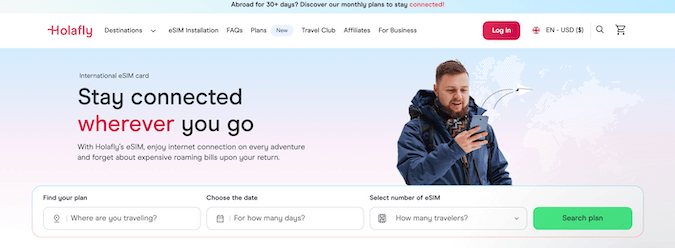
A defining characteristic of Holafly’s market strategy is its focus on unlimited data plans. While many competitors in the eSIM space sell data in fixed increments (e.g., 1GB, 3GB, or 5GB), Holafly’s primary offering revolves around time-based access. Travelers can select plans ranging from a single day to 90 days, providing a level of predictability that is particularly appealing to heavy data users, such as digital nomads, business travelers, and content creators. According to industry analysis, the demand for unlimited data is driven by the increasing data-intensity of modern travel apps; navigation via Google Maps, real-time language translation, and high-definition video calls for remote work can quickly exhaust limited data bundles.
Setup Procedures and Hardware Compatibility
The transition to eSIM requires specific hardware compatibility. Most flagship smartphones released after 2018, including the iPhone XS and later models, the Google Pixel 3 series and onwards, and the Samsung Galaxy S20 series, support eSIM technology. Before utilizing a service like Holafly, a device must also be "unlocked," meaning it is not restricted to a specific domestic carrier’s network.
The installation process for a Holafly eSIM is designed to be completed in a matter of minutes, often before the traveler departs their home country. Upon purchase, the user receives a digital package via email containing a QR code and activation instructions. The setup involves three primary methods:

- QR Code Activation: The most common method, where the user scans a code using their phone’s camera within the cellular settings menu.
- In-App Installation: A streamlined process through the Holafly mobile application that automates the profile download.
- Manual Entry: A fallback method where the user enters the SM-DP+ Address and Activation Code provided in the confirmation email.
On iOS devices, the path is typically Settings > Cellular > Add eSIM. On Android, the path is generally Settings > Network & Internet > SIMs > Add eSIM. A critical final step for the user occurs upon arrival in the destination country: enabling "Data Roaming" for the specific Holafly line while ensuring the primary domestic line’s data is disabled to avoid accidental charges from the home carrier.
Strategic Benefits and Operational Features
One of the primary advantages of the eSIM model is the ability to maintain "Dual SIM" functionality. Because the Holafly eSIM is a digital profile, the physical SIM slot remains free, or the primary domestic eSIM can remain active for voice calls and SMS. This allows travelers to keep their original phone number active for two-factor authentication (2FA) and messaging apps like WhatsApp or iMessage, which are often tied to a specific phone number, while using the Holafly eSIM for all data-heavy tasks.
Beyond data provision, Holafly has expanded its service suite to include:
- 24/7 Multilingual Support: Essential for troubleshooting connectivity issues across different time zones.
- Hotspot Capabilities: Allowing users to share their data connection with laptops or tablets, though this feature may be subject to fair usage policies depending on the specific regional plan.
- Regional and Global Plans: Offering a single eSIM that covers multiple countries, such as a "Europe" plan that functions across 30+ nations, eliminating the need to change settings when crossing borders.
- Refund Policies: A flexible six-month refund window, which is significantly more generous than the industry standard, reflecting a commitment to consumer confidence.
Economic Implications and the Future of the Roaming Market
The growth of companies like Holafly has significant implications for the global telecommunications market. Traditionally, international roaming was a high-margin revenue stream for domestic carriers. However, the transparency and ease of the eSIM market are forcing these traditional players to reconsider their pricing structures.
Market research suggests that the global eSIM market is expected to reach a valuation of approximately $16.3 billion by 2027, growing at a compound annual growth rate (CAGR) of nearly 15%. This growth is fueled not only by individual travelers but also by the Internet of Things (IoT) and the automotive industry. For the travel sector specifically, the shift toward eSIMs reduces plastic waste, as millions of physical SIM cards and their credit-card-sized plastic holders are no longer produced and discarded annually.
Furthermore, the "China factor" highlights the necessity of reliable data. In many East Asian markets, the economy is almost entirely cashless, with payments for everything from street food to public transit requiring apps like Alipay or WeChat Pay. Without a constant data connection, a traveler in these regions is functionally unable to participate in the local economy. Holafly’s ability to provide immediate access upon landing addresses this critical logistical barrier.
Broader Impact on the Travel Experience
The move toward digital SIM solutions like Holafly represents the final piece of the "paperless travel" puzzle. When combined with digital passports, mobile boarding passes, and app-based hotel check-ins, the eSIM completes a seamless digital journey. The convenience of being connected the moment the aircraft wheels touch the tarmac cannot be overstated; it allows for immediate ride-sharing bookings, navigation to accommodations, and communication with family without searching for airport Wi-Fi, which is often unreliable or unsecure.
In conclusion, Holafly’s rise within the telecommunications space is a testament to the market’s demand for simplicity and reliability. By prioritizing unlimited data and ease of installation, they have addressed the primary pain points of the modern traveler. As 5G networks continue to expand globally and more budget-friendly smartphones adopt eSIM technology, the physical SIM card is likely destined for obsolescence, replaced by the invisible, efficient, and instantaneous connectivity of the digital era. For travelers, this shift means less time spent managing logistics and more time engaging with the destinations they visit, backed by the security of a constant connection to the global digital grid.




 Anjar Salim
 Chandra Hamzah
 Tatiana Tantri Indah Sari
 Budi Mulyono
 Lukman Taruna Persada Ramadan
