
 Budi Mulyono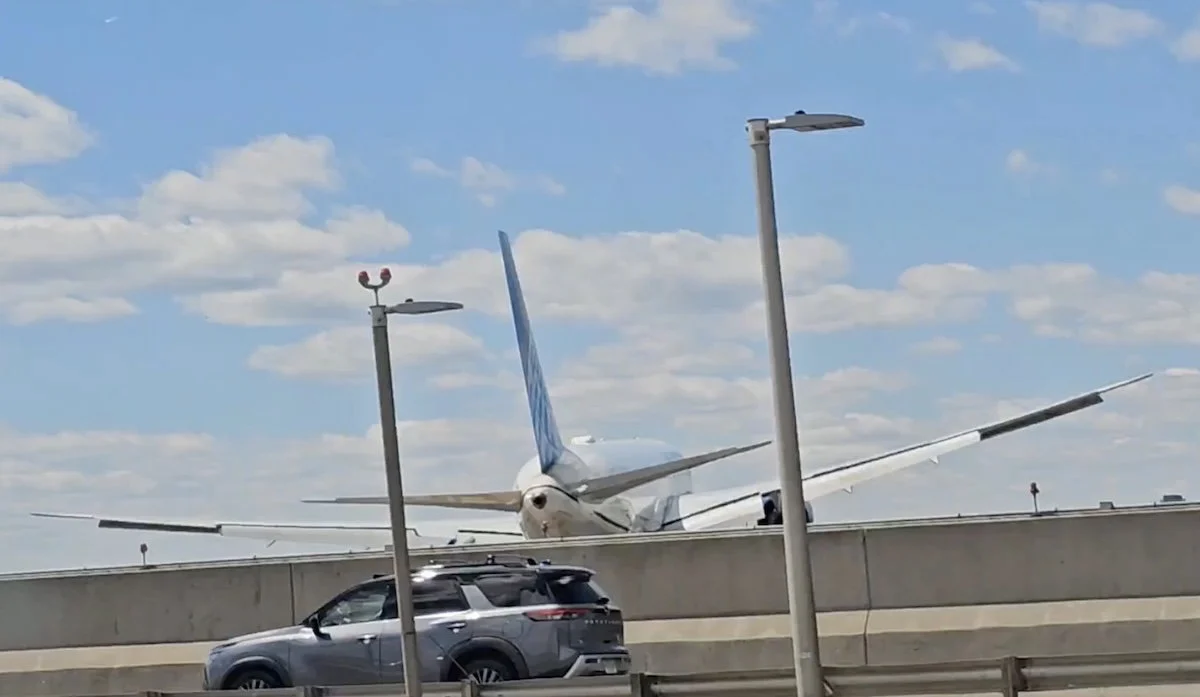
In a highly unusual and dangerous aviation occurrence, a United Airlines wide-body aircraft struck infrastructure and a commercial vehicle on a major interstate highway while attempting to land at Newark Liberty International Airport (EWR) on Sunday afternoon. The incident, which occurred on May 3, 2026, involved United Flight UA169, an international service originating from Venice Marco Polo Airport (VCE) in Italy. Despite the mid-air collision with objects on the ground, the aircraft, a Boeing 767-400ER, managed to touch down on the runway and taxi to the gate under its own power. While the aircraft sustained damage and a ground vehicle was struck, early reports indicate that no fatalities or serious injuries occurred among the 231 individuals on board or the motorists on the New Jersey Turnpike.
Detailed Chronology of Flight UA169
United Airlines Flight 169 is a regularly scheduled long-haul service connecting Venice with United’s primary transatlantic hub in Newark. On the day of the incident, the flight was operated by a Boeing 767-400ER with the registration N77066. The aircraft, which has been in service for approximately 23 years, is a staple of United’s international fleet, known for its reliability on medium-to-long-range routes. The flight departed Venice on schedule and proceeded across the Atlantic without any reported mechanical issues or emergency declarations.
The flight carried 221 passengers and a crew of 10, including three pilots, as is standard for transatlantic operations of this duration. After approximately eight hours and thirty minutes of flight time, the aircraft began its descent into the New York metropolitan area. Air traffic control (ATC) directed the flight to Newark’s Runway 29 for landing.
At approximately 1:50 PM local time, as the aircraft transitioned from its final approach path toward the runway threshold, it descended below the established glide slope. The approach to Runway 29 at Newark is known for its proximity to the New Jersey Turnpike, a major North American artery. As the aircraft crossed the perimeter of the airport, its landing gear and lower fuselage came into contact with at least one light pole situated along the highway. Furthermore, the aircraft’s landing gear struck a commercial delivery truck—specifically a bakery truck owned by Schmidt Bakery—traveling northbound on the Turnpike.
Impact Analysis and Ground Damage
Witness accounts and video evidence captured by motorists provide a harrowing view of the moments leading up to the impact. Footage from one vehicle shows the massive Boeing 767-400ER appearing significantly lower than the standard 3-degree glide path. The sound of the aircraft’s engines and the proximity of the airframe caused immediate alarm among drivers, with audio from the recordings capturing the shock and disbelief of those on the ground.
The most significant ground impact involved a Schmidt Bakery truck. According to Chuck Paterakis, Senior Vice President of the bakery’s parent company, the truck was hauling products toward Newark when the aircraft’s wheel assembly reportedly struck the driver’s side of the vehicle. The impact was concentrated near the driver’s window and the upper portion of the cab. Despite the violent nature of the collision and the massive weight of the aircraft, the driver was not seriously injured, a fact described by witnesses as a miraculous escape.
In addition to the vehicle strike, the aircraft severed or damaged light poles owned by the New Jersey Turnpike Authority. These poles, which stand several dozen feet high, were sheared by the aircraft’s landing gear or wing components. The debris from these impacts fell onto the roadway, creating additional hazards for Sunday afternoon traffic, though no secondary accidents were reported in the immediate aftermath.
Aircraft Condition and Post-Landing Procedures
Despite the impact with the light poles and the truck, the flight crew maintained control of the Boeing 767. The aircraft successfully touched down on Runway 29. Following the landing, the pilots taxied the aircraft to its assigned gate at Terminal C, where passengers were deplaned normally. It was only after the aircraft was stationary that the full extent of the damage began to be realized by the airline’s ground staff and maintenance crews.
United Airlines initially released a conservative statement, acknowledging only that the aircraft had "come into contact with a light pole" during its arrival. However, as social media footage and reports from the New Jersey State Police surfaced, the airline was forced to acknowledge the broader scope of the incident. The aircraft, N77066, has been removed from service indefinitely. Maintenance teams and structural engineers are currently conducting a comprehensive "heavy maintenance" inspection to determine the integrity of the landing gear, the lower fuselage, and the wing flaps.
Technical Context: The Challenges of Newark’s Runway 29
The incident has brought renewed scrutiny to the operational layout of Newark Liberty International Airport, specifically Runway 29. While Newark’s primary north-south runways (4L/22R and 4R/22L) are significantly longer and provide more ample clearance, Runway 29 is often used to manage traffic flow or during specific wind conditions.
Runway 29 measures 6,725 feet in length. While sufficient for a Boeing 767, it is considered relatively short for a wide-body aircraft arriving after a long-haul flight. This creates a psychological and operational pressure on pilots to "plant" the aircraft as close to the runway threshold as possible to ensure maximum braking distance. However, the threshold of Runway 29 is located just a few hundred feet from the New Jersey Turnpike.
The proximity of the highway means that the "Obstacle Free Zone" (OFZ) and the "Approach Lighting System" (ALS) are tightly integrated with public infrastructure. Any deviation below the glide path—even by a matter of twenty or thirty feet—places the aircraft in the immediate vicinity of high-profile vehicles like tractor-trailers and utility poles.
Regulatory Investigation and Safety Oversight
The Federal Aviation Administration (FAA) and the National Transportation Safety Board (NTSB) have launched a formal investigation into Flight UA169. Investigators will focus on several critical factors:
- Flight Data Recorder (FDR) Analysis: Data will be scrutinized to determine the aircraft’s exact altitude, airspeed, and rate of descent during the final two miles of the approach.
- Pilot Performance: The investigation will look at the crew’s experience levels, fatigue factors (given the 8.5-hour duration of the flight), and whether the approach was being flown manually or via the autopilot’s ILS (Instrument Landing System) coupling.
- Environmental Factors: While weather at the time was reported as clear, investigators will check for localized wind shear or "microburst" activity that could have forced the aircraft downward.
- Mechanical Integrity: Although no issues were reported mid-flight, a post-incident teardown will confirm if there were any undiagnosed issues with the aircraft’s altimeters or flight control surfaces.
This incident follows a period of increased scrutiny for United Airlines. In early 2024, the FAA initiated a formal increase in oversight of the carrier following a string of unrelated safety occurrences, including a wheel loss in San Francisco and a runway excursion in Houston. While a subsequent FAA audit concluded in late 2024 did not find "systemic" failures in United’s safety management system, this latest event at Newark will likely reignite discussions regarding pilot training and approach stabilization protocols.
Historical Precedents and Industry Implications
While striking a vehicle on a highway is an exceedingly rare event for a commercial airliner, it is not without precedent in aviation history. Similar incidents have occurred at airports where runways are adjacent to public roads, such as the 1940s-era layout of Chicago Midway or certain airports in the Caribbean. However, for a Tier-1 international hub like Newark, the event is considered a "near-catastrophic" safety breach.
The aviation industry may face calls to reassess the "Declared Distances" and threshold displacements for Runway 29. If the FAA determines that the margin for error is too slim for wide-body aircraft like the Boeing 767 or 777, they may implement restrictions on which aircraft types are permitted to use that specific runway for arrivals.
Furthermore, the New Jersey Turnpike Authority may be prompted to review the height and placement of light poles in the "Runway Protection Zone" (RPZ). In some jurisdictions, infrastructure near airports is required to be "frangible" (designed to break away upon impact) or submerged/lowered to prevent the type of structural damage seen in this incident.
Conclusion and Current Status
As of Sunday evening, United Airlines has redirected its focus toward cooperating with federal investigators and providing support to the affected ground parties. The driver of the Schmidt Bakery truck, though physically unharmed, is reportedly being monitored for shock. The 221 passengers of UA169 have been processed through customs, though many have expressed lingering trauma after realizing how close the aircraft came to a major disaster.
The investigation is expected to take several months to reach a final conclusion. In the interim, the FAA may issue a "Notice to Air Missions" (NOTAM) adjusting the minimum altitudes for the approach to Runway 29 at Newark to ensure a greater buffer between arriving aircraft and the thousands of vehicles that traverse the New Jersey Turnpike every hour. This incident serves as a stark reminder of the narrow margins in modern aviation and the complexities of managing high-density air traffic in urban environments where infrastructure and flight paths intersect.




 Anjar Salim
 Chandra Hamzah
 Tatiana Tantri Indah Sari
 Lukman Taruna Persada Ramadan