Anjar Salim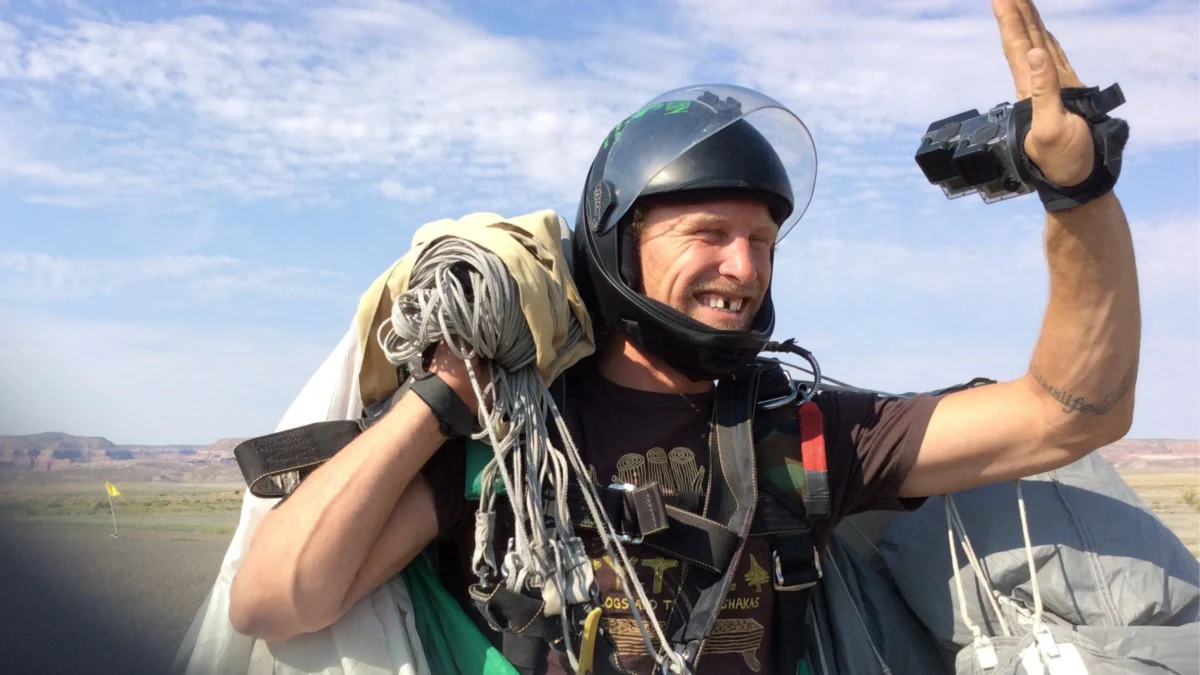
The global extreme sports community is mourning the loss of one of its most prolific and influential figures following a fatal BASE jumping accident in the rugged canyonlands of Moab, Utah. On Sunday, June 14, 2026, Andrew Lewis, widely known by his moniker “Sketchy Andy,” was killed during a tandem jump at a site known as Mary’s Gash in the Mineral Bottoms area. Lewis, 39, was accompanied by 68-year-old Danny Joe Kregle of Arizona, who also perished in the incident.
The Grand County Sheriff’s Office (GCSO) confirmed the fatalities via a formal statement, noting that the accident occurred during a commercial or guided tandem jump. Lewis, a world-renowned professional athlete and the founder of BASE Jump Moab, was acting as the tandem master, with Kregle secured to his harness. Initial reports indicate that the pair encountered a catastrophic equipment or deployment failure shortly after leaping from a 280-foot cliff. Despite the rapid response of local emergency services, both men were pronounced dead at the scene.
Chronology of the Incident
The events of June 14 began early in the morning, a typical timeframe for BASE jumpers seeking calm winds and lower temperatures in the Utah desert. According to witnesses and associates, Lewis and Kregle arrived at the Mineral Bottoms area, a remote section of Grand County characterized by sheer sandstone cliffs and limited accessibility.
At approximately 8:00 A.M., the pair initiated their jump from Mary’s Gash. The site, while popular among experienced jumpers, offers a relatively low altitude for a tandem configuration, providing a narrow window for parachute deployment and stabilization. Eyewitness accounts, including those from Lewis’s close friend Brent Cain—a trained EMT and firefighter who was on-site to assist with the day’s operations—suggest that the parachute failed to fully inflate or "cleanly" deploy following the exit.
The impact occurred within seconds of the leap. Due to the remote nature of the Mineral Bottoms, there was no cellular service available at the landing zone or the cliff top. Recognizing the severity of the situation, Cain immediately transitioned from observer to first responder, assessing the victims before realizing that emergency communication required a significant transit. Cain was forced to drive several miles out of the canyon to reach a location with sufficient signal to contact 911.
The Grand County Sheriff’s Office received the distress call shortly after Cain reached a service area. Dispatchers mobilized a Search and Rescue (SAR) team, alongside GCSO deputies and medical personnel. Responders arrived at the base of the cliff approximately 45 minutes after the initial call was placed. By the time medical teams reached the fallen jumpers, both Lewis and Kregle had succumbed to their injuries. Official records state that Lewis was pronounced dead at approximately 11:00 A.M., following extraction efforts.
Technical Context and Supporting Data
BASE jumping—an acronym for Building, Antenna, Span, and Earth—is widely regarded as one of the world’s most dangerous recreational activities. Unlike skydiving, which typically occurs from altitudes of 10,000 to 13,000 feet, BASE jumps are performed from fixed objects at much lower elevations. This significantly reduces the time an athlete has to react to malfunctions.
Tandem BASE jumping is a specialized niche within the sport. While tandem skydiving is a common entry-point for tourists, tandem BASE jumping requires a much higher degree of technical precision due to the lack of a reserve parachute (in most configurations) and the immediate proximity of the cliff face. In a tandem jump, the combined weight of two individuals increases the "opening shock" on the equipment and requires a larger canopy that must inflate rapidly.
The jump at Mary’s Gash involved a 280-foot drop. For context, in the world of BASE jumping:
- 300 feet and below: Considered a "low-altitude" jump where there is virtually zero margin for error.
- Deployment Window: At 280 feet, a jumper has roughly 3 to 4 seconds of freefall before impact if no parachute is deployed.
- Equipment: Tandem BASE rigs are engineered for high-performance deployment, but they remain susceptible to "line twists" or "off-heading openings," which can drive the jumpers back into the cliff wall or prevent the canopy from catching enough air to slow the descent.
Industry data suggests that while fatalities in skydiving have decreased due to technological advancements, BASE jumping remains statistically high-risk. According to the BASE Fatality List (BFL), an unofficial but widely cited database maintained by the community, the number of annual fatalities has trended upward as the sport has gained mainstream popularity, though tandem fatalities remain exceedingly rare due to the limited number of practitioners qualified to lead them.
The Legacy of Andrew "Sketchy Andy" Lewis
To understand the impact of this tragedy, one must look at the career of Andrew Lewis, a man who redefined the limits of human balance and aerial acrobatics. Lewis was not merely a jumper; he was a pioneer of the "Slacklife" movement.
In the mid-2000s, Lewis became the face of slacklining—the act of balancing on a narrow, flexible strip of polyester or nylon webbing. He transitioned the sport from a niche backyard hobby for climbers into a global phenomenon. Lewis was the first person to land a backflip on a slackline and held multiple Guinness World Records, including one for the most "side surfs" in a minute.
His most daring contributions involved "highlining," where lines are strung between mountain peaks or skyscrapers. Lewis famously pioneered "free-solo" highlining, walking lines hundreds of feet in the air without a safety leash, relying solely on his skill and mental fortitude. In these instances, he would often wear a BASE jumping parachute as his only "safety net," intending to jump if he fell.
In 2012, Lewis reached the pinnacle of mainstream visibility when he performed during Madonna’s halftime show at Super Bowl XLVI. His high-energy performance on a slackline in front of 114 million viewers brought extreme sports into the living rooms of the general public. Despite an offer from Madonna to join her world tour—a move that would have guaranteed mainstream fame and financial security—Lewis chose to return to the desert. He famously stated that he preferred the freedom of the canyons over the constraints of a commercial tour.
In 2018, Lewis founded BASE Jump Moab to share his passion with others. The company offered guided experiences that ranged from high-rope swings to the highly technical tandem BASE jumps that ultimately claimed his life.
Official Responses and Community Reactions
The Grand County Sheriff’s Office expressed their condolences in a public release: “The Grand County Sheriff’s Office extends its deepest sympathies to the families, friends, and all those affected by this tragic accident.” The office confirmed that an investigation into the equipment and the circumstances of the jump is ongoing, a standard procedure in such fatalities.
Hayley Ashburn, a professional athlete and Lewis’s former fiancée, spoke to the media about the void Lewis leaves behind. “He was the pioneer of slacklining, one of the most creative and boundary-breaking riggers we’ve ever seen,” Ashburn said. “Andy started it all. He showed us all the way. He lived and died on his own terms.”
Ryan Jenks, founder of the gear-testing organization HowNOT2 and a close friend of Lewis, highlighted the personal impact of Lewis’s personality. “He dove head-first into life, and it was chaos. It broke me out of my shell and gave me confidence I never had before,” Jenks remarked.
Matt LaJeunesse, owner of Tandem BASE Moab and a colleague in the industry, released a video statement acknowledging the inherent dangers of their profession. “BASE jumping is crazy,” LaJeunesse said. “I have lost a lot of people over the course of time. No matter how much we enjoy it, one word I could never use to describe it would be ‘safe.’”
Analysis of Implications for the Adventure Industry
The death of an athlete as prominent as Lewis, particularly during a guided tandem jump, is likely to have significant implications for the adventure tourism industry in Moab and beyond.
- Regulatory Scrutiny: Most BASE jumping in the Moab area occurs on land managed by the Bureau of Land Management (BLM). Unlike National Parks, where BASE jumping is generally prohibited, BLM land has historically been open to the sport. However, high-profile fatalities often lead to calls for increased regulation, permit requirements, or insurance mandates for commercial operators.
- Insurance and Liability: The tandem BASE jumping industry is extremely small, largely because of the difficulty in obtaining liability insurance. This incident may further tighten the market, making it nearly impossible for new operators to enter the space.
- Safety Standards: The community may see a push for standardized certification for tandem BASE masters. Currently, unlike skydiving, which is overseen by the United States Parachute Association (USPA), BASE jumping is largely self-regulated.
- Tourism Impact: Moab’s economy is heavily reliant on "extreme" tourism. While tragedies like this are somber, they often highlight the "edge" that draws visitors to the region. However, the loss of a foundational figure like Lewis removes a primary architect of the local culture.
Conclusion
Andrew Lewis was a figure who existed at the intersection of extreme physical capability and a counter-cultural philosophy that prioritized personal freedom above all else. His death, alongside that of Danny Joe Kregle, serves as a stark reminder of the uncompromising nature of the environments in which these athletes operate.
Lewis is survived by his parents, Lynn and Roger, and his sister, Molly. The family is reportedly establishing a charitable foundation to honor his legacy and support the community he helped build. As the investigation into the specific mechanics of the June 14 failure continues, the cliffs of Moab stand as a silent monument to a man who spent his life dancing on a thin line between the earth and the sky.

 Chandra Hamzah
 Gabriela Annisa
 Tatiana Tantri Indah Sari
 Budi Mulyono