
 Diana Nuri Rohmawati
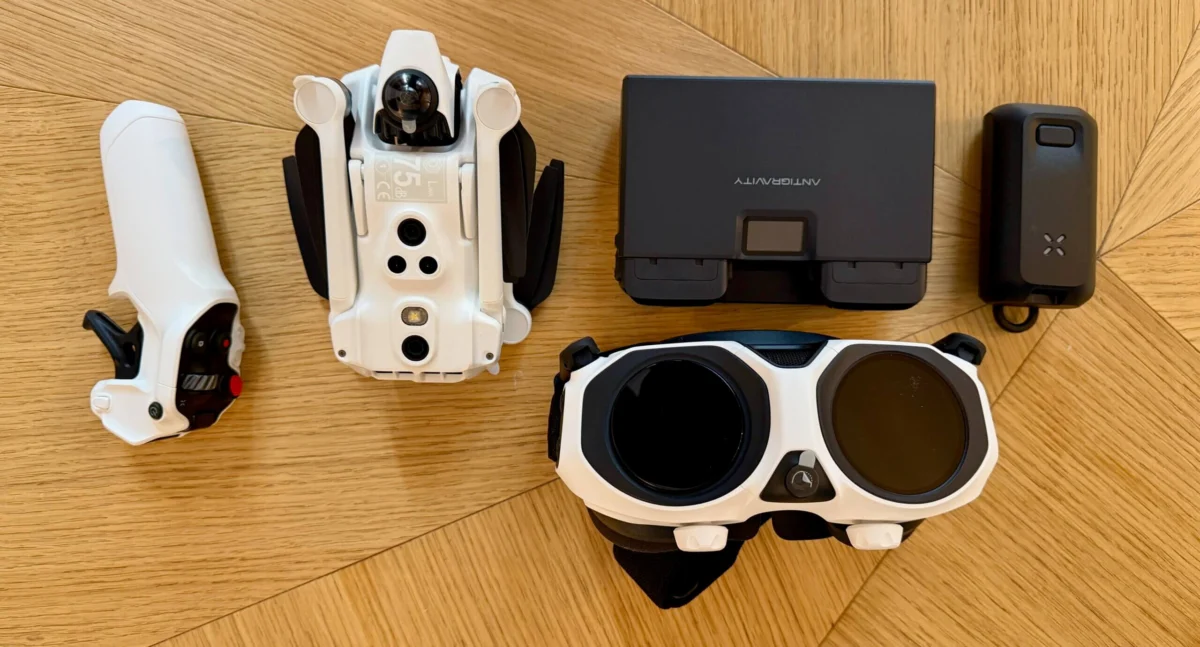
The consumer drone market has long been defined by steady incremental improvements, primarily focusing on extended battery longevity, higher sensor megapixel counts, and more reliable transmission protocols. However, the fundamental operational paradigm of aerial cinematography has remained remarkably consistent since the mainstream adoption of multirotors: a single forward-facing camera mounted on a motorized mechanical gimbal that requires real-time calculation of flight paths and framing angles simultaneously. The release of the Antigravity A1 drone in late 2025 challenges this convention entirely, offering a "fly now, frame later" methodology enabled by dual-lens 360-degree capture systems. By rendering the traditional mechanical gimbal obsolete for a significant segment of content creators and travelers, the A1 shifts the core competency of aerial recording from precise piloting execution to post-flight directorial framing.
Main Facts and Technological Architecture of the Antigravity A1
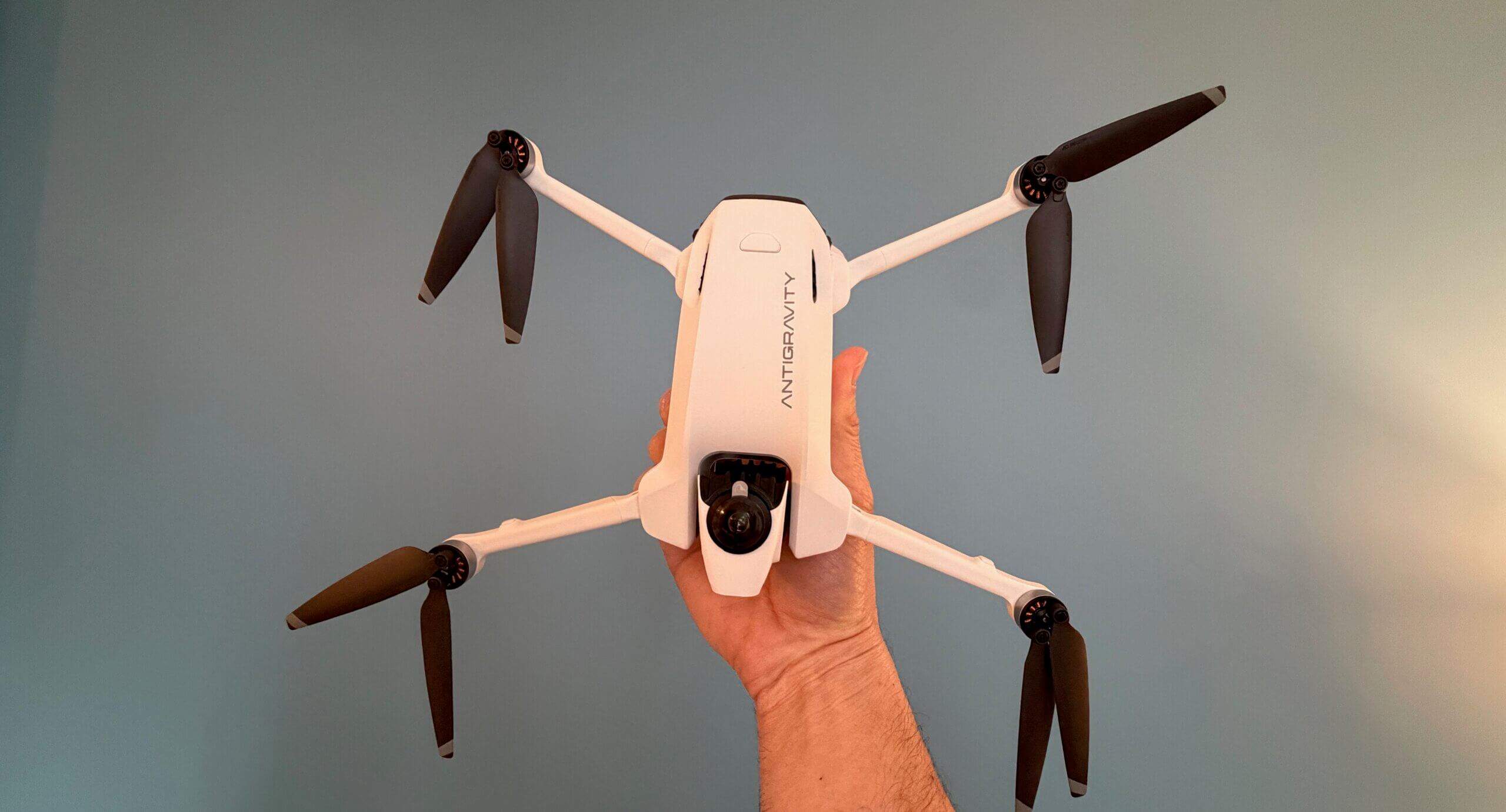
At the structural heart of the Antigravity A1 is a dual-lens 360-degree capture array. Unlike traditional platforms that utilize a single camera module oriented strictly toward the front, the A1 incorporates two ultra-wide-angle lenses positioned symmetrically on the top and bottom of the central fuselage. Each individual lens captures a 200-degree field of view, creating a generous spatial overlap that stitches together seamlessly into a complete 360-degree spherical recording.
A notable technical achievement in the post-processing pipeline is the algorithmic removal of the drone’s airframe from the final exported video file. This digital erasure creates the distinct visual illusion of an independent camera floating freely in mid-air without any visible mounting hardware or support structures.
The imaging sensors driving this system are 1/1.28-inch CMOS units. While these sensors are physically smaller than the 1-inch formats found on specialized professional photography platforms, they are significantly larger than the sensors typically embedded in conventional action-oriented 360 cameras. This scale disparity yields tangible benefits in low-light performance and dynamic range capture, allowing the A1 to preserve critical highlight and shadow details that are frequently clipped under harsh midday lighting conditions.
Weighing in at precisely 249 grams with its standard battery installed, the A1 strategically skirts the 250-gram regulatory threshold enforced by aviation authorities in numerous jurisdictions worldwide. This weight specification exempts operators from mandatory registration requirements in many regions, lowering the bureaucratic barriers frequently encountered by travelers and mobile creators who transport recording equipment across international borders.
Constructed from a high-grade carbon-fiber-reinforced polymer, the fuselage exhibits an advantageous strength-to-weight ratio compared to standard acrylonitrile butadiene styrene (ABS) plastics utilized in lower-tier models. The structural folding mechanism incorporates tactile, positive-click locking points designed to withstand the rigors of frequent deployment in field conditions. In its folded configuration, the aircraft approximates the footprint of a large-format smartphone, albeit with increased thickness.
Chronology and Development Background
The evolution of 360-degree capture technology has advanced rapidly over the preceding half-decade, transitioning from bulky, dual-camera rigs strapped together by third-party tinkerers to sleek, consumer-ready hardware. Antigravity began development on the A1 platform in early 2023, identifying a persistent pain point among travel vloggers and action sports enthusiasts: the inherent conflict between managing complex flight maneuvers and maintaining precise camera framing in dynamic environments.
Initial prototypes utilized experimental heavy-lift frames, which suffered from severely restricted flight times and high power consumption due to the processing overhead required to stitch dual video streams in real-time. By late 2024, advancements in system-on-chip (SoC) architectures allowed for onboard hardware acceleration, moving the stitching computations away from the primary flight controller and into dedicated image-signal processors.
The Antigravity A1 was officially unveiled to the global market in October 2025, following a closed beta testing phase involving select travel journalists, aerial cinematographers, and extreme sports athletes. Commercial shipments commenced in November 2025, positioning the product strategically ahead of the winter holiday travel season. Industry analysts noted that the launch represented a calculated attempt by Antigravity to capture market share from established legacy drone manufacturers who had been slow to integrate native 360-degree capture capabilities into sub-250-gram platforms.
Flight Dynamics and Control Interfaces
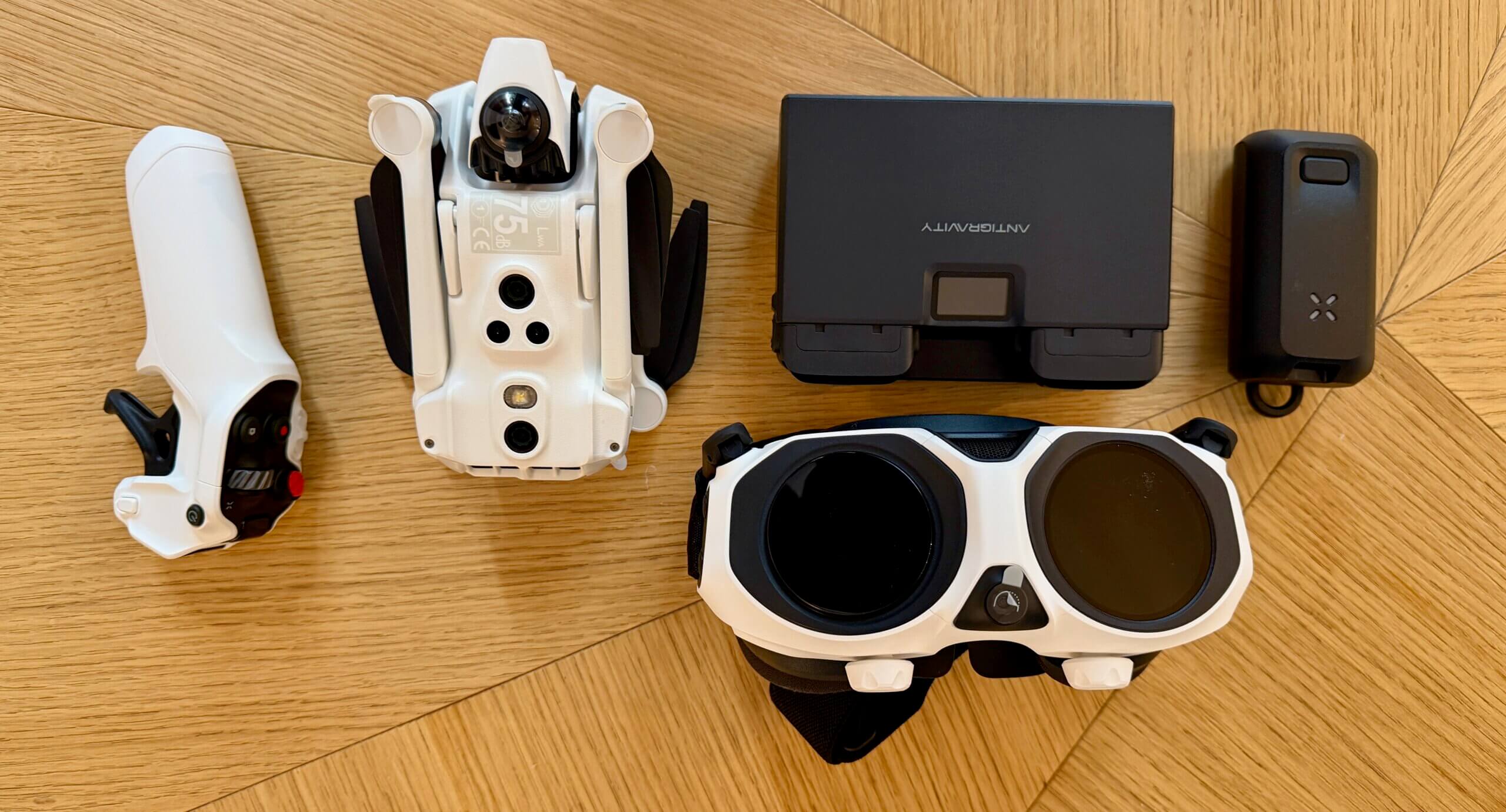
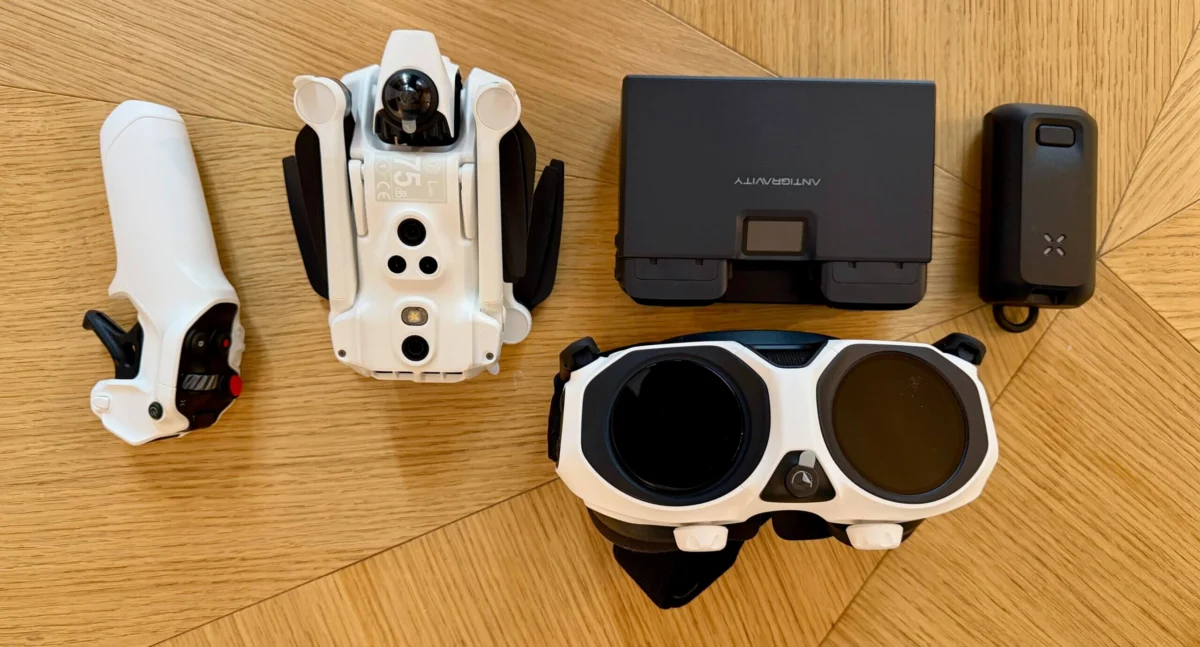
The operational ecosystem of the Antigravity A1 diverges sharply from standard multirotor platforms through its integration of dedicated vision goggles and single-handed motion controllers.
The accompanying vision goggles incorporate dual 4K micro-OLED displays operating at a 120Hz refresh rate. By leveraging low-latency digital transmission protocols, the system provides real-time visual feedback coupled with integrated head-tracking hardware. Because the underlying recording captures a full 360-degree sphere, operators are not visually constrained by the physical orientation of the drone’s nose. A lateral turn of the pilot’s head pans the field of view accordingly, generating spatial immersion that approximates true first-person perspective flight without the navigational blindness inherent to fixed-lens setups.
Control inputs are managed via a single-handed motion controller. Piloting relies on intuitive gestures: pointing the controller designates the directional vector, while pulling a trigger initiates acceleration. Wrist rotation banks the aircraft, and altering the pitch of the controller adjusts altitude. For operators requiring traditional manual acrobatic control, the A1 maintains compatibility with standard "Mode 2" dual-stick radio controllers, though the fluidity of the motion-control interface appeals primarily to novice and intermediate users.
Performance Metrics and Software Ecosystem
Examining the camera’s specifications reveals the nuances of high-resolution 360-degree video distribution. While marketing materials frequently highlight an "8K Resolution" specification, industry professionals understand the mechanical distinction between linear sensors and spherical captures. In a conventional 16:9 sensor, 8K resolution concentrates all available pixels into a single rectangular frame. In a 360-degree format, those pixels are distributed across a sphere; when the footage is subsequently reframed into a standard flat video export, the output represents a cropped sector of the total spherical recording.
Color science options include a punchy, high-saturation "Vivid" profile tailored for direct social media distribution, alongside a 10-bit "Log" profile designed for professional color-grading suites seeking to match A1 footage with primary cinema cameras. Stabilization is handled by proprietary algorithms that maintain horizontal and vertical horizon locks even when operating in crosswinds exceeding 20 miles per hour.
Post-production workflow is centralized within the Antigravity Studio application. Footage transfers wirelessly to mobile devices at sustained speeds of up to 80MB/s. The software utilizes smartphone gyroscopes to enable real-time reframing, allowing creators to pan, zoom, and tilt across the recorded sphere simply by moving their mobile device through space. Additionally, an artificial intelligence feature designated "Auto-Frame" analyzes spatial data to identify moving subjects, automatically generating dynamic cuts that maintain focus on primary points of interest without manual keyframing.
Battery Longevity and Operational Limitations
Energy density continues to serve as the primary operational constraint for compact aerial platforms. The A1’s standard Intelligent Flight Battery is rated for a theoretical maximum flight duration of 24 minutes. Under realistic environmental conditions featuring moderate wind resistance and continuous recording, practical flight times average between 19 and 20 minutes.
However, industry analysts emphasize that the efficiency metric of a 360-degree drone differs fundamentally from conventional models. Because a single flight captures every possible angle simultaneously, operators are not required to execute repeated flight paths to secure varying compositions. Consequently, a single 20-minute operational window on the A1 frequently yields an equivalent volume of usable perspective options compared to multiple flights on a traditional fixed-lens platform. An optional "Pro Battery" extends flight times to approximately 39 minutes, though the associated weight increase pushes the total aircraft mass beyond the 250-gram exemption threshold and marginally alters flight agility.
Operating as a cinewhoop-style multirotor, the A1 prioritizes stability and predictable handling over high-speed aggressive maneuvers. With a maximum horizontal velocity of approximately 36 miles per hour, it accommodates tracking shots of cyclists and automobiles but is unsuited for competitive high-speed drone racing. In the event of a rollover crash during landing or low-altitude navigation, an integrated "Turtle Mode" enables the aircraft to invert its orientation autonomously using reverse propeller rotation, minimizing retrieval recovery efforts.
Broader Industry Implications and Market Impact
The introduction of the Antigravity A1 points toward a transitional phase in consumer aerial technology. By decoupling flight path execution from visual framing decisions, the device lowers the technical barriers associated with capturing complex cinematic movements. Solo creators and mobile journalists benefit from a workflow that eliminates the need for dedicated camera operators or pre-planned flight choreography.
While trade-offs remain—principally concerning the optical delicacy of exposed dual-lens elements and the resolution loss inherent to flat-file reframing from a 360-degree sphere—the technological trajectory is clear. As sensor densities increase and stitching algorithms improve, the traditional mechanical gimbal faces serious competition from software-defined optical capture systems. The A1 demonstrates that immersive documentation and cinematic storytelling can coexist within a lightweight, highly portable footprint, permanently altering expectations for travel and documentary production toolkits.



 Gabriela Annisa

 Lukman Taruna Persada Ramadan

 Tatiana Tantri Indah Sari

 Anjar Salim


 Dwi Wanna
