Budi Mulyono
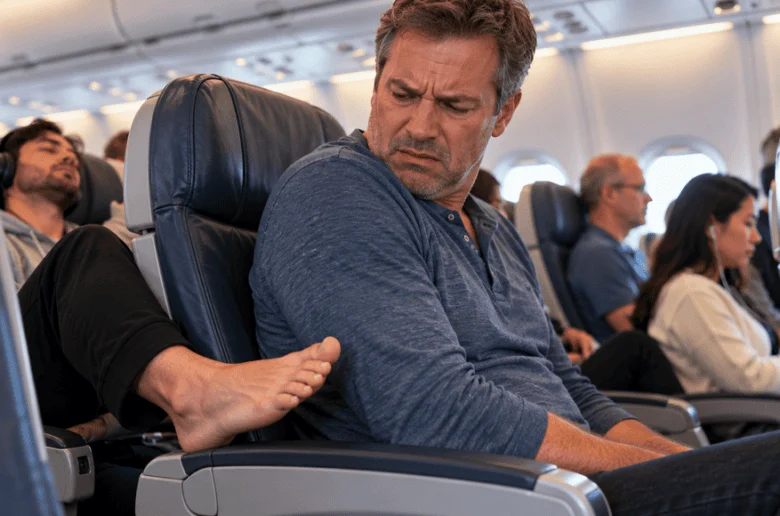
Air travel has long been a breeding ground for social friction, bringing together hundreds of strangers in a pressurized, confined space for hours at a time. While commercial aviation has evolved to offer various amenities, the fundamental laws of personal space remain a frequent point of contention among passengers. The unwritten social contract of flying dictates a baseline level of mutual respect, yet boundary violations—ranging from noisy media consumption to invasive luggage placement—occur on nearly every commercial flight. Among these infractions, none elicits a more visceral reaction than the unauthorized intrusion of a fellow passenger’s body parts, specifically feet, into another traveler’s designated zone. A recent viral incident highlighting this exact grievance has once again thrust the topic of cabin etiquette into the global spotlight, generating widespread discussion regarding passenger rights, conflict resolution at 35,000 feet, and the limits of acceptable behavior in shared public spaces.
The Anatomy of an In-Flight Violation: Background Context
The modern commercial aircraft cabin is engineered to maximize passenger capacity, resulting in diminishing square footage per traveler. Against this backdrop of shrinking legroom and narrow seating configurations, the preservation of personal boundaries is vital for maintaining order. While airlines issue explicit safety instructions regarding seatbelt usage and electronic device regulation, they largely rely on implicit social norms to govern interpersonal conduct.
Common infractions identified by frequent flyers and consumer advocacy groups typically include blocking the aisle during boarding, failing to use headphones for audio devices, reclining seats during meal services, and conducting loud, disruptive phone conversations prior to departure or after landing. However, the issue of footwear removal occupies a unique and heavily debated category of air travel behavior.
Opinions on removing shoes during long-haul flights are nuanced. Many travel experts and medical professionals acknowledge that prolonged periods of sitting can cause lower extremity swelling, making footwear removal a practical measure for physical comfort. Consequently, taking off one’s shoes—provided proper hygiene is maintained and ambient odors are absent—is generally tolerated by fellow passengers. The threshold of acceptability is crossed, however, the moment a traveler extends their feet beyond the boundaries of their own seat. Industry standards and basic etiquette dictate that bare feet, socks, or slippers must remain strictly confined to the floor space, under-seat storage area, or footrest of the offender’s specific ticketed location. Placing feet on bulkheads, adjacent seats, aisle pathways, or, most egregiously, the armrests of seats occupied by other passengers constitutes a direct breach of these unwritten rules.
Chronology of a Viral Confrontation
The incident that captured the attention of millions began much like any other routine commercial flight, though specific details regarding the airline, date, and exact geographic route remain unverified due to the anonymous nature of the initial social media upload. A male passenger, seated in a row behind an unsuspecting traveler, decided to remove his footwear and rest a bare foot directly upon the armrest of the seat immediately in front of him.
Rather than merely brushing against the structure, the individual positioned his foot firmly and deliberately upon the armrest—a prime piece of shared or exclusive real estate belonging to the passenger occupying the forward seat. In many similar historical scenarios, affected passengers resort to passive-aggressive behaviors, such as glaring backward, shifting uncomfortably, or waiting indefinitely for flight attendants to intervene during service rounds.
Opting for a direct and publicly documented approach, the occupant of the front seat chose not to suffer in silence. Recognizing the blatant disregard for his personal space, he executed an immediate, unscripted response designed to address the intrusion directly while recording the encounter on a mobile device. The resulting footage was subsequently uploaded to the popular short-form video platform TikTok by the account @the.walker.twins, rapidly ascending algorithmic charts to achieve viral status. The video featured the caption indicating that he simply "had to do something," accompanied by visual evidence of the foot resting on the armrest and the subsequent countermeasure enacted by the aggrieved passenger.
Public Reaction and the Authenticity Debate
Upon entering the digital ecosystem, the video generated an immediate surge of engagement, accumulating hundreds of thousands of views, shares, and commentary within hours. The public response was sharply divided into distinct schools of thought regarding the appropriateness of the passenger’s reaction and the fundamental legitimacy of the recorded event.
A significant portion of the audience lauded the passenger’s decisive action, viewing it as a long-overdue retribution against discourteous behavior that frequent flyers routinely face. Psychological analysis of such viral content suggests that these videos serve as vicarious outlets for consumers who have experienced similar boundary violations but felt powerless to act due to social pressures or fear of escalation. For these viewers, the video represented a moment of poetic justice against entitlement in public spaces.
Conversely, a vocal segment of online commentators questioned the authenticity of the recording. Citing the prevalence of staged scenarios designed for digital clout and algorithmic visibility, skeptics argued that the interaction may have been pre-arranged between traveling companions playing roles for comedic or viral effect. Aviation security experts note that while staged pranks do occur within the industry, the underlying anxiety and frustration the video taps into remain entirely genuine for the traveling public. Whether spontaneous or orchestrated, the cultural resonance of the content underscored a profound public fatigue regarding declining standards of courtesy during commercial transit.
Data and Statistics on Air Travel Friction
To understand the frequency and severity of such incidents, industry analysts frequently examine data concerning passenger behavior and cabin disruptions. According to reports compiled by the International Air Transport Association (IATA) and the Federal Aviation Administration (FAA), reports of unruly passenger behavior have seen fluctuating trends over the past decade, with a notable spike following the easing of global health restrictions in the early 2020s.
While the majority of reported incidents involve non-compliance with crew instructions or verbal altercations regarding safety protocols, a significant percentage of day-to-day friction stems from inter-passenger disputes over physical space. Surveys conducted by consumer travel platforms indicate that over 65% of frequent flyers report experiencing a major space-invasion incident—such as reclining without warning, armrest hogging, or intrusive limbs—at least once per year. Furthermore, approximately 40% of respondents admitted to harboring intense frustration toward fellow passengers who remove their shoes without adequate regard for surrounding travelers. These data points illustrate that cabin etiquette is not merely a matter of polite conversation, but a persistent operational challenge affecting passenger well-being and overall travel satisfaction.
Aviation Industry Policies and Legal Implications
Commercial airlines operate under strict legal frameworks governing onboard conduct, primarily enforced by federal regulations in the United States and international aviation authorities globally. Title 14 of the Code of Federal Regulations (14 CFR) prohibits interfering with crew members or engaging in behavior that threatens the safety, order, or comfort of a flight.
While placing a foot on an armrest rarely constitutes a direct violation of federal aviation safety laws punishable by law enforcement upon landing, it frequently triggers intervention by flight deck or cabin crew under general company policies of passenger comfort and decorum. Flight attendants are empowered to issue warnings, relocate passengers if seating availability permits, or involve ground security upon arrival if an escalating dispute threatens to compromise the peaceful environment of the cabin.
Airlines generally prefer to de-escalate such disputes informally, relying on crew intervention to remind passengers of basic behavioral guidelines. However, as incidents involving digital recording and public shaming become more prevalent, carriers face additional pressures to address cabin culture proactively. Legal and aviation safety experts consistently advise passengers against engaging in physical confrontations or aggressive retaliatory measures at 35,000 feet, emphasizing that escalation can transform a minor etiquette violation into a security incident resulting in delays, flight diversions, or placement on airline no-fly lists.
Broader Impact and Societal Implications
The widespread attention garnered by the viral foot-rest video highlights a broader cultural shift regarding accountability in public spaces. In an era dominated by smartphones and social media, private misbehavior in public transit settings is increasingly subject to instant public documentation and global critique. This phenomenon acts as a double-edged sword: while it can deter egregious social transgressions by introducing immediate reputational consequences, it also risks inciting unnecessary hostility and vigilante justice within confined environments where de-escalation is paramount.
Ultimately, the incident serves as a stark reminder of the fragile social contract that enables mass commercial transportation to function efficiently. As passenger volumes continue to rebound and surpass pre-pandemic levels, the demand for personal space will only intensify. Industry observers suggest that airlines, travel agencies, and consumer advocates must continue to promote awareness campaigns regarding basic travel etiquette.
For the individual traveler, the prescription remains straightforward: the pursuit of personal comfort during a journey must never infringe upon the physical autonomy of the person seated adjacent, behind, or in front of them. Whether through heightened self-awareness or the implicit threat of digital exposure, maintaining basic civility remains the single most effective tool for ensuring a safe, pleasant, and harmonious journey for everyone on board.


 Lukman Taruna Persada Ramadan

 Tatiana Tantri Indah Sari

 Anjar Salim