
 Anjar Salim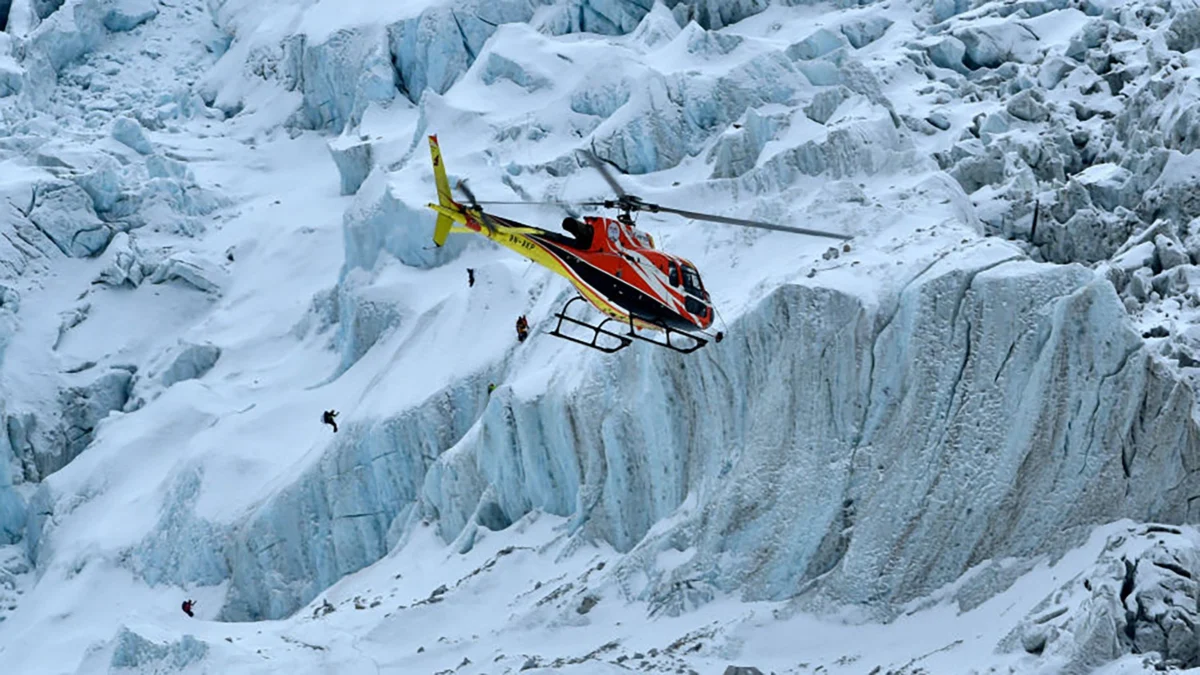
The Khumbu Icefall, widely regarded as the most treacherous section of the standard South Col route to the summit of Mount Everest, lived up to its fearsome reputation in the early hours of Tuesday, May 5, 2026. A sudden collapse of an ice serac buried two climbers, triggering an emergency response that mobilized multiple expedition teams and high-altitude rescue pilots. The incident occurred as the 2026 climbing season entered a critical phase, with over 100 climbers and guides navigating the frozen labyrinth of the glacier for their initial acclimatization rounds.
The rescue operation, which unfolded in the predawn darkness and early morning light, resulted in the successful evacuation of a high-altitude guide and an international client. Both individuals were airlifted to Kathmandu for emergency medical treatment. While the event underscores the inherent risks of Himalayan mountaineering, it also highlights the increasing efficiency of search-and-rescue protocols on the world’s highest peak.
Detailed Chronology of the Incident
The accident took place at approximately 5:45 A.M. local time. At this hour, the Khumbu Icefall is typically crowded with "puja"-blessed climbers attempting to navigate the shifting terrain before the sun warms the glacier, which increases the likelihood of ice movement. On this particular morning, the traffic was heavy, with more than 100 individuals—comprising Sherpa guides, support staff, and paying clients—making their way toward Camp I and Camp II.
The collapse occurred in a section of the icefall located several meters below a notorious, oversized serac that had already been identified as a significant hazard earlier in the season. While that specific hanging glacier had caused delays in the rope-fixing process in April, Nepal’s Department of Tourism (DoT) confirmed that the May 5 collapse involved a different, smaller formation.
Eyewitnesses at Base Camp, including journalists from Outside magazine, reported hearing the sharp crack of fracturing ice followed by urgent radio transmissions. Within minutes, the climbing community at Base Camp was alerted to the fact that two individuals had been struck and partially buried by the falling debris.
By 6:15 A.M., the rescue machinery was in full motion. Helicopter crews stationed at Lukla airport, located approximately 40 miles from Everest Base Camp, received the scramble order. Despite the thin air and the technical difficulty of landing or hovering near the fractured ice of the Khumbu, pilots initiated the flight path toward the mountain immediately.
Profiles of the Injured Climbers
The two individuals caught in the collapse represent the two pillars of the Everest climbing industry: the international client and the veteran Nepali guide.
The client has been identified as Nimish Kumar Singh, a 40-year-old mountaineer from India. Singh was climbing under the banner of Pioneer Expeditions, a prominent outfitter known for managing large-scale Himalayan ventures. Singh was reportedly in the middle of his first rotation to higher camps to prepare his body for the oxygen-depleted environment of the "Death Zone" later in the month.
The second individual is Pema Thenduk Sherpa, a 44-year-old high-altitude guide affectionately known in the mountaineering world as "Black Yak." A native of the Solukhumbu region, Pema Thenduk is a titan of the industry. Since beginning his career as a high-altitude worker in 2011, he has recorded 34 successful ascents of peaks over 8,000 meters. His resume includes 12 successful summits of Mount Everest, making him one of the most experienced professionals currently working on the mountain. At the time of the accident, he was working for Seven Summit Treks, the largest expedition operator in Nepal.
The Rescue and Medical Response
The immediate response on the ice was a collaborative effort involving personnel from multiple agencies. Guides and safety teams from Asian Treks and Seven Summit Treks, who were in the immediate vicinity of the collapse, pivoted from their climbing objectives to perform a manual extraction. Using shovels and ice axes, they cleared the debris to reach Singh and Sherpa, stabilizing them on the unstable surface of the glacier.
The technical nature of the Khumbu Icefall makes helicopter evacuations extremely dangerous. The terrain is a jumble of house-sized ice blocks and bottomless crevasses, leaving very few places for a helicopter to touch down. In this instance, a rescue helicopter performed a "long-line" or a precision landing near the site to extract the injured.
By the mid-morning hours, both Singh and Sherpa had been flown from the mountain to Kathmandu. They were admitted to HAMS (Himalayan International Care Clinic and Hospital), a facility specialized in treating high-altitude trauma and mountaineering injuries. According to official statements from the Department of Tourism, both men are in stable condition. Sources at Seven Summit Treks indicated that Pema Thenduk Sherpa suffered non-life-threatening injuries and is expected to be discharged within 24 hours, while Singh remains under observation for trauma-related injuries.
Context: The Perils of the Khumbu Icefall
The Khumbu Icefall is a river of ice that moves at a rate of approximately three to four feet per day. This constant motion creates a landscape of deep crevasses and towering ice towers (seracs) that can collapse without warning. For climbers on the South Side of Everest, the icefall is an unavoidable gauntlet that must be traversed multiple times during the acclimatization process.
Historically, the icefall has been the site of Everest’s most tragic events. In 2014, a massive serac collapse on the western shoulder of Mount Everest sent an avalanche into the icefall, killing 16 Nepali guides. That event led to a temporary shutdown of the mountain and spurred a global conversation about the safety and ethics of Sherpa labor in the Himalayas.
The 2026 season has already seen heightened anxiety regarding the stability of the icefall. Earlier in the spring, the "Icefall Doctors"—the specialized team of Sherpas responsible for maintaining the route with ladders and ropes—expressed concerns about a particularly large serac hanging over the route. While the May 5 collapse was not directly caused by that specific formation, the incident confirms the general instability of the glacier this year.
Supporting Data and Environmental Analysis
Data from the International Centre for Integrated Mountain Development (ICIMOD) suggests that the Khumbu Glacier is thinning at an accelerating rate due to rising global temperatures. Scientific surveys indicate that the glacier has lost a significant portion of its mass over the last three decades. As the ice thins, the structural integrity of the icefall diminishes, making serac collapses more frequent and less predictable.
The timing of the collapse—5:45 A.M.—is also significant. Traditionally, climbers are advised to be through the icefall and into the Western Cwm by 10:00 A.M. to avoid the "solar oven" effect, where the sun’s heat destabilizes the ice. The fact that a collapse occurred before sunrise suggests that structural failures are now happening independently of daily temperature fluctuations, a phenomenon that glaciologists attribute to deeper thermal changes within the glacier.
Broader Implications for the 2026 Climbing Season
The rescue of Nimish Kumar Singh and Pema Thenduk Sherpa has sent ripples through the Base Camp community. With over 400 permits issued for Everest this season, the mountain is crowded, and the Khumbu Icefall remains the primary bottleneck.
Safety Protocols and Congestion
The presence of over 100 people in the icefall at the time of the collapse highlights the ongoing issue of "traffic jams" on Everest. When large numbers of climbers move through a hazardous zone simultaneously, the potential for mass-casualty events increases. While this incident resulted in only two injuries, the proximity of dozens of other climbers suggests that the outcome could have been far worse.
The Role of High-Altitude Rescues
The speed of the rescue—from the 5:45 A.M. accident to a 6:15 A.M. helicopter launch—demonstrates the maturation of Nepal’s search-and-rescue infrastructure. In previous decades, a collapse in the icefall would have required a grueling manual carry-down to Base Camp, often taking hours or days. The availability of high-altitude helicopters and skilled pilots has significantly lowered the mortality rate for reachable injuries on the mountain.
Economic and Official Reactions
The Department of Tourism has reaffirmed its commitment to monitoring the route and ensuring that the Icefall Doctors have the resources needed to adjust the path as conditions change. However, officials have also noted that the "inherent risk" of mountaineering cannot be entirely eliminated. For Nepal, the Everest climbing season is a vital economic engine, generating millions of dollars in permit fees and supporting thousands of jobs in the tourism and trekking sectors.
Conclusion
As Nimish Kumar Singh and Pema Thenduk Sherpa recover in Kathmandu, the climbing season on Mount Everest continues. The 100-plus climbers who witnessed the event or heard the radio calls have been reminded of the fragile boundary between a successful expedition and a disaster.
The "Black Yak’s" survival is a testament to the resilience of the Sherpa community, yet the incident serves as a sobering prologue to the summit pushes expected in late May. As climate change continues to reshape the topography of the world’s highest peaks, the mountaineering community may be forced to reconsider traditional routes and timing, as the "moving river" of the Khumbu Icefall becomes increasingly volatile. For now, the focus remains on the recovery of the injured and the cautious advancement of the hundreds of climbers still seeking the top of the world.



 Chandra Hamzah
 Tatiana Tantri Indah Sari
 Budi Mulyono
