
 Walid Sujud Trenggono
Tasmania’s north-east coast has long held a reputation as a premier destination for wilderness enthusiasts, combining rugged topography with high-end culinary tourism. Recently, guided excursions along the region’s coastal paths—notably the Larapuna/Bay of Fires trail—have experienced a surge in popularity among travellers seeking immersive nature experiences paired with contemporary comforts. A three-day guided expedition with Intrepid Travel highlights how modern eco-tourism merges physical endurance with regional gastronomy, drawing diverse demographics to Australia’s southern isle.
Main Facts and Itinerary Overview
The structured three-day itinerary commences in Launceston, acting as a gateway for participants traversing the state’s north-east. The route covers varied terrain within the Humbug Point Conservation Area, Mount William National Park, and the coastal fringes of St Helens—Australia’s recognized game-fishing capital.
Rather than requiring participants to carry heavy multi-day packs, the tour operates on a lodge-based model. Hikers complete daily segments ranging from 6 to 12 kilometres, returning each evening to settled accommodations such as the recently renovated Panorama Hotel in St Helens. This operational structure targets the growing market segment of adventure travellers who prefer remote landscapes by day and climate-controlled infrastructure by night.
The expedition group reflects a broad cross-section of adventure tourism demographics. Participants on the recent trek included emergency service personnel training for overseas expeditions, international hikers in their seventies, and specialised media documentation crew members. Guided by experienced wilderness leaders, the itinerary is intentionally graded: beginning with moderate coastal walks, progressing to more challenging dune and headland traverses, and concluding with geological landmarks in the state’s interior.
Chronology of the Route
The expedition’s progression is mapped across three distinct geographical phases, offering participants a cross-section of Tasmania’s coastal and historical ecosystems.
Day One: Coastal Heath and Liquid Sunshine
The initial leg follows the Skeleton Bay Track to Dora Point within the Humbug Point Conservation Area. Variable meteorological conditions—locally described as "sneaky rain" or "liquid sunshine"—characterise the microclimate of the north-east coast. The trail traverses coastal heath meeting temperate rainforests populated by ferns, flowering paperbarks, banksia, tea trees, and eucalypts.
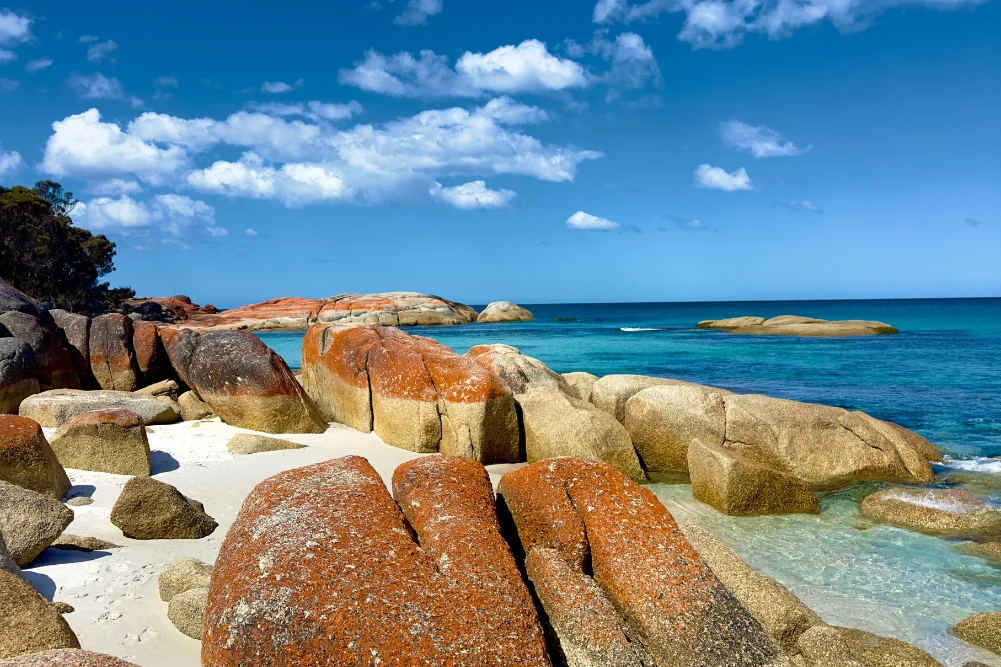
The geological defining feature of the area is the pervasive presence of orange-hued granite boulders, stained by crustose lichen. Named in 1773 by British navigator Captain Tobias Furneaux after the campfires of the indigenous Palawa people, the landscape retains its luminous coastal aesthetic, contributing to the region’s designation as one of Australia’s premier beach environments.
Day Two: Maritime Heritage and Dune Traverses
The second day centers on Eddystone Point Lighthouse, a 35-metre-high pink granite structure built in 1889 to mitigate the historical maritime hazards of the treacherous north-eastern tip. Exposed to high-velocity winds often exceeding 60 kilometres per hour, the area features extensive shell coves composed of accumulated marine deposits, alongside significant dune formations shaped by mineral leaching.
Beyond the immediate coastline, the route incorporates historical context regarding Tasmania’s penal era. Guides often brief participants on figures such as colonial convict William Swallow, whose maritime escapes from Sarah Island underscore the historical wildness of the region. The day concludes with a 12-kilometre tally, averaging approximately 25,000 steps per participant.
Day Three: National Park Exploration and Geological Anomalies
The final leg transitions to Mount William National Park and Stumpy’s Bay. The park supports a high density of wombats, with Tasmania’s macropod and marsupial populations—including an estimated one million wombats—outnumbering human residents.
The return journey to Launceston incorporates a stop at the Little Blue Lake near Derby. Formed as a byproduct of historical tin-mining operations active from the 1870s through the 1980s, the body of water exhibits an intense turquoise hue resulting from suspended white clay particles and mineral content. The tour concludes in Derby, a former mining hub that has successfully transitioned into a world-renowned mountain-biking destination.
Regional Gastronomy and Economic Impact
A significant component of the modern Tasmanian wilderness experience is the integration of hyper-local food and beverage economies. St Helens and surrounding coastal leases supply high volumes of southern rock lobster, Pacific oysters, and game fish, directly supporting local hospitality enterprises.
During the evaluated tour, participants engaged directly with the regional supply chain:
- Oyster Consumption: Oysters harvested from lease sites within a five-minute drive of St Helens restaurants formed a staple of the evening menus.
- Artisanal Dining: Breakfast and lunch menus heavily featured regional produce, including locally sourced grains, cold-pressed oils, and bespoke bakery items such as chocolates from St Helens and vegetarian wraps from the Lifebuoy Café.
- Hospitality Infrastructure: Investments in renovated properties like the Panorama Hotel illustrate how regional tourism development directly upgrades local accommodation capacity, allowing small towns to absorb influxes of active travellers.
Participant Perspectives and Demographic Trends
Tour participants interviewed during the excursion highlighted the psychological and physical benefits of structured wilderness access. Betsy, a 75-year-old solo traveller from New Zealand, noted the appeal of removing logistical friction from remote-area travel.
"My nature is to be in my solitude," Betsy stated. "But I like it now, being 75, not having the responsibility of thinking where I’m going next or what I’m going to eat. This hike has been absolutely gorgeous. We’ve had rain, sunshine, wind, sand in our faces, all the coastal elements. It’s so good for the body and the mind."
Similarly, participants training for international treks, such as the 96-kilometre Kokoda Track in Papua New Guinea, utilized the Tasmanian terrain for conditioning. Logging significant mileage across varied topography provided controlled risk environments supported by professional emergency preparedness standards.
Broader Impact and Industry Implications
The commercial success of guided walks along the Bay of Fires points to broader shifts within the Australian eco-tourism sector. By decoupling wilderness immersion from the traditional hardships of backcountry camping—such as carrying heavy rations and sleeping on the ground—operators lower the barrier to entry for older demographics and time-poor professionals.
At the same time, conservation management remains a critical priority. Balancing increased foot traffic with the preservation of sensitive coastal flora, lichen-encrusted granite formations, and native fauna populations requires strict adherence to minimal-impact guidelines by commercial operators.
Booking and Operational Details
Intrepid Travel coordinates small-group walking tours along the Bay of Fires departing from Launceston on select Saturdays between October and April. Direct aviation links connect Launceston to major domestic hubs including Sydney, Melbourne, and Adelaide. Standard package pricing for the Bay of Fires walking itinerary commences at $1,680 AUD, catering to the growing domestic and international demand for premium, low-impact wilderness exploration.



 Gabriela Annisa

 Lukman Taruna Persada Ramadan

 Tatiana Tantri Indah Sari

 Anjar Salim


 Dwi Wanna
