Anjar Salim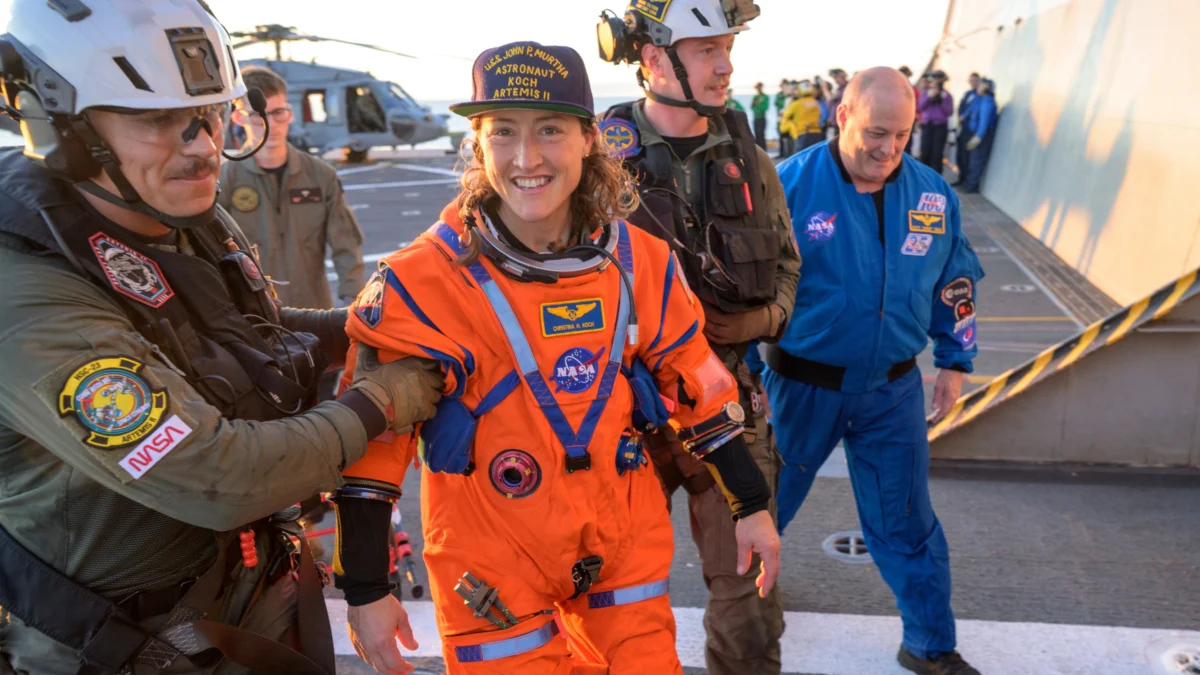
On April 10, 2026, at approximately 12:27 PM PDT, the NASA Orion spacecraft, christened Integrity, successfully splashed down in the Pacific Ocean off the coast of San Diego, California. This event concluded the Artemis II mission, a 10-day journey that represented the first time humans have orbited the Moon since the conclusion of the Apollo program in 1972. The mission, crewed by Commander Reid Wiseman, Pilot Victor Glover, and Mission Specialists Christina Koch and Jeremy Hansen, achieved several historic milestones, including the farthest distance from Earth ever reached by a crewed spacecraft. As the capsule bobbed in the gentle swells of the Pacific, supported by its uprighting flotation system, it signaled the successful completion of a flight that has redefined the boundaries of 21st-century space exploration.
The return of the Artemis II crew was witnessed by a global audience of more than 27 million people via NASA’s digital platforms. The mission’s conclusion involved a complex recovery operation led by NASA and the U.S. Navy. Following the splashdown, recovery teams deployed from the USS John P. Murtha to secure the capsule and inflate the specialized recovery raft, colloquially known as the "front porch." This platform allowed the four astronauts to exit the spacecraft and receive initial medical evaluations before being transported back to shore. The successful recovery marked the end of a mission that lasted exactly 9 days, 1 hour, 31 minutes, and 35 seconds—a period during which the crew traveled over 250,000 miles to reach the lunar far side.
Mission Chronology and Technical Achievements
The Artemis II mission began with a flawless liftoff from Launch Complex 39B at the Kennedy Space Center in Florida. Powered by the Space Launch System (SLS) rocket, the Orion spacecraft was propelled into a high Earth orbit to test its critical life-support systems and maneuverability. Following a series of checkouts, the crew performed a Translunar Injection (TLI) burn, a high-stakes engine firing that set them on a trajectory toward the Moon.
During the outbound journey, the crew conducted a series of proximity operations, using the spent Integrated Cryogenic Propulsion Stage (ICPS) as a target to test Orion’s handling characteristics. This was a vital step for future missions, such as Artemis III, which will require precise docking with the Lunar Gateway and the Human Landing System (HLS). As the spacecraft approached the Moon, the crew reached a peak altitude of 252,756 miles from Earth, breaking the previous record for a crewed spacecraft set during the Apollo 13 mission.
While in lunar orbit, the crew performed extensive scientific observations. They identified and named a previously uncatalogued crater on the lunar far side and tested advanced optical communication technology designed to transmit high-definition video across deep space. One of the most significant technical challenges occurred during the 37-minute communication blackout as the spacecraft passed behind the Moon. During this window, the crew operated autonomously, conducting geological surveys of the lunar surface and preparing for the critical return burn that would slingshot them back toward Earth.
The Human Element: Records and Representation
The Artemis II mission was notable not only for its technical prowess but also for the diversity of its crew. Christina Koch, a veteran of the International Space Station (ISS), became the first woman to orbit the Moon. Koch already held the record for the longest single spaceflight by a woman (328 days) and participated in the first all-female spacewalk in 2019. Her presence on the mission served as a testament to NASA’s commitment to inclusive exploration.
The crew also included Jeremy Hansen of the Canadian Space Agency (CSA), marking the first time a non-American has traveled to the lunar vicinity. Victor Glover, acting as the pilot, became the first person of color to participate in a lunar mission. The synergy between these four professionals was a focal point of NASA’s public outreach, which utilized social media to foster a sense of global participation.
The phrase "moon joy" became a viral sensation during the mission. The term originated from Science Officer Angela Garcia at Mission Control, who used the phrase to describe the palpable excitement shared between the ground team and the crew. This digital engagement represented a significant departure from the Apollo era, as high-resolution photography and poetic reflections from the crew were shared in real-time with an audience on Earth. One particularly resonant image captured Koch’s face illuminated by the "blue marble" of Earth as she gazed through Orion’s window, her hair floating in microgravity—a visual reminder of the human presence in the vastness of the cosmos.
Perspectives from the Lunar Orbit: An Interview with Christina Koch
Following her return and initial quarantine period, Mission Specialist Christina Koch shared insights into the psychological and physical demands of deep space travel. Her reflections highlighted the parallels between terrestrial exploration and the rigors of a lunar mission. Koch, an avid rock climber and outdoorswoman, noted that her experiences in the wilderness were fundamental to her success in space.
According to Koch, the mental discipline required for traditional rock climbing—specifically the ability to "turn fear into focus"—is directly applicable to the high-stakes environment of a spacecraft. She emphasized that in both climbing and spaceflight, there is a point where an individual must rely entirely on their training and their partner, recognizing that the only way forward is through meticulous execution of known procedures.
When comparing the experience of space to Earth-bound adventures, Koch pointed to the "work-to-reward ratio." She noted that just as one might hike for days to see the summit of Mount Kenya or Mount Whitney, the immense effort of a lunar mission is justified by the unique perspective it provides. However, despite the grandeur of the lunar vista, Koch expressed a profound appreciation for Earth’s sensory richness. She remarked that while space food—specifically the modern freeze-dried iterations—is more efficient and palatable than many expect, it cannot replace the "magical" quality of Earth’s natural environment.
Koch highlighted the specific sensory experiences she missed most, such as the sound of birds and the smell of the ocean. She described the "Earthrise" and "Earthset" moments as the most poignant parts of the mission, punctuating the periods of intense scientific focus. For Koch, the mission reinforced a central philosophy: that space exploration is not an escape from Earth, but a means to better appreciate and protect it.
Supporting Data and Mission Statistics
The Artemis II mission provided a wealth of data that will be analyzed by engineers and scientists for years to come. Preliminary reports indicate that the Orion heat shield performed within expected parameters, enduring temperatures of nearly 5,000 degrees Fahrenheit during reentry while maintaining a cabin temperature comfortable for the crew.
- Total Distance Traveled: Approximately 640,000 miles.
- Maximum Velocity: 24,500 mph (during atmospheric reentry).
- Scientific Output: Over 2,000 high-resolution images and 500 gigabytes of lunar surface data.
- Public Engagement: 27 million live viewers; 1.5 billion social media impressions globally.
- Biological Impact: The crew was equipped with dosimeters to measure radiation exposure outside the Van Allen belts. Initial readings suggest that Orion’s shielding provided effective protection against solar particle events.
The success of the mission’s life support systems is particularly crucial. Artemis II was the first time the Orion’s Environmental Control and Life Support System (ECLSS) was tested with a full crew in a deep-space environment. The system successfully regulated oxygen levels, removed carbon dioxide, and managed the internal temperature, proving that the spacecraft is ready for longer-duration missions.
Official Responses and Global Implications
NASA Administrator Bill Nelson lauded the mission as a "triumph of international cooperation and human ingenuity." In a press conference following the splashdown, Nelson emphasized that Artemis II has cleared the path for Artemis III, which aims to land the first woman and the next man on the lunar South Pole. "We are no longer just visiting the Moon," Nelson stated. "We are preparing to stay there, to learn, and to eventually use those lessons to send humans to Mars."
The Canadian Space Agency also celebrated the mission’s success, noting that Jeremy Hansen’s participation has solidified Canada’s role as a major player in the global space economy. International partners, including the European Space Agency (ESA), which provided the Service Module for Orion, viewed the mission as a validation of the "Gateway" concept—a planned lunar-orbiting space station that will serve as a hub for future exploration.
Analysis of Broader Impacts
The Artemis II mission represents a shift in the strategic objectives of human spaceflight. Unlike the Cold War-era "Space Race," the Artemis program is built on a framework of sustainability and commercial partnership. The involvement of private companies in the development of various mission components signifies a new "Space Economy" that aims to make lunar exploration more frequent and cost-effective.
Furthermore, the mission has significant implications for scientific research. The data collected from the lunar far side provides new clues about the history of the solar system and the geological evolution of the Moon. The testing of new communication technologies also paves the way for high-bandwidth data transmission from Mars, which will be essential for future crewed missions to the Red Planet.
Perhaps the most lasting impact of Artemis II is its effect on the public consciousness. By bringing the lunar experience to millions of screens in high definition, NASA has successfully revitalized interest in space exploration for a new generation. The mission serves as a reminder that despite the challenges facing our home planet, the human spirit of discovery remains a powerful force for unity and progress.
As the Artemis II crew begins their post-mission debriefings and physical recovery, the global scientific community is already looking toward the horizon. The lessons learned from the voyage of the Integrity have turned the dream of a permanent human presence on the Moon into an impending reality. The mission has confirmed that while we may venture into the darkness of the void, our ultimate focus remains the "blue marble" we call home.



 Chandra Hamzah
 Gabriela Annisa
 Tatiana Tantri Indah Sari
 Budi Mulyono