
 Anjar Salim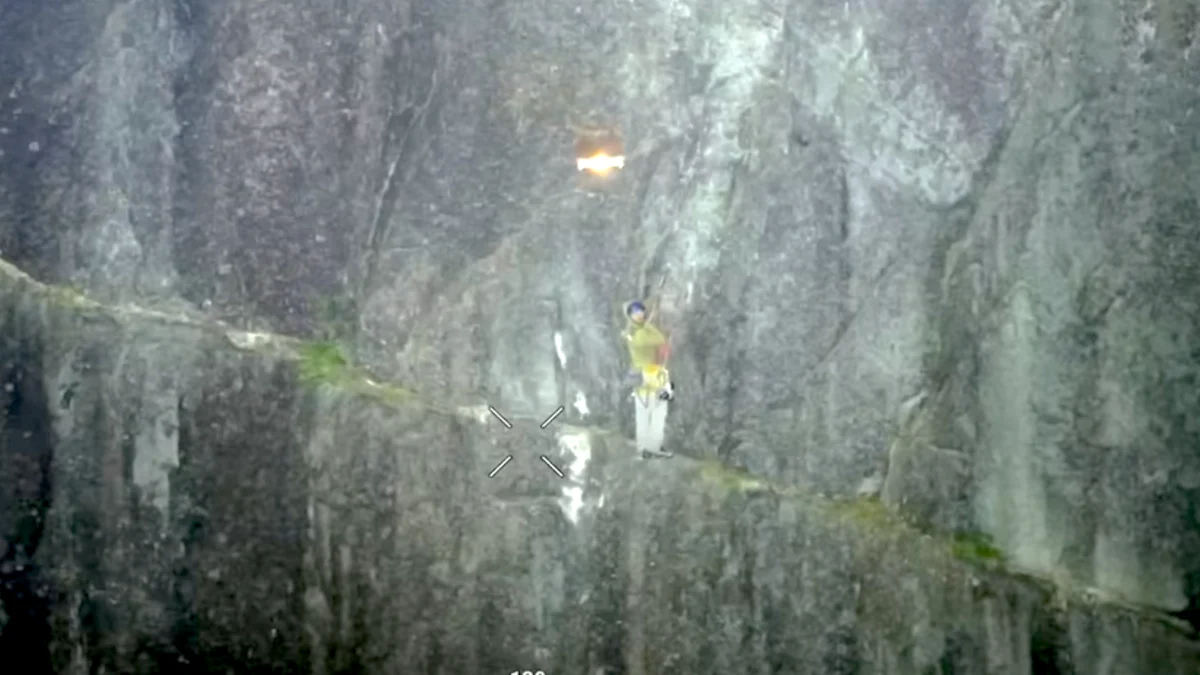
In a milestone deployment for mountain rescue operations, emergency responders in Squamish, British Columbia, utilized a specialized two-drone tactic to safely extract a climber stranded on a sheer cliff face in total darkness. The operation, executed late at night on September 10, bypassed the severe hazards of traditional nocturnal rope work and helicopter deployment on the Stawamus Chief, one of the world’s largest granite monoliths.
The incident began when an evening climbing excursion on the multi-pitch route known as the Alaska Highway went awry. The unidentified male climber found himself marooned on a 10-inch ledge, situated 250 feet above the base of the monolith. While the climber was securely tied into a fixed anchor, he faced a critical equipment limitation: he lacked sufficient rope length to complete a rappel to the ground. Compounding the urgency, two climbing partners who had been accompanying him successfully descended the route and alerted authorities, leaving the third climber isolated as temperatures dropped and night settled over the rugged terrain.
Squamish Search and Rescue (SSAR) mobilized immediately, arriving at the base of the Stawamus Chief shortly after 10:00 P.M. Faced with pitch-black conditions, the inherent risk of rockfall, and the immense scale of the vertical granite wall, incident commanders determined that conventional rescue strategies—such as sending a team of human rescuers up the rock face in the dark or attempting a risky night helicopter hoist—carried exceptionally high hazards for both the victim and the rescue personnel.
Instead, SSAR turned to its dedicated drone program, a specialized unit that had spent the preceding two years rigorously training for complex vertical environments without ever having deployed the tactic in a live rescue scenario.
Chronology of a Midnight Aerial Operation
The execution of the rescue required precise coordination between ground teams, drone pilots, and the stranded climber. Upon arrival, SSAR ground personnel established voice communication with the climber, assessing both his physical condition and his immediate needs. According to Dustin Wales, the 36-year-old drone program coordinator for SSAR, establishing a dialogue was vital to evaluate the climber’s mental preparedness and determine the exact logistical requirements for the extraction.
Once the assessment was complete, the first phase of the aerial operation commenced. Rescuers attached a lightweight pilot line to a tactical drone, which was then carefully flown up the vertical rock face to the climber’s precarious perch. The climber successfully grabbed the line, allowing ground crews to securely attach a jacket and a high-powered headlamp. The climber hauled the supplies up, providing him with essential thermal protection against the dropping nighttime temperatures and illuminating the immediate work area.
With the climber stabilized and visibility improved, the rescue team transitioned to the next phase. Using lasers and integrated rangefinders on the drone equipment, operators accurately measured the exact distance from the cliff face to the ground.
SSAR then deployed a second, larger drone equipped with high-intensity illumination to hover above the climber, effectively acting as an airborne spotlight that bathed the granite wall in daylight-quality light. Meanwhile, the primary drone was rigged with a 300-foot, high-strength, thin-gauge Dyneema climbing line, spooled carefully between a ground operator and the aircraft.
The pilot flew the drone directly to the climber, who successfully intercepted the line out of the air. The climber then secured the high-strength Dyneema rope to his climbing harness and his anchor system, detaching his previous gear as he prepared for descent. Using the newly delivered lifeline, the climber successfully rappelled down the remaining face of the Stawamus Chief, reaching the base unharmed to the cheers of the waiting ground crew.
The Evolution of Unmanned Aerial Vehicles in Mountain Rescue
The successful Squamish operation underscores a broader technological shift within global search-and-rescue (SAR) infrastructure. Over the past decade, unmanned aerial vehicles (UAVs) have transitioned from novel peripheral tools to indispensable assets for emergency response agencies operating in remote environments.
Traditional vertical rescue operations in alpine and big-wall environments are notoriously time-consuming and resource-intensive. Rescuers must scale technical terrain under immense time pressure, often exposing themselves to objective hazards such as loose rock, variable weather, and fatigue. Night operations amplify these dangers exponentially.
By contrast, modern enterprise-grade drones offer rapid deployment, thermal imaging capabilities, laser altimetry, and precise payload delivery systems. International SAR organizations have increasingly integrated drones into their standard operating procedures. Recent notable applications globally include autonomous thermal searches for lost hikers in dense wilderness, the delivery of emergency hydration and medical supplies to inaccessible gorges, and detailed aerial photogrammetry of disaster zones.
However, the Squamish incident pushes the envelope further by demonstrating that drones can actively participate in technical mountaineering extractions by delivering structural climbing gear and heavy-duty life support lines directly to vertical cliff faces.
Administrative and Technical Preparation
The triumph of the SSAR drone team was not a matter of serendipity, but the culmination of prolonged institutional preparation. Dustin Wales noted that the agency’s leadership and technical pilots invested two years into specialized training programs, protocol development, and risk mitigation strategies specifically tailored for complex topographical challenges.
Operating a drone near a sheer vertical granite wall presents significant aerodynamic hurdles, including unpredictable wind turbulence, signal interference against rock faces, and the strict requirement for absolute spatial precision. The pilots had to maintain visual line-of-sight or rely on precise telemetry while navigating the Stawamus Chief in absolute darkness.
Furthermore, the integration of payload tethering—where the aircraft must manage the tension and physics of a suspended line attached to ground operators—requires advanced piloting skills. The successful deployment on September 10 validates the rigorous investment in equipment and training made by the volunteer-driven organization.
Broader Implications for Search and Rescue Protocols
The precedent set by Squamish Search and Rescue is expected to influence search-and-rescue protocols internationally. As big-wall climbing and backcountry recreation continue to grow in popularity, rescue agencies face increasing frequencies of night calls and technical evacuations in hazardous terrain.
While drones will not entirely replace human mountaineering rescue teams—who remain essential for patient medical care, extraction management, and complex rigging—they offer an invaluable force multiplier. By mitigating the initial risks associated with nighttime vertical approaches, drones can stabilize a stranded subject, deliver vital survival gear, and establish primary descent infrastructure fractions of the time traditional operations require.
For the community of Squamish and the broader SAR sector, the rescue stands as a defining moment. What began as a theoretical capability during years of drills transformed into a textbook demonstration of engineering, human coordination, and tactical innovation, ultimately turning a potential multi-hour nocturnal cliffside crisis into a safe, precision-executed extraction.




 Chandra Hamzah
 Tatiana Tantri Indah Sari
 Budi Mulyono
 Lukman Taruna Persada Ramadan