
 Anjar Salim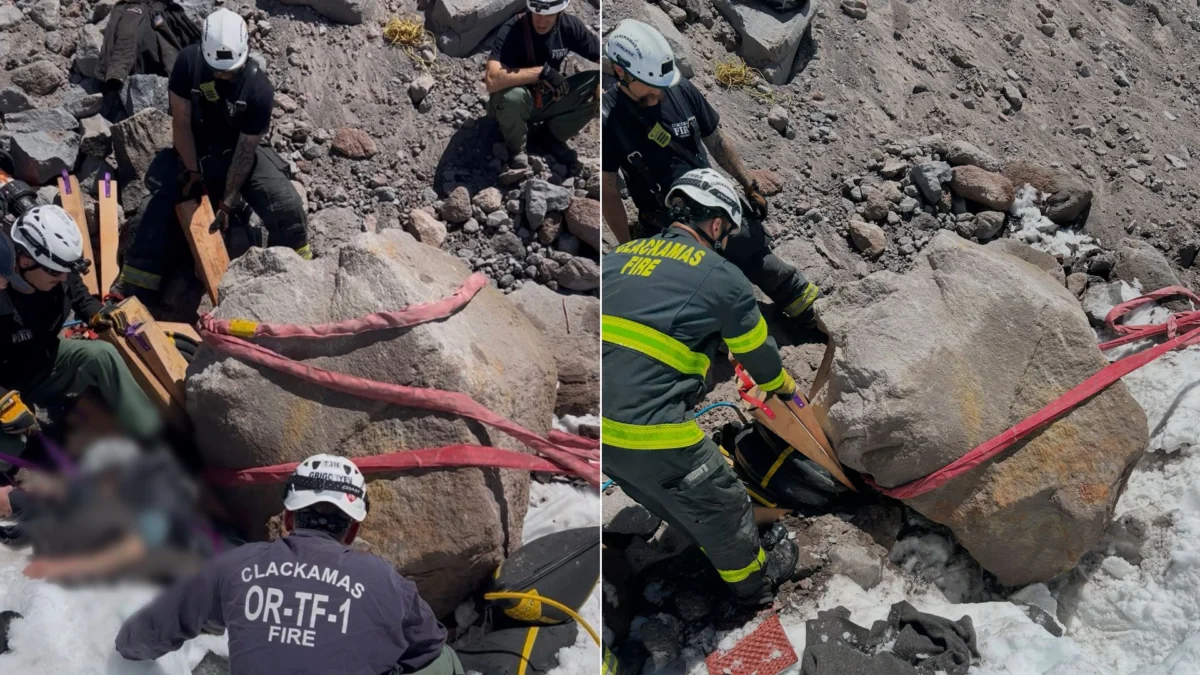
In a remarkable display of inter-agency coordination and technical precision, emergency personnel on Oregon’s Mount Hood successfully extracted a climber who had become pinned beneath a 16,000-pound boulder. The incident, which occurred on May 24, 2026, necessitated a high-stakes response that combined heavy-duty rigging, specialized mountain rescue tactics, and an extremely rare deployment of a field surgical team to the mountainside. Following a two-hour operation under grueling conditions, the unidentified climber was airlifted to a regional trauma center, where officials now confirm he is expected to make a full recovery.
The rescue serves as a stark reminder of the inherent volatility of the Cascade Range’s volcanic terrain. Mount Hood, while one of the most frequently climbed peaks in the world, is notorious for its unstable "rotten rock" and debris-prone slopes. The event triggered the activation of nine separate emergency and search-and-rescue (SAR) agencies, highlighting the complexity of medical emergencies occurring above the snowline.
The Incident: A Routine Passage Turns Perilous
The emergency began on the afternoon of May 24, approximately one mile from the historic Timberline Lodge. The lodge, a National Historic Landmark situated at an elevation of 6,000 feet, serves as the primary base for hikers and climbers attempting the South Side route of the 11,249-foot peak. According to reports from the Clackamas County Sheriff’s Office, the climber was navigating a well-defined trail when he encountered a group of hikers traveling in the opposite direction.
Adhering to standard trail etiquette, the man stepped off the established path to allow the others to pass. He moved into a scree field—a slope composed of loose rock fragments—where the ground stability was significantly compromised. As he stepped, he inadvertently triggered a localized rockslide. A massive boulder, estimated to weigh approximately eight tons, dislodged from a ledge roughly 15 feet above him. The rock tumbled down the slope and landed directly on the lower half of his body, pinning him from the waist down against the mountain’s rugged surface.
Nearby hikers immediately rushed to the victim’s aid. Despite their collective efforts to shift the stone, the 16,000-pound mass proved immovable. Recognizing the gravity of the situation, witnesses used cellular devices to alert emergency dispatch, initiating one of the most complex rescue operations seen on the mountain in recent years.
Chronology of the Two-Hour Rescue Mission
The timeline of the rescue reflects the urgency and efficiency of the responding units. Within minutes of the initial 911 call, a multi-agency task force was mobilized.
0-30 Minutes: Initial Response and Stabilization
First responders from the Clackamas County Fire District and Timberline Lodge Ski Patrol were the first to reach the scene. Upon arrival, they found the victim conscious and communicative but suffering from the immense pressure of the boulder. The immediate priority was to stabilize the victim’s vitals and assess the stability of the surrounding scree field to prevent further rock movement that could crush the victim further or injure rescuers.
30-60 Minutes: Technical Rigging and Surgical Mobilization
As the Clackamas Fire Technical Rescue Team arrived, they began constructing a "lift ladder" system. This mechanical advantage setup utilized high-strength ropes, pulleys, and wooden wedges to create a controlled lifting force. Simultaneously, medical directors realized that the nature of the "crush injury" posed a lethal risk. When a heavy object is removed from a limb after a prolonged period, toxins accumulated in the compressed tissue can rush to the heart, a condition known as crush syndrome. To mitigate this, a specialized surgical team from Oregon Health and Science University (OHSU) was requested.
60-90 Minutes: Aerial Insertion of the Surgical Team
In a move described by officials as "incredibly rare," a Life Flight Network helicopter transported OHSU surgeons and advanced field surgical equipment directly to the mountain. The surgical team was prepared to perform emergency procedures on-site, including a potential field amputation if the boulder could not be moved, or the administration of specialized intravenous fluids to counteract the effects of crush syndrome.
90-120 Minutes: The Extraction
Rescuers worked in a synchronized rhythm, driving wooden wedges beneath the boulder while tensioning the rope systems. The lift ladder system allowed the team to raise the 16,000-pound rock just enough to slide the victim out from beneath it. Once freed, the climber was immediately handed over to the OHSU surgical team and Life Flight paramedics for stabilization before being loaded onto the helicopter for transport.
Technical Challenges of the "Lift Ladder" System
Lifting an object weighing eight tons on an inclined, unstable slope presents a significant engineering challenge. Traditional hydraulic jacks, often used in urban search and rescue, are difficult to transport and stabilize on loose scree and snow. Instead, the Technical Rescue Team utilized a combination of primitive physics and modern materials.
The lift ladder system involves placing a rigid structure—often a heavy-duty ladder or specialized struts—at an angle against the load. By applying tension via a pulley system (often a 5:1 or 9:1 mechanical advantage), the rescuers can convert horizontal pulling force into vertical lift. Wooden cribbing and wedges are then inserted into the growing gap to ensure that if any part of the rope system fails, the boulder remains supported.
"The precision required in these moments cannot be overstated," said Lynsey Amundson, Public Information Officer for Clackamas County Fire District. "Every inch the rock moves must be captured with wedges to ensure the safety of both the patient and the personnel working directly under the shadow of that weight."
Medical Implications: Why Field Surgeons Were Necessary
The decision to fly surgeons from Portland to Mount Hood underscores the severity of crush injuries. In medical literature, "Crush Syndrome" (also known as Bywaters’ Syndrome) occurs when major muscle mass is compressed. This leads to rhabdomyolysis—the breakdown of muscle fibers—which releases myoglobin and potassium into the bloodstream.
Once the pressure (the boulder) is removed, these substances can cause acute kidney failure or cardiac arrest. By having OHSU surgeons on the scene, the medical team could initiate aggressive fluid resuscitation and electrolyte management before the boulder was even moved. This "active triage" is a hallmark of high-level trauma care and is credited with the victim’s positive prognosis.
The Geography of Mount Hood and SAR Statistics
Mount Hood is a stratovolcano characterized by its steep, crumbling ridges. Unlike the solid granite found in the Sierra Nevada or the Swiss Alps, the rock on Mount Hood is often described as "chossy"—loose, brittle, and prone to failure. This geological reality makes off-trail travel particularly hazardous.
According to data from the Clackamas County Sheriff’s Office and Portland Mountain Rescue, the mountain sees between 50 and 100 search-and-rescue missions annually. While most involve lost hikers or climbers who have fallen on the upper slopes (such as the Hogsback or the Zigzag Glacier), boulder-pinning incidents are a rare but recurring danger. Nationally, search-and-rescue crews in the United States extract approximately two to three individuals per year from similar "pinned" scenarios in wilderness areas.
The agencies involved in this successful mission represent a broad coalition of Oregon’s emergency infrastructure:
- Clackamas Fire & Hoodland Fire: Provided technical rescue and initial medical response.
- Clackamas County Sheriff’s Office: Coordinated the overall SAR mission.
- Portland Mountain Rescue (PMR) & PNW Search and Rescue: Specialized in high-angle and technical mountain terrain.
- The Hood River Crag Rats: The oldest mountain rescue group in the U.S., providing local expertise.
- Timberline Lodge and Mount Hood Ski Patrol: Provided immediate on-mountain logistics.
- Life Flight Network & OHSU: Provided critical care transport and surgical expertise.
Analysis of Implications for Outdoor Recreation
The rescue of the climber on May 24 has prompted a renewed discussion regarding mountain safety and the ethics of trail usage. As outdoor recreation continues to see record-high participation numbers, the strain on volunteer-heavy SAR organizations increases.
"Outdoor recreationists should stay aware of their surroundings, remain on marked trails whenever possible, recreate within their skill level, and avoid hiking alone," stated Amundson. The recommendation to stay on marked trails is particularly relevant in volcanic environments where "stepping off-trail" can have immediate geological consequences.
Furthermore, the incident highlights the high cost and high stakes of mountain rescues. While Oregon does not currently charge victims for the cost of search and rescue, the mobilization of a Life Flight helicopter and a surgical team represents a massive expenditure of public and private resources. The success of this mission is being hailed as a triumph of training and inter-agency cooperation, demonstrating that even under the weight of an eight-ton boulder, survival is possible when the "system" works as intended.
As of the latest update, the climber remains under the care of physicians at OHSU. While his identity remains protected, his recovery is being monitored by the climbing community as a testament to the specialized skills of Oregon’s rescue personnel. The boulder remains in the scree field, a silent marker of a day when the combined forces of physics, medicine, and human bravery converged to save a life on the slopes of Mount Hood.



 Chandra Hamzah
 Tatiana Tantri Indah Sari
 Budi Mulyono
