Diana Nuri Rohmawati

Home to a population of approximately 3.5 million residents within city limits and over 6.5 million across its greater metropolitan area, Madrid stands as both the political and cultural capital of Spain. As the nation’s largest municipality, the city welcomes more than 10 million international and domestic visitors annually, cementing its status as one of Europe’s premier urban travel destinations. Characterized by expansive boulevards, grandiose 19th-century architecture, and an internationally renowned culinary and nightlife ecosystem that routinely operates past midnight, Madrid presents a complex synthesis of deep-rooted imperial heritage and forward-looking cosmopolitanism.
Tourism economists and urban development analysts note that Madrid’s tourism sector has experienced a steady upward trajectory, driven in part by significant municipal investments in pedestrian infrastructure, UNESCO-recognized cultural landscapes, and the systematic preservation of historic neighborhoods. Unlike coastal competitors such as Barcelona, Madrid’s urban cadence is defined by a distinct diurnal rhythm: commerce and daily routines begin at a measured pace, extending late into the evening with nocturnal dining hours and vibrant cultural participation. For travelers, navigating this sprawling metropolis requires strategic planning to balance the city’s dense concentration of world-class museums, royal architecture, and neighborhood culinary institutions.
Chronological Framework and Structural Overview of the Five-Day Itinerary
To maximize efficiency and cultural immersion, travel authorities and destination management organizations recommend a structured, multi-day approach that systematically addresses the city’s distinct geographic zones. This five-day framework synthesizes UNESCO World Heritage assets, Habsburg-era architecture, avant-garde gastronomy, and off-the-beaten-path cultural repositories.
Day 1: Immersion in the Paseo del Prado and the Arts Walk
The inaugural day centers on the Paseo del Prado and Retiro district, an urban cultural corridor designated as a UNESCO World Heritage site in July 2021. Spanning over 40 historic monuments and architectural landmarks, this zone represents the zenith of Enlightenment-era urban planning in Spain.
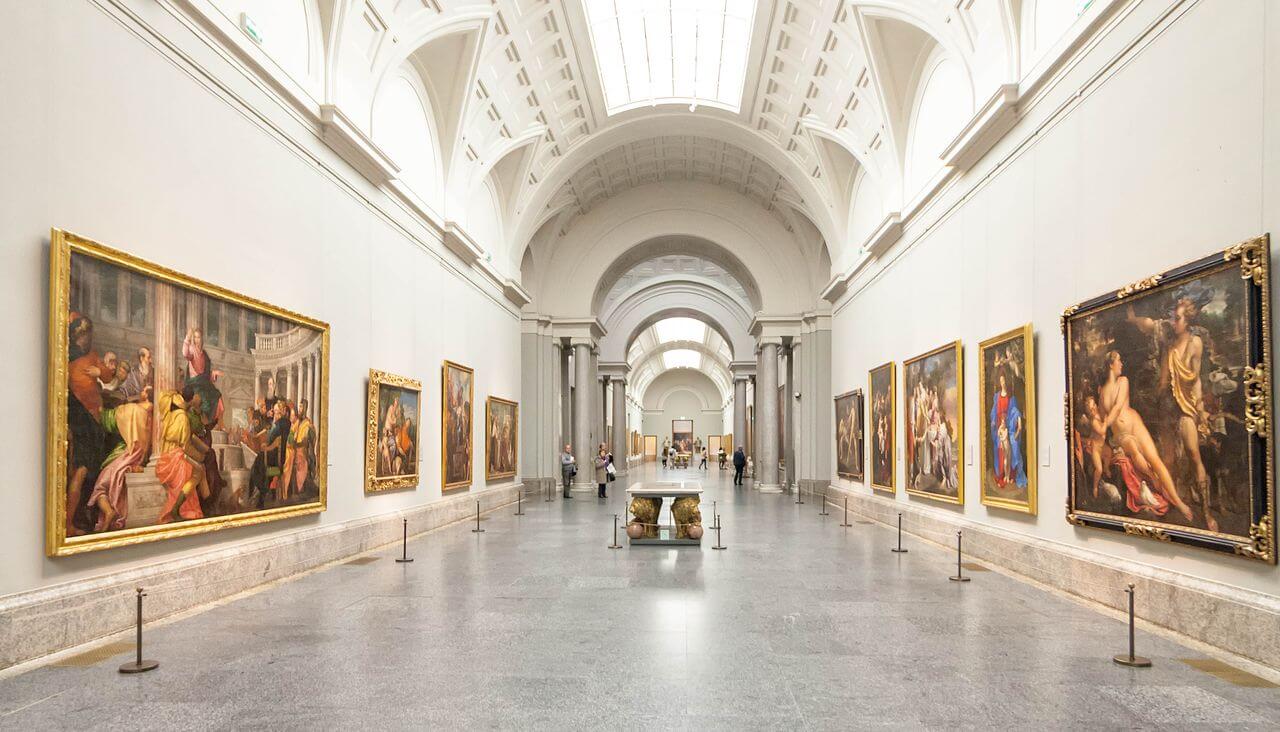
The itinerary initiates at the Museo del Prado, widely acknowledged as one of the preeminent fine arts institutions globally. Housing a permanent collection that exceeds 8,000 cataloged works, the museum features foundational masterpieces by Spanish masters such as Diego Velázquez, Francisco Goya, and El Greco, alongside premier Italian and Flemish holdings by Titian, Rubens, and Hieronymus Bosch. Cultural heritage officials emphasize that a minimum of three to four hours is required for even a cursory examination of the facility’s primary galleries.
A ten-minute pedestrian transit down the tree-lined Paseo del Prado leads to the Thyssen-Bornemisza Museum, which bridges historical gaps in European art history by exhibiting a vast private collection spanning from the 13th-century primitives to late-20th-century Pop Art. The day’s artistic circuit culminates at the Museo Nacional Centro de Arte Reina Sofía. Dedicated to 20th-century and contemporary visual arts, the Reina Sofía holds significant works by Pablo Picasso, Salvador Dalí, Joan Miró, and Wassily Kandinsky. Its primary attraction remains Picasso’s 1937 monumental oil painting Guernica, a universally recognized anti-war masterpiece commissioned by the Spanish Republican government.
Following the morning’s museum-hopping schedule, visitors engage with Madrid’s traditional culinary landscape. Dining options in the immediate vicinity include Taberna La Fragua de Vulcano for authentic cocido madrileño (a traditional slow-cooked chickpea and meat stew), Arzábal near the Reina Sofía for elevated tapas, and Bodega de los Secretos, which offers dining within structurally restored 17th-century brick wine caves.
The afternoon introduces Madrid’s distinct portfolio of historic house museums—former private aristocratic palaces preserved in their original residential states. Foremost among these is the Sorolla Museum, situated within the former home and studio of Joaquín Sorolla, frequently designated as the "painter of light." Following an extensive multi-year architectural restoration, the institution reopens its doors to showcase both Sorolla’s sun-drenched Mediterranean canvases and the preserved regional gardens designed by the artist himself. Alternative options include the Museum of Romanticism and the Lázaro Galdiano Foundation Museum, the latter housing a diverse private collection of works by Goya, El Greco, and Zurbarán within a neo-Renaissance mansion.
Day 2: The Architectural Legacy of Habsburg Madrid
The second day investigates the historic center, locally designated as Madrid de los Austrias (Habsburg Madrid), reflecting the urban layout established under the Habsburg dynasty during the 16th and 17th centuries.
The morning commences at the Puerta del Sol, the bustling public square that functions as the literal and symbolic heart of Spain. Embedded within the pavement outside the historic Post Office (now the headquarters of the regional presidency) lies Kilometer Zero (Kilómetro Cero), the foundational point from which all national radial highway distances are measured. Adjacent to the square stands the iconic bronze statue El Oso y el Madroño (The Bear and the Strawberry Tree), depicting motifs drawn directly from the municipal coat of arms.
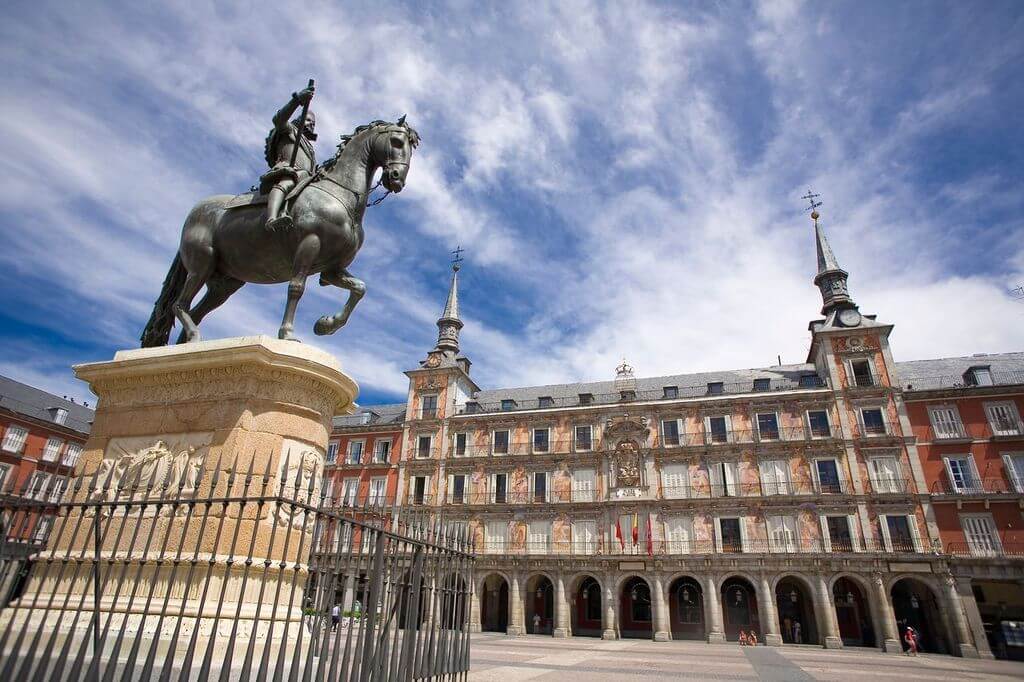
A short walk west leads to the Plaza Mayor, a grand porticoed square constructed during the reign of King Philip III. Historically serving as the venue for royal ceremonies, public executions, bullfights, and commercial markets, the square is presently enclosed by residential apartments, outdoor cafés, and commercial retail outlets. Culinary custom dictates sampling a traditional fried calamari sandwich (bocadillo de calamares) within the adjacent vaulted alleyways.
In the afternoon, the itinerary transitions to the Royal Palace of Madrid (Palacio Real). As the largest functioning royal palace in Western Europe by floor area (spanning over 135,000 square meters and containing 3,400 rooms), the 18th-century Baroque structure was built upon the foundations of a 9th-century Moorish alcazar. While it serves as the official residence of the Spanish royal family, it is utilized exclusively for state ceremonies, receptions, and official audiences, with the monarchs residing elsewhere. Guided and self-guided tours provide access to the Grand Staircase, the Throne Room, the Hall of Halberdiers, and the Royal Armory, which preserves an extensive collection of medieval tournament armor and weaponry belonging to Charles V and Philip II.
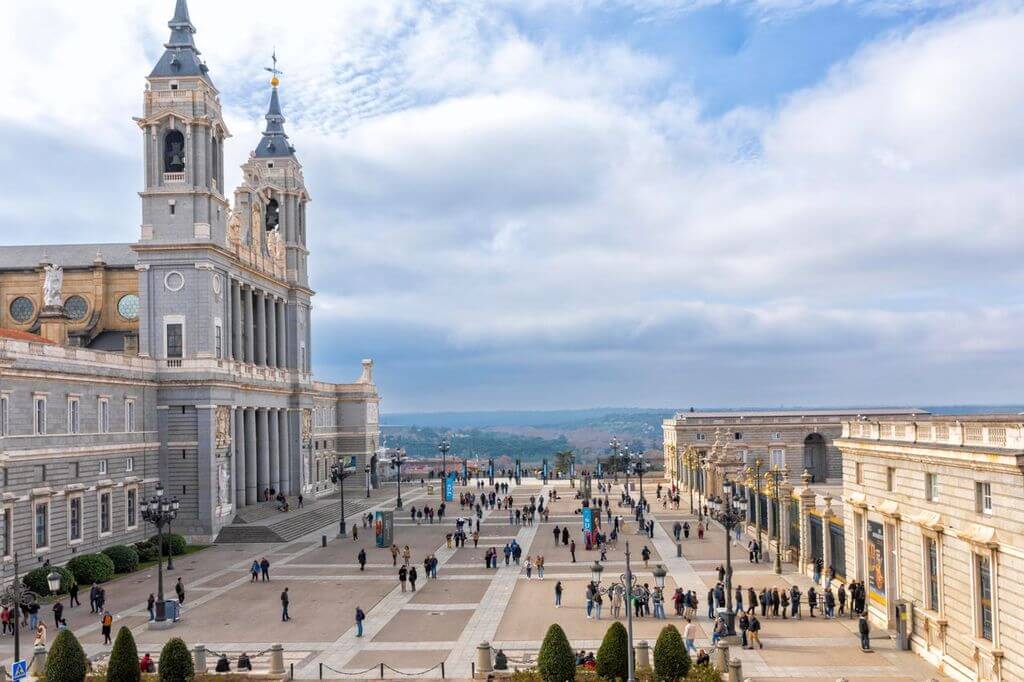
The day concludes at the Cathedral of Almudena (Catedral de Santa María la Real de la Almudena). Unlike Europe’s medieval cathedrals, construction on this monument commenced in the late 19th century under the direction of architect Francisco de Cubas and was not completed until 1993, when it was formally consecrated by Pope John Paul II. The exterior exhibits a Neoclassical design intended to harmonize with the adjacent Royal Palace, while the interior features striking neo-Gothic elements and a neo-Romanesque crypt supported by more than 400 idiosyncratic columns.
Day 3: Gastronomic Evolution and Culinary Markets
Recognized globally as a premier culinary capital, Madrid’s food sector bridges traditional Castilian comfort food with avant-garde international gastronomy.
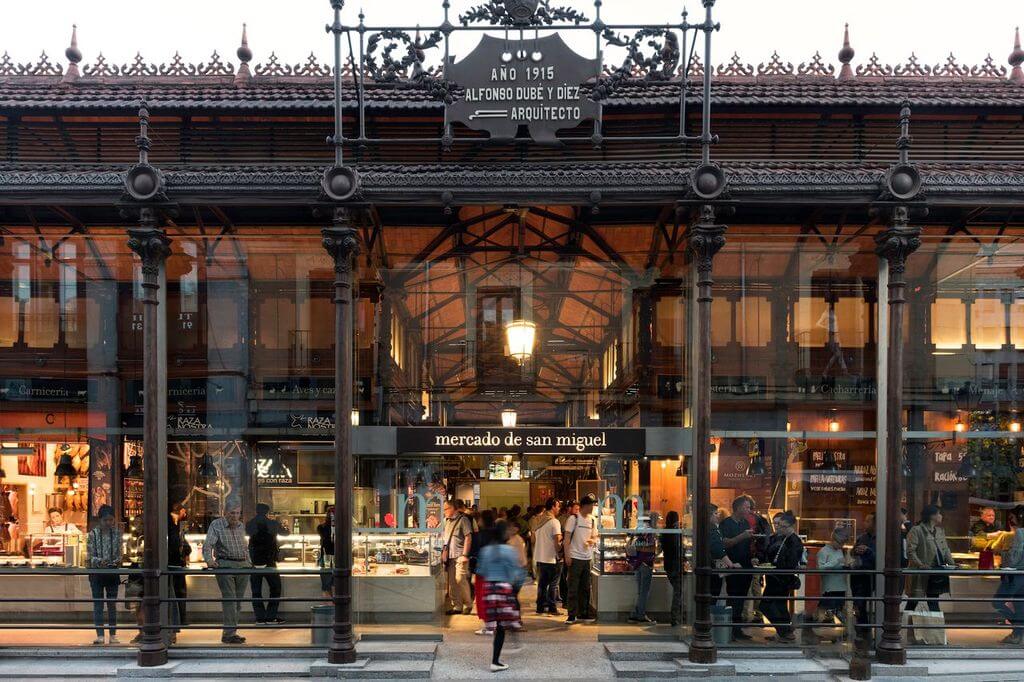
The third day begins with an exploration of municipal gastronomic markets. The iron-and-glass Mercado de San Miguel, situated near Plaza Mayor, operates as a high-end gourmet culinary hub featuring specialty tapas, artisanal wines, and regional delicacies. For a more neighborhood-centric experience, visitors frequent the Mercado de San Antón in the Chueca district or the Mercado de Vallehermoso in Chamberí, both of which reflect the shifting demographics and culinary innovations of contemporary Madrid.
For the evening meal, travelers often seek reservations at Sobrino de Botín, officially certified by Guinness World Records as the oldest continuously operating restaurant in the world, having opened its doors in 1725. Historically frequented by literary figures such as Ernest Hemingway, the establishment specializes in traditional Castilian roast suckling pig (cochinillo asado) and roast lamb (cordero asado). Alternatively, visitors engage in the traditional practice of tapas crawling through the historic alleyways of La Latina or the literary quarter (Barrio de las Letras).
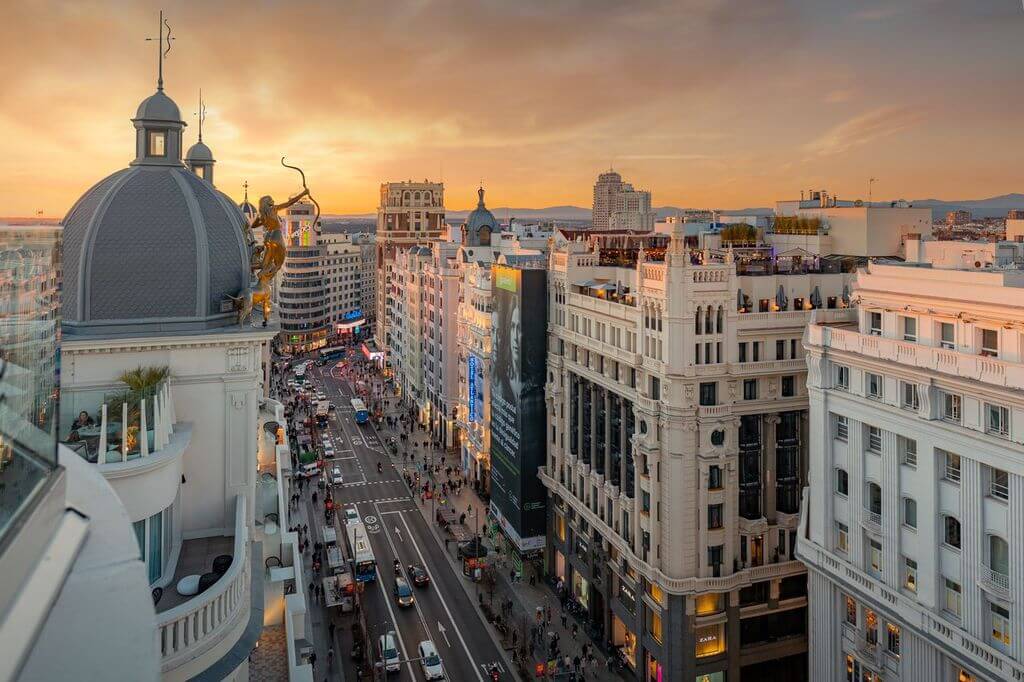
As evening transitions into night, attention shifts to the Gran Vía, Madrid’s bustling commercial and entertainment artery. Modern rooftop establishments, such as The Roof at Picalagartos and the Riu Plaza España’s 360-Degree Sky Bar, offer panoramic views of the urban skyline, reflecting the city’s burgeoning rooftop lounge culture. Furthermore, demographic shifts over the past decade have transformed Madrid into a leading European destination for plant-based dining, with neighborhoods like Malasaña hosting an array of innovative vegetarian and vegan establishments specializing in cruelty-free interpretations of traditional Spanish cuisine.
Day 4: UNESCO World Heritage Day Trips
Capitalizing on Madrid’s central geographic position within the Iberian Peninsula, the fourth day is dedicated to exploring UNESCO World Heritage sites located within a one-hour radius of the capital.
The first primary excursion leads north to the Monastery of San Lorenzo de El Escorial. Commissioned by King Philip II in the 16th century and constructed under the supervision of architects Juan Bautista de Toledo and Juan de Herrera, the monumental complex served as the political center of the Spanish Empire. Recognized by UNESCO in 1984, the complex encompasses a royal palace, a basilica, a pantheon housing the remains of most Spanish monarchs from Charles V onward, a historic library containing thousands of priceless manuscripts, and a functioning monastery. Built in the austere Herrera architectural style using gray granite, the structure projects an atmosphere of sober imperial authority.
An alternative day trip directs travelers south to the Royal Palace and Gardens of Aranjuez, a designated Cultural Landscape of UNESCO. Originally established as a royal hunting lodge in the 16th century along the banks of the Tagus River, the palace served as the spring residence for the Spanish monarchy. The site exhibits a sophisticated synthesis of Renaissance and Baroque architecture, complemented by expansive formal gardens featuring fountains, mythological statuary, and monumental tree-lined avenues that rival the historical scale of Versailles.
A third regional option includes Alcalá de Henares, located 45 minutes east of the capital. Celebrated globally as the birthplace of Miguel de Cervantes—author of Don Quixote—the city features a historic university district founded in 1499 by Cardinal Cisneros, which established the architectural and pedagogical blueprint for colonial university construction throughout Spanish America.
Day 5: Off-the-Beaten-Path Monasteries and Urban Green Spaces
The final day focuses on lesser-known institutional repositories and expansive natural reserves within the municipal boundaries, allowing visitors to bypass standard tourist circuits.
The morning is dedicated to two cloistered royal monasteries: the Monastery of Las Descalzas Reales and the Royal Monastery of La Encarnación. Founded in 1559 by Joanna of Austria, daughter of Charles V, Las Descalzas Reales occupies a 16th-century Renaissance palace where aristocratic women historically took religious vows, bringing substantial dowries, rare art collections, and tapestries. Consequently, the convent functions today as an exceptional museum of sacred art. Similarly, the Royal Monastery of La Encarnación, founded in 1611 by Queen Margaret of Austria, displays an austere exterior concealing a lavish Baroque interior adorned with religious relics, polychrome sculptures, and frescoed ceilings.
To conclude the five-day itinerary, travelers visit the Casa de Campo. Spanning over 17 square kilometers (6.5 square miles), this municipal park is more than five times larger than New York’s Central Park. Originally established as a royal hunting estate by Philip II when the court moved to Madrid in 1561, the park was ceded to the public by the Second Spanish Republic in 1931. Featuring an artificial lake (Lago de la Casa de Campo), extensive cycling and walking paths, and lakeside dining terraces, the park provides unobstructed views across the water toward the monumental silhouettes of the Royal Palace and the Almudena Cathedral, completing a comprehensive exploration of Spain’s historic capital.



 Gabriela Annisa
 Lukman Taruna Persada Ramadan
 Tatiana Tantri Indah Sari
 Anjar Salim

 Budi Mulyono