
 Walid Sujud Trenggono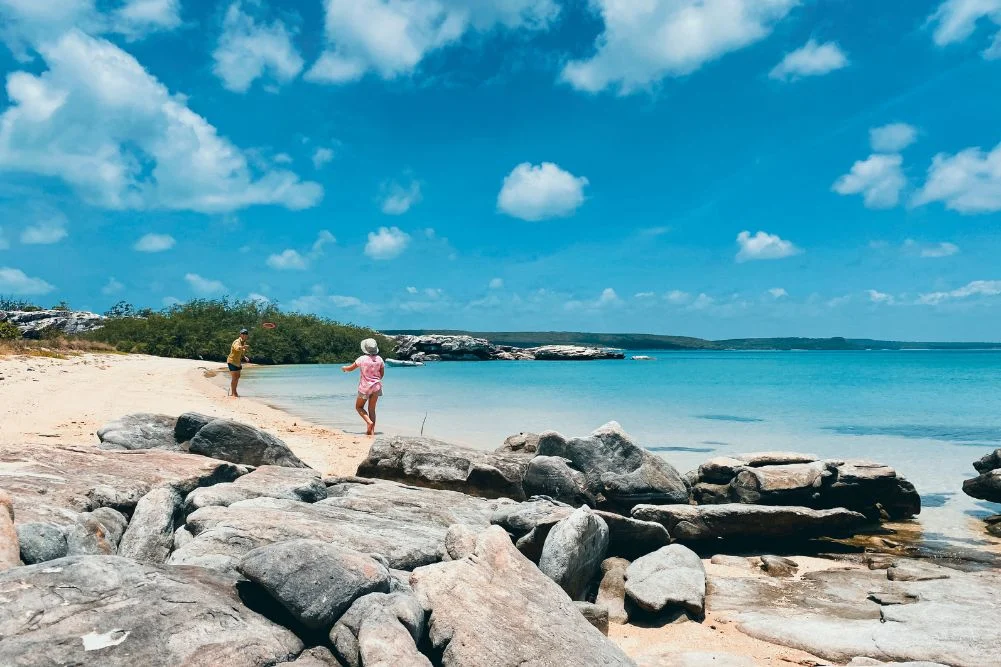
Located on the northeastern tip of the Gove Peninsula in the Northern Territory, the town of Nhulunbuy and its surrounding Yolngu lands serve as a profound repository of a pre-colonial history that challenges conventional narratives of Australian isolation. At the heart of this historical landscape are the Wurrwurrwuy stone arrangements, situated at Garanhan (Macassan Beach). These archaeological features are not merely artistic expressions but are detailed historical records of an international trade network that thrived long before European settlement. For centuries, the Yolngu people of East Arnhem Land engaged in a sophisticated and mutually beneficial relationship with Makassan seafarers from the port of Makassar in present-day Sulawesi, Indonesia. This cross-cultural exchange, centered on the harvest of trepang (sea cucumber), transformed the social, economic, and linguistic fabric of the region, leaving a legacy that remains visible in the landscape and the living culture of the Yolngu today.
A Chronology of International Trade: 1640 to 1906
The timeline of the Makassan-Yolngu relationship is one of the most significant chapters in Australia’s maritime history. While the exact start date remains a subject of archaeological debate, carbon dating and oral histories suggest that the Makassan fleets began arriving on the Australian coast as early as the mid-17th century, approximately 1640. Each year, taking advantage of the northwesterly monsoon winds (the bara), fleets of up to 60 wooden perahu (sailing boats) would traverse the Arafura Sea. These vessels carried hundreds of fishermen who established seasonal camps along the Arnhem Land coast.
The primary objective of these voyages was the collection and processing of trepang, a marine invertebrate highly prized in Chinese markets for its medicinal and culinary properties. The Makassans established elaborate processing sites, such as the one at Garanhan, where they constructed stone fireplaces to boil the trepang before drying and smoking them for the return journey. This industry represented Australia’s first modern export trade.
The relationship was characterized by a high degree of cooperation. The Makassans sought permission from the Yolngu traditional owners to fish in their waters, paying for access with goods such as cloth, tobacco, rice, knives, and axes. In 1803, during his circumnavigation of the continent, English explorer Matthew Flinders encountered a Makassan fleet near Cape Wilberforce. Flinders recorded an interview with a captain named Pobassoo, who confirmed that the trade had been established for generations and that Yolngu men frequently traveled back to Makassar on the perahu, with some even settling in Indonesia.
This era of international cooperation came to an abrupt end in 1906. The newly formed Australian Commonwealth government, driven by protectionist policies and the burgeoning "White Australia" ideology, imposed heavy duties and eventually banned the Makassan fishers. The cessation of the trade ended a 250-year period of maritime globalization, yet the cultural links remained.
The Wurrwurrwuy Stone Arrangements: A Pictorial Archive
The Wurrwurrwuy stone arrangements are unique in the Australian archaeological record. Unlike many Indigenous stone arrangements that serve ceremonial or spiritual purposes, the Wurrwurrwuy site is primarily secular and documentary. Constructed by Yolngu elders—most notably by the father of the late activist Galarrwuy Yunupingu and musician Mandawuy Yunupingu—the stones serve as a permanent record of the Makassan presence.
Visitors to the site can observe stones meticulously laid out to depict the structural elements of the Makassan industry. These include:
- Perahu (Sailing Boats): Detailed outlines showing the hulls, masts, and rudders of the Indonesian vessels.
- Dugout Canoes: The introduction of the dugout canoe (lipa-lipa) by the Makassans revolutionized Yolngu hunting, allowing for more efficient harvesting of dugong and sea turtles.
- Processing Infrastructure: Representations of the trepang fireplaces and drying racks.
- Houses and Trepang Warehouses: Indicating the semi-permanent nature of the seasonal camps.
Historian Campbell Macknight, who conducted extensive research in the 1960s, noted that these arrangements were a deliberate effort by the Yolngu to preserve the memory of their "Makassan brothers" for future generations. The site is now protected under the Heritage Act and is managed by the Dhimurru Aboriginal Corporation, an Indigenous-led organization responsible for the conservation of the Gove Peninsula’s cultural and natural values.
The Cultural Epicenter: Buku-Larrnggay Mulka Art Centre
The preservation of Yolngu history is not confined to the stone arrangements at Garanhan. In the nearby community of Yirrkala, the Buku-Larrnggay Mulka Art Centre stands as one of Australia’s most prestigious Indigenous art institutions. The name "Buku-Larrnggay" translates to the feeling of the sun on one’s face, while "Mulka" refers to a sacred archive or a holding place.
The center is famous for its collection of bark paintings, which use natural ochres to depict the complex "moieties" (social and spiritual divisions) of Yolngu society: the Dhuwa and the Yirritja. A pivotal exhibit within the museum is the Yirrkala Church Panels. Painted in 1962, these two four-meter-high panels represent the first formal assertion of Indigenous land rights in Australian law. The panels were created to demonstrate the Yolngu people’s deep spiritual connection to their land at a time when the federal government had granted mining leases on the Gove Peninsula without local consultation.
In addition to bark painting, the center is a hub for traditional weaving. Using the leaves of the gunga (pandanus), Yolngu women create intricate baskets, mats, and nganiyal (conical baby cradles). The evolution of these crafts, including the introduction of vibrant natural dyes, reflects the adaptability of Yolngu culture. The art center also houses the Mulka Project, a digital archive that uses modern technology to preserve ancient songs, dances, and genealogical records, ensuring that the "Two-Way" learning system remains robust in the 21st century.
Ecological Context and Sustainable Tourism: Bremer Island
Beyond the historical and cultural sites of the mainland, the region’s ecological health is a critical component of its significance. Dhambaliya, also known as Bremer Island, located a short distance from Gove Harbour, provides a template for sustainable, Indigenous-led tourism. The island is largely uninhabited, save for a small Yolngu outstation and the Banubanu Beach Retreat, a solar-powered, low-impact luxury camp.
The environmental data for the region highlights its status as a biodiversity hotspot. The East Bremer Islets comprise the Higginson Important Bird Area (IBA), which supports globally significant populations of:
- Bridled Terns: A major breeding colony.
- Roseate Terns: Frequently sighted in high numbers.
- Common Noddies: The only known breeding site for this species in the Northern Territory.
Furthermore, the beaches of Bremer Island serve as vital nesting grounds for four species of sea turtles: the green, flatback, hawksbill, and olive ridley. The management of these areas by the Dhimurru Sea Rangers represents a successful integration of traditional ecological knowledge and Western conservation science. Visitors to these areas are required to obtain permits from the Dhimurru Aboriginal Corporation, a system that regulates foot traffic and generates revenue for land management programs.
Analysis of Implications and Broader Impact
The historical and cultural landscape of Nhulunbuy and the Gove Peninsula carries significant implications for the broader understanding of Australian identity. First, the Makassan-Yolngu relationship serves as a definitive rebuttal to the legal fiction of terra nullius. The existence of centuries-old international trade agreements, linguistic integration (with hundreds of Makassan loanwords still used in Yolngu Matha), and shared family lineages prove that Australia was a connected, globalized space long before the arrival of the First Fleet in 1788.
Second, the success of institutions like Buku-Larrnggay Mulka and the Banubanu Beach Retreat demonstrates the viability of "cultural tourism" as an economic driver for remote Indigenous communities. Unlike extractive industries, which have a finite lifespan and significant environmental footprints, cultural tourism leverages the intangible heritage of the land, providing employment and fostering pride among younger generations.
Finally, the preservation of the Wurrwurrwuy stone arrangements and the Yirrkala Church Panels highlights the role of art as a political and historical tool. These works are not merely aesthetic; they are legal documents and historical texts that continue to inform contemporary debates over land rights and constitutional recognition.
As Australia continues to grapple with its pre-colonial past and its path toward reconciliation, the Gove Peninsula stands as a testament to the resilience of Indigenous culture. It is a place where history is not found in dusty textbooks but is etched in stone, woven into pandanus fibers, and kept alive in the songs of the Arafura Sea. For the traveler, Nhulunbuy offers more than a scenic escape; it offers a necessary re-education on the origins of the Australian story.


 Anjar Salim
 Dwi Wanna
 Budi Mulyono
 Lukman Taruna Persada Ramadan
 Chandra Hamzah
 Gabriela Annisa