Tatiana Tantri Indah Sari
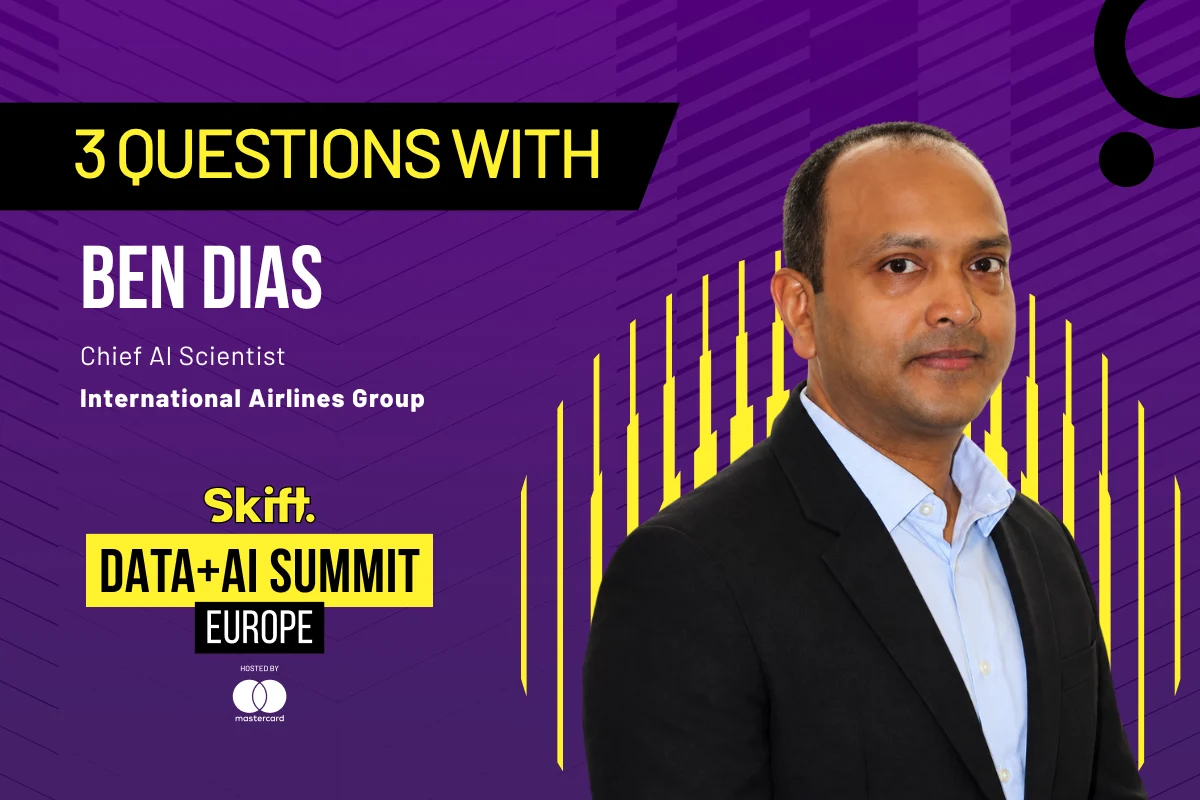
International Airlines Group (IAG), the multinational airline holding company that oversees some of Europe’s most prominent carriers including British Airways, Iberia, Aer Lingus, and Vueling, faces a distinct operational challenge when deploying artificial intelligence. Managing a diverse portfolio of airlines under a single corporate umbrella means that every enterprise-level technology initiative immediately raises the question of where implementation should realistically begin. For Ben Dias, IAG’s chief AI scientist, the answer is remarkably methodical: you start with a single airline, prove the return on investment, and only then scale the solution across the broader group.
Ahead of his scheduled appearance at the upcoming Skift Data + AI Summit Europe, scheduled for October 6, 2026, in London, Dias outlined his philosophy on artificial intelligence deployment, regulatory compliance within the European Union, and the strategic intersection of machine learning and human aviation expertise. His insights arrive at a critical juncture for the global aviation sector, as legacy carriers increasingly turn to advanced data science to optimize operations, mitigate supply chain disruptions, and enhance customer personalization in a fiercely competitive marketplace.
The Skift Data + AI Summit Europe serves as a premier annual gathering for travel technology leaders, executives, and data scientists, bringing together influential figures to discuss the practical application of emerging technologies. The 2026 agenda features a robust lineup of industry authorities, including Filip Filipov of OAG, Peer Bueller of KAYAK, Sheena Varma of American Express Global Business Translation, and Nicolas Maynard of Accor, alongside Dias. The conference has rapidly evolved into a definitive forum for evaluating how digital transformation directly influences operational resilience and long-term financial performance across the travel vertical.
The Strategy of Incremental Deployment: One Airline, Then the Group
When examining the single most important factor for successfully scaling artificial intelligence within complex travel operations across disparate European markets, Dias emphasizes disciplined sequencing over reckless acceleration. Attempting to build an all-encompassing, group-wide solution from day one frequently introduces friction, scope creep, and operational delays that can derail digital transformation initiatives before they deliver tangible results.
According to Dias, the most effective methodology begins with identifying a genuine, high-friction business problem within one specific operating carrier. By focusing initial deployment on a single brand—such as British Airways or Vueling—the data science team can establish a clear operational baseline, rigorously test the algorithms, learn from inevitable initial missteps, and document measurable value. Once the model proves its efficacy in a controlled environment, the framework can be systematically adapted and expanded across the remaining portfolio companies. This incremental approach not only generates financial value at an accelerated pace but also yields critical operational insights that refine and strengthen the technology as its footprint expands.
Navigating the Complex Regulatory Landscape of the European Union
Deploying artificial intelligence within the aviation sector requires strict adherence to a labyrinth of international and regional legal frameworks, most notably the European Union Artificial Intelligence Act and the General Data Protection Regulation (GDPR). For IAG, operating primarily out of European hubs means that regulatory compliance cannot be treated as an afterthought or a secondary compliance hurdle managed downstream.
Dias notes that these stringent regulatory standards have fundamentally transformed how IAG approaches the architecture and deployment of machine learning models. Rather than retrofitting compliance onto finished software, governance must be embedded into the engineering process from the very inception of a project. A prime example of this philosophy in practice is IAG’s internal AI Creative Studio. During the development of this initiative, legal compliance, intellectual property protections, and responsible artificial intelligence governance were integrated directly into the foundational design parameters.
This proactive adherence to regulatory expectations provides the corporate group with the institutional confidence required to scale successful use cases across multiple international markets and distinct airline brands without running afoul of rapidly evolving statutory guidelines. By treating compliance as an innovative enabler rather than an administrative bottleneck, IAG successfully mitigates legal exposure while maintaining public trust.
Empowering Human Expertise Through Advanced Decision-Support Systems
A common anxiety surrounding the proliferation of enterprise artificial intelligence is the specter of automation replacing human labor. However, within safety-critical industries like aviation, Dias argues that the most profound opportunities for artificial intelligence lie not in substitution, but in enhancement—specifically, placing advanced computational tools directly into the hands of seasoned human experts.
Modern aviation operations are characterized by staggering complexity. Airlines must constantly manage volatile fuel prices, unpredictable weather patterns, air traffic control restrictions, fleet maintenance schedules, and dynamic passenger demand. In this high-stakes environment, artificial intelligence excels at processing immense volumes of historical and real-time data to evaluate millions of potential operational scenarios at speeds that far exceed human cognitive limits.
Dias points out that the true value of machine learning in travel operations is realized when it helps professionals make better, faster, and more confident decisions in high-pressure scenarios. Whether the application involves optimizing complex predictive maintenance schedules for widebody aircraft fleets, improving day-of-operations resilience during major storm events, or assisting logistics teams in re-accommodating displaced passengers, the technology functions as a force multiplier. It relieves human experts from tedious data aggregation and number-crunching, allowing them to apply their contextual intuition and professional judgment to strategic problem-solving.
Broader Economic Implications and Industry Analysis
The strategic framework articulated by IAG’s chief AI scientist reflects a broader maturation trend within the travel technology sector. During the initial wave of the generative artificial intelligence boom, many global enterprises rushed to launch experimental projects without establishing clear metrics for financial return or operational integration. This unstructured experimentation frequently resulted in high computational costs yielding negligible business impact.
By contrast, IAG’s measured, iterative methodology represents a sophisticated shift toward sustainable enterprise deployment. Analysts note that legacy airlines operating on narrow profit margins cannot afford costly, sprawling technology failures. Dias’s emphasis on proving value within a single operating unit before committing capital to a group-wide rollout provides a prudent financial blueprint for other multinational travel conglomerates.
Furthermore, as the aviation industry continues its post-pandemic recovery while simultaneously facing mounting pressure to decarbonize operations, data-driven efficiency is no longer merely a competitive advantage—it is an operational imperative. Artificial intelligence applications that optimize flight trajectories, reduce fuel burn through precise weight and balance calculations, and streamline ground turnaround times contribute directly to both corporate bottom lines and sustainability targets.
Looking ahead to the discussions at the Skift Data + AI Summit Europe on October 6, 2026, industry observers will be watching closely to see how pioneers like Ben Dias continue to balance rapid technological innovation with rigorous risk management, regulatory compliance, and a steadfast commitment to human-centric operational design.




 Lukman Taruna Persada Ramadan

 Anjar Salim

 Budi Mulyono